Theatre Street, Norwich today. Now see romanticism's poster boy.
Photo (c) On An Overgrown Path 2009. Report errors to - overgrownpath at hotmail dot co dot uk


Re: BBC Radio 3 - Exclusive Content
From: Nadia Ruggiero
Sent: 29 April 2009 13:28:23
To: Bob Shingleton
Dear Bob,
BBC Radio 3 would like to invite you to become an exclusive partner of their Mendelssohn season. We would like to offer you access to a range of events and content in return for support on On An Over Grown Path.
For example, the opportunity to attend the rehearsal for A Midsummer Night's Dream complete with Mendelssohn's incidental music at Middle Temple Hall this Saturday 2 May (timings tbc today).
Or a live broadcast of the drive-time show "In Tune" presented by Sean Rafferty, taking place at the Birmingham Town Hall on Friday 8th May (travel & accommodation provided).
We are happy to approach artists and contributors for interview if you'd be interested in talking to any of them.
I would be grateful if you could indicate asap whether you would like to attend either of the above events at your earliest opportunity. I'm also happy to discuss alternative opportunities should these not fit with your diary/interests.
We look forward to hearing back,
Nadia Ruggiero
On Behalf of the Radio 3 Team
___________________
Nadia Ruggiero
Internal Operations Manager Interaction London

Whatever else the YouTube Symphony was, it was fantastically exciting for its performers, who were plucked from their daily lives and treated like star musicians for a few days.We don't need more star musicians. In fact the star system, with its barely concealed commercial agendas, is at the root of classical music's current woes. We need more lean forward music where there are no celebrities, just amateur performers discovering the joys of live music making. This quote from Anne Midgette's article says it all:
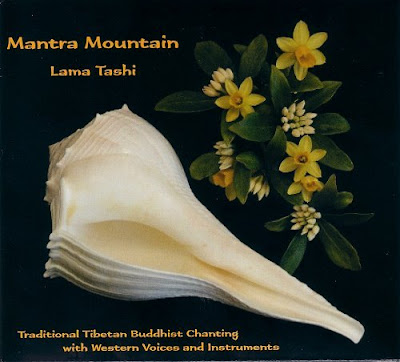
Clive Gillinson, Carnegie Hall's Executive Director, put it well at a press conference on Tuesday, saying that today the level of music-making is higher than it's ever been, but that classical music itself is less important to most people's lives. "We have to invert that pyramid," he said - speaking, rather poignantly, to a group of journalists who, to judge by their questions, did indeed see classical music as an exotic phenomenon.An important new example of 'inverting the pyramid' is seen in my header photo. The Mantra Mountain Project is making CDs of popular Tibetan mantras available so that Westerners can learn them and chant them. The chants are led by a former chant master of the famous Drepung Loseling Monastery in south India. Accompanying him are flute, cello and other Western instruments and a choir of Tibetan and western voices singing antiphonally. The first beautifully packaged CD comes with an explanation and translation of the chants, together with large format sheet music for voice, piano and guitar, as seen below.

When we listen to chanting, we receive the blessings or commit good karma. However, if we, ourself, join into it, it will be more helpful and beneficial. So it's not just listening, but you can chant with it. So that's why we have the music notation. So you can look at the notation, read it, and then play the music or chant with it.The first Mantra Mountain CD has been realised by Lyle Sanford, who as a registered music therapist working in rural Virginia knows a thing or two about the power of lean forward music. Lyle has done a superb job of arranging and producing the CD, and also contributes to the exemplary documentation. Further CDs and scores offering various transpositions of the chants are planned. Mantra Mountain, complete with sheet music, is available from CD Baby. And before dismissing this project as a whacky post-hippie indulgence remember that Lama Tashi's Tibetan Master Chants CD was, as reported here, short-listed for a Grammy in 2006. The YouTube Symphony Orchestra has a way to go yet.


With regard to existing copyright laws, naturally we hope that common sense prevails when the EU vote on the proposed extension later this year.On Thursday the European Parliament voted in favour of extending copyright protection on music recordings from 50 to 70 years, which is still considerably more lenient than US copyright law. This EU ruling will affect labels such as Naxos Historical as well as Archive Classics. But the fat lady in Brussels hasn't sung yet. Once the law is agreed by member states, they will have two years to put it into place. Which should put the European copyright watershed at around 1942.

On a mildly related topic which would have fit better a few topics back, I've never really come to grips with what "world music" is. Specifically, why are Ravi Shankar and Ali Akbar Khan (to mention a personal favourite) often mentioned as world music? Surely they are classical music (or art music) as much as is Schoenberg.Thanks Scott, as ever a perceptive comment. As it's Friday and the sun is shining I am going to freewheel down the path you sent us on with those important words 'more lasting'. Back in 2006, when I was writing on Arvo Pärt's Passio, I quoted Mark Van Doren (from the introduction to Thomas Merton's The Seven Storey Mountain incidentally) as saying:
Sometimes I think that world music is anything that the writer thinks is more lasting than "popular music" but which doesn't fit within the boundaries of western art music or jazz.
'A classic is a book that remains in print'.The test as to whether a piece of music (of any category) remains in performance (live or recorded) is a telling one. 'Enduring music' is not the same as good music. A lot of bad music remains in performance, and, conversely, some very good music is rarely performed. But, as the search for the musical viagra that will rejuvenate the classical format continues, there are some interesting lessons to be learnt from 'enduring music'.

Within the classical framework, I find it difficult to appreciate fully more recent music, beginning from Schoenberg and atonal music, through avant-garde, musique concrète and electronic music. Strange enough I have great trouble with anything discordant. In Darmstadt, Germany, there is a regular festival of modern music featuring pieces by all the famous modern composers, and I have twice been invited to give sitar recitals there. If I arrive at such a venue one day before my performance, I always make a point of listening to what is going on. On those two occasions in Darmstadt, and at least two other times since, I have noticed that I develop a peculiar problem.From Raga Mala, Ravi Shankar's autobiography (ISBN 1566491045 OP). Other musicians suffer worse than stomach cramps.
It is mystifying how it happens, but I find that when I start hearing those strange sounds or discordant combinations, within a few minutes I feel a stomach cramp, and from stomach cramp I develop a terrible headache and nausea. At first I thought these physical effects were coincidental, and that my suffering was due to some bad food I must have eaten; but it has happened again and again, right up to this day! I feel ashamed of myself, because thousands of people rave about this music. Though I am sure most of them are sincere in their appreciation, one has to wonder whether some are just behaving in a trendy manner, motivated by snobbery. Sometimes I can intellectually appreciate the intelligent combinations used, yet the whole gamut of this modern music, I am embarrassed to admit, is a physical problem to me. I have to try harder, maybe!

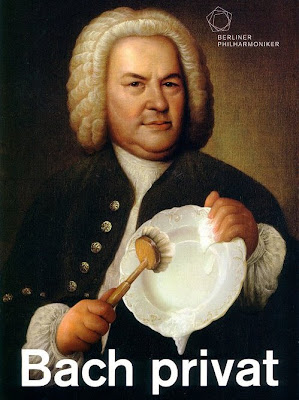
Centuries of Bach research have revealed the minutiae of his domestic life. That he was a prolific father of numerous children is a well-known fact. This intimate portrait reveals his lesser-known penchant for 'Das washing-up'. Remarkable!Read about Bach and modern technology here.


In 1972 I was in the south of France. I had eaten some bad fish and was in consequence rather ill. As I lay in bed I had a strange recurring vision, there, before me, was a concrete building like a hotel or council block. I could see into the rooms, each of which was continually scanned by an electronic eye. In the rooms were people, everyone of them preoccupied. In one room a person was looking into a mirror and in another a couple were making love but lovelessly, in a third a composer was listening to music through earphones. Around him there were banks of electronic equipment. But all was silence. Like everyone in his place he had been neutralized, made grey and anonymous. The scene was for me one of ordered desolation. It was as if I were looking into a place which had no heart. Next day when I felt better, I was on the beach sunbathing and suddenly a poem popped into my head. It started out 'I am the proprietor of the Penguin Cafe, I will tell you things at random' and it went on about how the quality of randomness, spontaneity, surprise, unexpectedness and irrationality in our lives is a very precious thing. And if you suppress that to have a nice orderly life, you kill off what's most important. Whereas in the Penguin Cafe your unconscious can just be. It's acceptable there, and that's how everybody is. There is an acceptance there that has to do with living the present with no fear in ourselves.Penguin Cafe Orchestra founder Simon Jeffes describes how the idea of the band came to him. They were supported by Brian Eno, appeared with Kraftwerk, and their music has been linked with that of Philip Glass. Ten albums were released by the PCO between 1976 and 1997. Simon Jeffes died from a brain tumour in 1997. The Penguin Cafe Orchestra - A Brief History, seen in my header image, is currently available on CD. The Orchestra's official website is here.
Dear Bob, I hope you are really well! I work for Valerie Barber PR and we are responsible for the PR of Archive Classics, which launched on 3rd April (www.archiveclassics.com). This site was launched by Classics Arts with the aim of making great recordings from the past more accessible to both collectors and to a new generation audience. Broadcaster Stephen Johnson presents a weekly podcast centred around an archive recording, and takes the listener on a journey through this recording in an enjoyable and informative style. The podcast is available for download from the website and the recording itself is available for download by subscribers. Please find attached the press release and if you would like any further information please do not hesitate to get in touch.>>>>>>>>>>>>>>>>>>>
Many thanks and best wishes
Iain Handyside
Account Executive
>>>>>>>>>>>>>>>>>
Iain, thanks for that. I'm interested in running a piece about Archive Classics. To help me understand where Archive Classics are coming from can you explain their position re. copyright?
Are all the podcasts out-of-copyright recordings? Is the Elly Ney podcast produced with HMV's approval? I note the partner labels are mainly small re-issue specialists - what is the relationship with the major labels? Will there be any contemporary material on Archive Classics? If the business model is the use of out-of-copyright material what are the implications for American downloaders where copyright law is different, and what is the Archive Classics view on the proposed EU extension of recorded copyright?
Any other background would be of help. As you probably know I don't 'do press releases', but I'm keen to give Archive Classics some coverage as the subject matter is on message for my readership.
Thanks, Bob
>>>>>>>>>>>>>
Hi Bob, Many thanks for your patience on this. Below is an answer from Classic Arts:
All the recordings featured in Archive Classics are indeed out of copyright. All our partner labels specialise in restoring recordings that are in the public domain, and they have given us their permission to use their re-masters in our weekly podcasts. What their individual relationships are with the major labels I couldn't say I'm afraid.
With regard to contemporary material in Archive Classics, we will indeed feature some pieces from the 20th century. However, due to the terms of the MCPS/PRS license we have in place, these pieces will feature more occasionally than the main canon of composers from the classical and romantic eras.
With regard to existing copyright laws, naturally we hope that common sense prevails when the EU vote on the proposed extension later this year.
I hope this helps, but do let me know if you need anything else.
Many thanks and best wishes,
Iain.
Hodja wanted to learn how to play the lute. So he approached a music teacher and asked him, "How much do you charge for private lute lessons?"From Essential Sufism. Header image is peerless Moroccan oud player Said Chraibi's CD for an Arab record label with a secret life. Read more here.
"Three silver pieces for the first month; then after that, one silver piece a month."
"Oh, that's very fair," exclaimed Hodja. "I'll start with the second month."

At no time in his life after the age of about fifteen did Grainger abandon his sadistic and masochistic pleasure-seeking. Blood-letting was often part of his activities and he nearly always laundered his own shirts because of the telltale bloodstains. With the possible exception of Mimi Kwast, all his girlfriends were to be drawn into his particular form of lovemaking and there is ample photographic evidence of this. Several photographs exist which he took himself after one of his bouts of auto-flagellation. An indication of his extraordinary mentality can be detected from the fact that as he stood before the camera lens with bleeding wounds he also held up a notice which gave details not only of the exact time of day, location of session and number of lashes with what kind of whip, but also the type of film used in the camera and the exposure and aperture. Whenever he went on tour he took a selection of several dozen whips with him.From Percy Grainger by John Bird (ISBN 0571117171 - OP). Photo is my European LP pressing of the classic 1959 recording by Frederick Fennell and the Eastman-Rochester "Pops" Orchestra of Grainger's music. It still is available as a CD transfer coupled with a 1965 recording by Fennell of Eric Coates' The Three Elizabeths. It is worth noting that the stunning sound on the 1959 Grainger sessions was produced by a woman, Mercury's legendary Wilma Cozart Fine. She also produced Antal Dorati's still-unbeatable Firebird for Mercury; more on that here.

When the city of Madrid organised the first Marathon race back in 1978, an anoymous neighbour who lived near the 41th kilometre milestone placed the loudspeakers of his sound system in his balcony facing the street and playing Handel's Hallelujah chorus at full volume in an endless loop while runners passed by. This became a custom that was even announced by the organisation in later editions.More on the Hallelujah chorus here.
In 1999 the race had to change its course in the last kilometres in order to accomodate the growing number of participants. This would have deprived them from their Handel when they approached the last kilometre. But the association of Handel to the race was so entrenched that the organisation set up a booth at the 41th kilometre milestone with a powerful sound system playing Handel's Hallelujah chorus "as usual". I can confess that its effect on the runners is really uplifting.


There are many dangers which hedge around the unfortunate composer: pressure groups which demand true proletarian music, snobs who demand the latest avant-garde tricks ... He may find himself writing more and more for machines, in conditions dictated by machines, and not for humanity: or of course he may end by creating grandiose clap-trap when his real talent is for dance tunes or children's piano pieces.But Britten would never have wanted Aldeburgh to become a stuffy museum for his art, and, thankfully, today the Snape creative campus is much more about the future than the past. On Easter Saturday daring to be different came in the form of Tallis in Wonderland, I Fagiolini's deconstruction and reconstruction of polyphonic masterpieces from Tallis and his contemporaries, developed during one of the admirable Aldeburgh Residencies.

The best possible response, however, to the question 'What are your songs about?' was vintage 60s Bob Dylan: 'Oh, some are about four minutes, some are about five, and some, believe it or not, are about eleven or twelve,' he replied.Quote is from Karen O'Brien's biography of Joni Mitchell. Read about the birth of rock here.

'Our highest business is our daily life' - John CageHe may have been a student of Zen Buddhist and a self-proclaimed anarchist. But the thinking behind John Cage's words applies across all faiths and philosophies. In Christian monastic orders the business of daily life is defined by the Opus Dei. These are the Holy Offices during which all the Psalms are sung in rotation in a never ending affirmation of faith. Music is central to the liturgy. Again John Cage is surprisingly in tune with the contemplative life. He was famously influenced by the Indian musician Gita Sarabhai whose definition of the purpose of music explains why singing is central to monastic worship:
'The purpose of music is to sober and quiet the mind, thus making it susceptible to divine influences.'Probably the most moving of the Divine Offices is Compline. This is the last of the daily cycle and it celebrates the completion of the day. Compline is sung in darkness, and ends joyfully with the singing of that most moving of Marian antiphons, the Salve Regina. As the reverberation from the final O clemens, O pia, O dulcis Virgo Maria dies away the monastic community is transported into the Great Silence, which will be broken by the bell calling the faithful to Matins the following morning.


'The power of music ... is one of the greatest practical and theoretical importance ... What we see, fundamentally, is the power of music to organise - and to do this efficaceously (as well as joyfully!), when abstract or scematic forms of organisations fail ..'.I have described how the Sisters from L'Abbaye Notre-Dame de la Grace Dieu will join the monastery at Indry. While at Belval I bought a 1995 CD from Art & Musique, a label which has featured here before. Recorded by the nuns of L'Abbaye Notre-Dame de la Grace Dieu, the disc of Easter music (sleeve below, but now deleted) is notable for its settings by Jacques Berthier (1923-94), who is best known for his music for the Taizé Community.

Whoever travels without a guideForget about the Rough Guide. Thinking is the best way to travel, and the very affordable (less than £9 in the UK) compendium of Sufi wisdom seen above is the perfect companion. One in a series from HarperOne that also includes Essential Zen and Essential Tibetan Buddhism. Below is Thames & Hudson's lavish visual guide to Islamic mysticism, which is an even bigger bargain at, again, less than £9. Contemporary music and Sufism here.
needs two hundred years for a two-day journey
Rumi


Most of us see ourselves as corks floating in a stream, persisting things moving along in the stream of time ... The fact is, however, that there are no corks in the stream. There is only one stream. What we conceptualize as "cork" is also stream. We are like music. Music, after all, is a type of stream. Music exists only in constant flow and flux and change. Once the movement stops, the music is no more. It exists not as a particular thing, but as pure coming and going with no thing that comes and goes.

Each movement is virgin, even the repeated one - you can't repeat anything exactly - even yourself!Which means none of us hear the Matthew Passion the same way, and none of us hear the same Matthew Passion twice. Most importantly, it means there is no permanence in music. Comparisons require permanence. So our endless search for the newest, most authentic, best performed, award winning and best recorded version of a work is meaningless. The only Matthew Passion is the one you are hearing right now. Savour it, because it will never sound the same again.


If you ask yourself why I am turning off, rather than being pleased with turning off, then you may learn something.But, I agree, Eastern tunings can be problematic.