Showing posts with label benedictines. Show all posts

Thursday, March 27, 2008

What price the music of an unsung master?


1968 was a year of upheaval. It was the year of sex and drugs and rock and roll and saw the assasination of Martin Luther King and Bobby Kennedy, the accidental death of Trappist monk and social activist Thomas Merton, the Tet offensive in Vietnam, the rise of the anti-war movement, the student rebellion that paralysed France, and the growth of the civil rights and women's movements. Stockhausen composed Stimmung, Hair opened on Broadway, the Beatles released their White Album and a Lindsay Anderson film put an African version of the Latin Mass at the top of the UK charts. Finally, as a reminder that history rarely repeats itself, but its echoes never go away, in October 1968 Tommie Smith and John Carlos made their controversial protest in support of the Olympic Project for Human Rights (OPHR) on the podium at the Mexico Olympics.

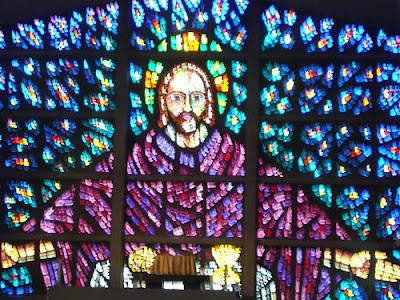
While society was in upheaval elsewhere Dom Charles was completing the remarkable work of art seen above in the Abbey church of the Benedictine community at Buckfast in a peaceful Devon valley. The huge east window (judge the size by the altar visible in lower foreground of my photo) is in the Blessed Sacrament Chapel at Buckfast Abbey. It uses the technique known as dalles-de-verre in which ‘tiles’ of coloured glass are chipped to shaped and laid mosaic-fashion in a matrix of resin. The window was made by the monks in the Abbey's workshop, and since its completion in 1968 windows have been made by the Brothers for more than 150 other churches using the same technique. One of the most recent commissions has been a window commemorating the New York firefighters who died in 9/11.

We had travelled to Buckfast to hear a concert of choral works by the unsung master Philippe de Monte. The music of this 16th century Flemish composer is very rarely performed today (although it is recorded), which is surprising as he wrote 1,073 secular and 144 spiritual madrigals, 45 chansons, 319 motets and 38 mass settings - eat your heart out Leif Segerstam! The intelligently planned and beautifully delivered concert was given in the Abbey church (Lady Chapel seen in my photo below) by the vocal ensemble Voces directed by Martyn Warren. There may still be many voices to a part in choirs in Devon and the men may still wear suits, ties and white shirts, but in other ways they are right up there with Radiohead. Here is an extract from the free programme book which included texts:

Concerts are normally free, allowing you to make your own decision about the contribution you make to the retiring collection. After expenses this will be split equally between the Abbey and the Voce music fund. Neither singers nor conductor take a fee. As a rough guide, a ticket for a concert like this would normally cost you at least £8, and we hope you will give generously with your money as the performers have given of their time in preparing and performing.


Masses of early music on iPods here.
My wife and I stayed in one of the Buckfast Communities splendid retreat houses on the edge of the monastic domain - recommended. Photos (c) On An Overgrown Path 2008. Report broken links, missing images and errors to - overgrownpath at hotmail dot co dot uk

Saturday, January 19, 2008

Early music's high Noone


Early music is more volatile than rock music. Hot new groups keep appearing, new personalities keep emerging, and early music has a dynamism that is noticeably absent from other parts of the classical music scene. One of the hot groups right now is Ensemble Plus Ultra under their director Michael Noone. Born in Sidney, Michael Noone studied at the University of Sydney and King's College, Cambridge, and specialises in Spanish Renaissance music. He is known especially for his work in the archives of El Escorial and the Cathedral of Toledo, and his CD Morales en Toledo featured here back in 2005.

Ensemble Plus Ultra record for the enterprising Spanish Glossa label who are one of the few companies still placing importance on the design and presentation of their CDs. I am playing music from their new disc (beautiful artwork above) of sacred choral music by the 16th century Venetian Gioseffo Zarlino in my Future Radio programme at 5.00pm UK time on Sunday 20th January. Zarlino is best known for his great treatise, Istitutioni harmoniche of 1558, and is little known as a composer. His cycle of motets from the Song of Songs, Canticum Canticorum, uses Isidoro Chiari's 1544 translation. This reflects the aesthetic priorities of the Cassinese Congregation of Benedictines of which Chiari was an abbot. Cassinese churches had polished white interiors, clear windows, and a choir centered under the main dome. Among architects and artists who worked for the Congregation were Palladio and Correggio.

In Sunday's programme Zarlino's motets frame Luigi Dallapiccola's Canti di prigionia. Dallapiccola was born in 1904 and grew up as a supporter of the Italian Fascist leader Benito Mussolini. But Dallapiccola’s wife was Jewish, and when the Italian government aligned itself with the German Nazis in 1936 he turned against Mussolini, and expressed his opposition in music. His masterpiece is Canti di prigionia which was completed in 1941. This is a hymn to all those who have been imprisoned for their beliefs, and it provides a fascinating companion piece to Zarlino's motet settings from four centuries earlier.

Now read about, and hear, masses of early music on iPods.
Listen on Future Radio at 5.00pm UK time this Sunday, January 13th in real time here (convert to local time zones here). An Overgrown Path podcast will follow. Windows Media Player doesn't like the audio stream very much and takes ages to buffer. WinAmp or iTunes handle it best. Unfortunately the royalty license doesn't permit on-demand replay, so you have to listen in real time. If you are in the Norwich, UK area tune to 96.9FM. Photo (c) On An Overgrown Path 2008. Report broken links, missing images and errors to - overgrownpath at hotmail dot co dot uk

Friday, October 19, 2007

New music with a Benedictine habit


My love of Gregorian Chant started years back when I first stayed in L'Abbaye Sainte Madeleine at Le Barroux in France and heard the Benedictine monks singing the Holy Offices according to the scholarship of Solesmes. Once you've heard plainsong at 3.30 in the morning during Matins you never forget it! The two photos here were taken by me a few weeks ago when I visited the monastery again.

On this Sunday's Overgrown Path programme on Future Radio I will be playing a twentieth century Requiem which is closely based on the Gregorian original. Composers from Victoria to Ligeti have set the Requiem Mass, but the non-restored Gregorian funeral chants of the Roman Rite are rarely heard. To rectify this I am starting my programme with the Introit, Kyrie, Dies Irae, Sanctus and Agnus Dei from the Gregorian Mass for the Departed sung by the monks of l'Abbaye de Fontgombault in central France.

The recording I am playing is on the invaluable Art & Musique label. Unfortunately, their CDs are very difficult to find outside France. My copy was bought in the wonderful Abbey shop at Le Barroux the day I took the photographs here. You can buy the recording online from the shop. This is my sort of CD - the sleeve notes say the following: 'The recording sessions took place in the 12th century abbey church of Fontgombault on the cold and windy days of March 12-14 2001. One can hear a little of the windstorm in the background.'

Maurice Duruflé wrote his Requiem Op. 9 in 1947 for full orchestra and organ, and it is is closely modelled on the Gregorian original. In 1961 Duruflé made a revised version for reduced orchestra and organ, and it is this version I will be playing to give continuity from the austerity of the opening plainchant. In fact the transition from the plainsong to the Duruflé is so seamless the linking announcement almost seems an intrusion.

The programme will be broadcast at 5.00pm UK time on Sunday 21 October. Listen online in realtime only via this link. And after that windstorm in Fongombault it must be raindrops falling on my chant.


Listen to the Future Radio audio stream here. Convert Overgrown Path radio on-air times to your local time zone using this link. Windows Media Player doesn't like the audio stream very much and takes ages to buffer. WinAmp or iTunes handle it best. Unfortunately the royalty license doesn't permit on-demand replay, so you have to listen in real time. If you are in the Norwich, UK area tune to 96.9FM.

All photos (c) On An Overgrown Path 2007. Any copyrighted material on these pages is included as "fair use", for the purpose of study, review or critical analysis only, and will be removed at the request of copyright owner(s). Report broken links, missing images and other errors to - overgrownpath at hotmail dot co dot uk

Friday, July 06, 2007

How precious this human life is ...


You too must contemplate your own death, meditate upon it, learn to understand and accept it. For only when you understand that life and death are not two opposites but only different sides of one reality, will you have no fear of death. For life is a candle which burns in the wind, its light can be gone in a moment. Death comes to all that lives. We must therefore never forget how precious this human life is, with its wonderful possibility of wisdom, which we should take avantage of before death ~ Tibetan Lama

+ In memory of Frère Ferréol (1959-2007) of the Benedictine Community of L'Abbaye Sainte-Madeleine du Barroux who has died in a tragic accident. The photo above shows the Requiem Mass held for him in the Abbey. Below is my translation from the newsletter of Les Amis du Monasterie, which also supplied the photos.

Throughout this tragedy the liturgy has been a huge consolation to us. The Requiem Mass is the crowning glory of choral music, and the Gregorian setting, with its economy of gesture and transcedental beauty, is its ultimate expression. Music has never been so noble yet so humble, with the plainchant underpinning the solemn text. The Requiem Mass tells us that although death is a terrible test, there is something better beyond it. The liturgy confirms our faith, and tells us that it is the peace beyond death that is most important.

Now playing - music from a green hill far away.
Lead quote from Touching Tibet by Niema Ash (Eye Books ISBN 190307018). The Liturgie des Défunts in the Gregorian setting sung by the monks of l'Abbaye Notre-Dame de Fontgombault is available on an Arts & Musique CD. Any copyrighted material on these pages is included as "fair use", for the purpose of study, review or critical analysis only, and will be removed at the request of copyright owner(s). Report broken links, missing images and other errors to - overgrownpath at hotmail dot co dot uk

Monday, January 01, 2007

Listen - fulfil!

Listen. Benedict deliberately chose this word as the beginning of his Rule. It also is the first word that strikes us when the Rule is read on January 1; and it stands as a kind of theme for every year. Benedict starts without preliminaries and addresses the person directly. The last word of this sentence forms an inclusion together with the first word: 'Listen - fulfil!' The entire verse describes this listening with its fullest sense.

Aquinata Böckmann OSB quoted in The Monastic Way, Canterbury Press ISBN 1853117579. Now follow the monastic way to Columns of plainsong soaring upwards.
Aquinata Böckmann is a member of the Benedictine Missionary Sisters of Tutzing, Germany. Image of Saint Benedict (detail of Crucifixion) by Fra Angelico, 1441-42, from Convento di San Marco, Florence. Any copyrighted material on these pages is included as "fair use", for the purpose of study, review or critical analysis only, and will be removed at the request of copyright owner(s). Report broken links, missing images and other errors to - overgrownpath at hotmail dot co dot uk

Sunday, May 29, 2005

France says "No" - with help from Father Joe


So the French referendum has rejected the EU constitution, and the pieces of the jigsaw that make up Europe are once again thrown up into the air. Political bloggers such as Clive Davis are better qualified than me to analyse the implications of the "No" vote, but I cannot let the result pass without some personal comment. In a few days time I depart for my annual extended stay in France. It is a country I love, but also find deeply puzzling. The "No" vote seems to be more of a vote of no confidence in the Chirac government than a rejection of the new EU constitution. France is a fascinating mixture of traditionalism and extremism, and this is nowhere better illustrated than in the French attitude to religion. Although the national constitution makes France a secular state, Catholicism is still a strong force in society.

I had written the post below a few days ago ready to upload while I was on the road south to the Vaucluse next weekend, but I am posting it today as the referendum result reverberates around Europe and the world. The "No" result was determined by a large number of centre-left voters rather than the small extremist groups such as the royalists and Le Pen's National Front party which I mention. But the story of L'Abbaye Sainte-Madeleine at le Barroux is an interesting example of the tensions between traditionalism and extremism that make France unique.

.............................................

The death of Pope John Paul II brought out the best and worst in people. One prominent British playright said the Pope 'meant nothing to me.' This struck me as a supremely silly comment. Whether you are Catholic or not the impact of Catholicism on society, politics, architecture, music and the world in general is imeasurable. I would be the first to agree the impact is most definitely not all for the good, and much has been written about, for instance, the Catholic Church's role in the spread of Aids in Africa, and the Catholic support for Franco in the Spanich Civil War. But without Catholicism classical music would not exist in the form it does today, and we would not have the inspitational legacy of sacred architecture, and much, much else.

I am not a Catholic, nor am I a candidate for conversion. Two of my paternal great grandparents were Scottish Catholics, and I was brought up in a vaguely Anglo-Catholic household. And as I have travelled on the overgrown path called life I have been awestruck by the magnificence of the cathedrals of Reims and Chartres, the power of monastic ruins such as Castle Acre and Llanthony, the humility of Mother Teresa, the beauty of the Requiems of Cristobal de Morales and Tomas luis de Victoria, the striking relevance of the fifteen hundred year old year old Rule of St Benedict, and the power of the the pre-Vatican II liturgy when sung in Gregorian Chant as restored by the monks at Solesmes Abbey.

I wanted to know more about the extraordinary power that drove these achievements. And I also wanted to understand how the same doctrine that created the Abbey at Cluny, could teach that condoms are ineffective in preventing the spread of Aids. As part of my journey down an overgrown path I spent a week last autumn in the remarkable Benedictine community at the Abbey of Sainte-Madeleine at le Barroux in southern France (see my post Pliable's Travels). The Abbey and Monastery at le Barroux are an extraordinary achievement, and can be seen in my header photo. It is Romanesque in style, but was in fact built in the 1980's. There are various local rumours about where the funding came from. Word has it that one of the wealthy cognac dynasties bankrolled construction, and that a former Abbot was a member of the Calvet family who control a major Bordeaux wine brokerage. The monks are traditionalists in their approach to the liturgy and use of Gregorian Chant. There are suggestions that the monks come from wealthy families and are Royalists (souverainiste). American in France Ruth Philips on her blog Meanwhile here in France has alleged right-wing connections, and the support of National Front leader Jean-Marie Le Pen. The new 'conservative' Pope Benedict XVI also has links with Sainte-Madeleine . (It all sound like good material for a novel) But as a French family living close to le Barroux wrote to me in response to a question about the alleged political links of the monks ............. ...

"Where does it all end?!! Have a glass of cognac and enjoy the Gregorian chant and don't vote Le Pen! The Abbey is certainly a very beautiful place and was built by "Compagnons", very skilled tradesmen, who are certainly not extremists. Have you heard of the Compagnons? (See the footnote at the end of this post for more information on Compagnons - Pliable) Young people wanting to learn a trade can join and do a "tour" of France, staying in lodgings where a "mother" looks after them for the time they are there learning skills from experienced artisans. They then move on to another town, all this lasts a year and the rules etc are very strict and it is not open to just anyone. At the end of the year they make an objet representing so many hours of work showing what they have learnt in their year. There are museums that collect and show these objects, little roofs, stairs etc. I do not know much about them but I do know that anyone who has done his year is highly skilled in his trade and very serious about his work. I am sure this side of the monastery is more interesting!"

I am one of those obsessive people who tries to read and research as much as they can about a subject they are interested in. One of the things that struck me was the lack of accessible literature about the Benedictine way of life. Of course there is the Rule of St Bendict, which is readable, meaningful, and important. But I found other books such as the Genesee Diary largely impenetrable.

So I was intrigued by the publication of a new book called Father Joe. The prognosis looked unpromising. The author is Tony Hendra who progressed from Cambridge University (by one of those strange coincidences that are a feature on an overgrown path he went to St John's College which is where we saw Monteverdi in Cambridge) , through Monty Python to National Lampoon and Spitting Image. Along the way Hendra did two marriages, and moderate quantities of drugs and alcohol. Throughout his journey along this particularly thorny overgrown path he maintained a relationship with Father Joseph Warrilow, a monk in the Bendictine community at Quarr Abbey on the Isle of Wight. Quarr Abbey was founded by a group of monks who fled from France in 1907 at a time of religous persecution.

Father Joe is the story of the remarkable relationship between Tony Hendra and the Benedictine monk. At one level the book is a fascinating semi-autobiography which avoids most of the pitfalls of the usual media personality best seller, although Hendra does take himself a bit seriously when expounding his views about creation. But at a deeper level Father Joe is a surprisingly useful, and accessible, primer to the Benedictine way of life. Tony Hendra has created a readable, relevant, and remarkably erudite portrait of why Bendictine communities are as relevant in the 21st century as they were in the sixth century .

There are concepts in this book that once again made me stop and think.... laborare est orare - to work is to pray, contemptus mundi - detachment (not contempt) for the world, and the disturbing questions 'Do you do the work you've chosen with joy and gratitude? Do you do it conscientously? Do you do it for others first, and yourself second?

I wish I had read Father Joe before I visited the Benedictine community at le Barroux. It is a rare insight into the continuing relevance of the contemplative way of life, and I recommend it.

If you enjoyed this post try The armchair pilgrim invisible hit counter


Footnote from understandfrance.org: "Compagnonnage" is a French tradition which goes back to the Middle-Ages. Highly skilled workers travel and work in different places in order to acquire the knowledge of their specialty from a master ("maître") ; their field can be anything from carpentry to cooking, pastry, plumbing, ironworks, stone-cutting, etc... Moving from one employer to another, they make their "Tour de France" and progress from "apprenti" to "compagnon" and finally "master". This is a medieval tradition going back to the time of the builders of Gothic cathedrals. The Compagnons du Tour de France stay in specific hotels for young workers, called "cayenne", managed by a woman, "la mère" who takes care of them. To become a "master" of the Compagnons du Devoir (founded 1347), they have to realize a "chef d'oeuvre", which is something professionally very difficult, submitted to a college of masters. Needless to say that this is extremely close to freemasonry.
All famous chefs in French restaurants have been through this cursus and can use the title "Meilleur Ouvrier de France" which is its classical expression, but your plumber can also be a "Meilleur Ouvrier de France" and, in this case, you can be sure he is a good plumber. In Paris, you can admire a sample of very impressive "chefs d'oeuvres" in the Maison du Compagnonnage, 2 rue de Brosse 75004. Compagnonnage is a fascinating world of highly skilled professionals with very high technical and ethical standards grounded in a very ancient tradition. Each of them is given a name which includes his region and a moral characteristic (for instance : Tourangeau la Vertu or Périgord Coeur-Loyal).

Saturday, March 26, 2005

Easter at Aldeburgh

Example
Iken Church in the distance from Iken Cliff, all photos taken today under a typical East Anglian sky.

The overgrown path led me to Iken Church this Easter Saturday morning. The church is on a promontory sticking out into the River Ald downstream from Snape. It is a place of inspiring beauty and peace, a wonderful setting for a monastery. St Botolph built his minster at Iken in the 7th century, and became the first person in Britain to follow the Rule of St Benedict. The monastery was destroyed by raiding Danes in the winter of 969/70, and parts of the current church date from the rebuilding which started in the 11th century. The story of destruction by Viking invaders is a reminder of how this part of East Anglia is on the margins of civilisation. During World War 2 the village of Iken was evacuated and the church closed to make way for a practice battleground. And despite the beauty of the area the Sizewell nuclear power station to the north is a constant, and visible, reminder that this area remains on the edge. Further north is even more graphic evidence of the precarious existence here. The medieval town of Dunwich was half the size of London in the 12th century, and contained eight churches and several religous orders. Coastal erosion has claimed the whole town in Gotterdammerung style, and all that remains today is St James' Church, part of a leper hospital built outside the town walls. The themes of the power of nature, tragedy and exclusion are never far away here, and they are the threads that are woven through Britten's opera Peter Grimes which is set on this coast.

When Iken monastery was in its heyday in the seventh and eighth centuries it was a base for monks making missionary journys into East Anglia. Today the church is a destination for pilgrims, both of the religous kind who visit it as one of the first Christian sites in the country; and also musical, as Iken Church was used as a venue for performances by Benjamin Britten. This remarkable church was the venue in 1949 for the first performance of Britten's opera for children, The Little Sweep. (The thin line between civisation and the abyss is well illustrated here. This premiere of a morality tale for children by the pacifist Britten, who had spent part of the war in safety of the US, took place just two years after the church had re-opened after spending years isolated in a middle of a mock battlefield).

Example
Iken Church

From Snape into Aldeburgh, and a repeat visit to Maggi Hambling's Scallop sculpture on the beach. The artist created the twelve and a half foot high work in stainless steel in 2003 at a cost of £70,000, and the brief called for it to withstand gales of up to 100 mph - shades of the sea interludes! It was raised as as a tribute to Benjamin Britten, the Aldeburgh resident who put this small Suffolk town on the map. The words cut into the top edge of the shell, and visible in my picture, are from Peter Grimes - "I hear those voices that will not be drowned." But despite its status as a tribute the Scallop has fiercely divided local residents, and has been the subject of petitions, rows in the council chamber, and even paint daubings. We think it is a wonderful work, and we are also delighted that the townspeople can get passionate (both for, and against) a work of art. And the bitter controversy neatly sums up the schizophrenia of Aldeburgh under Britten - creative brilliance coupled with conservatism, small-mindedness and in-fighting. For a wonderfully entertaining portrait of Britten see his eponymous biography by the late lamented Humphrey Carpenter. (What a strange convergnce of overgrown paths, the scallop shell is of course the symbol of the medieval pilgrim, and is still referred to as 'St James shell').

Example
The Scallop sculpture, art or aesthetic vandalism? - add your comments at the end of this post.

After lunch I buy the Britten and Richter recording of Schubert piano duets recorded live by the BBC in the Jubilee Hall in Aldeburgh, and now released on Decca. (A measure of the cultural capital invested in Aldeburgh is that this town of just 3500 residents can support a first class independent bookshop, and an excellent classical CD outlet). As we return to the car we wander into a craft fair in a small hall. On the stage of the hall we buy some essential oils from a stall. And then realise that the hall is the Jubilee Hall, and we are standing at precisely the spot where Britten and Richter played (and recorded) their Schubert recital forty years ago. Another remarkable direct line to Britten.

Example
invisible hit counter

Friday, March 11, 2005

Master Tallis' Testament


Authentic performance is conventionally defined as played on original instruments and in an original style (without vibrato etc), but performances in 'authentic' surroundings can add an equally valid frisson.

Norwich Priory became a Benedictine Monastic Priory five years after its foundation in 1096, and the Norman groundplan is the most authentic of any English cathedral. Among many glories the cloisters, which unusually for a dissolved house remain intact, are outstanding. They were burnt down in 1272, and subsequently rebuilt with an unusual covered upper story for the monks to use for work and contemplation in winter. (It is a common mistake to think cloisters were simply used by monks walking in silent, contemplative circles. Together with the Chapter House and church they were a central point for the monks, used for working, reading and writing. When I arrived to stay in the Benedictine L'Abbaye Sainte-Madeleine du Barroux I didn't know the etiquette of monastic life, and had to ask what could be done, and what was forbidden in the cloisters. I was surprised to find that the cloister was a working, as well as contemplative area).


The Cloisters, Norwich Cathedral Priory

Norwich Cathedral Priory is almost within a stone's throw of a Dominican Friary which is acknowledged as the finest remains of any medieval friary church in England. The Dominican Friary was retained after the suppression as St. Andrew's Hall, a venue for public events, and is now the principal concert venue in Norwich. Alas, and quite inexplicably for a large ecclesiastical building, the acoustics of the architecturally magnificent St. Andrew's Hall are abysmal. The Cathedral Priory, which is now the Episcopal Cathedral, is also a concert venue with along and chequered history including the first performance of Elgar's Sea Pictures conducted by the composer in 1899. Thankfully, it is in the flattering acoustic and magnificent setting of the Cathedral that the Keswick Hall Choir have chosen to present an innovative programme entitled Mater Tallis' Testament (taking its name from Herbert Howells' organ work of the same name which was included in the concert).

Master Thomas Tallis was represented by his Lamentations of Jeremiah and two motets, Suscipe quaeso and Loquebantur varris linguis. (The latter using a Saron plainchant as a Cantus Firmus , with a wonderful unadorned presentation of the chant at the end). Framing Tallis's masterpieces were works by Britten, Howells, Vaughan Williams (his Mass in G Minor, itse;f a homage to Tudor polyphony), Walton's The Twelve (which is closer to Belshazzar's Feast than polyphony), and a very effective contemporary cantata Haes Dies by Peter Ashton who was in the audience.

Tallis, Vaughan Williams, Britten et al soared to the wonderfully embellished Norman roof. The Keswick Hall Choir conducted by John Aplin were in their usual impeccable form (although at forty-four strong, some would argue, a little full bodied for the Tallis), and in the 20th century works the contribution from the from David Dunnett at the console of the modern organ (which is the second largest cathedral organ in Britain) perched on the pulpitum screen was magnificent.


Keswick Hall Choir in rehearsal in Norwich Cathedral

And the silent contribution of the Benedictine Priory was wonderful. We walked in the darkened cloisters during the interval as snow flurries swirled outside, and I was reminded of my stay at the Benedictine L'Abbaye Sainte-Madeleine du Barroux , and the monks in their black habits walking into the darkened abbey church at three o'clock in the morning for matins. As Peter Levi wrote in the Frontiers of Paradise - "English monastic ruins are almost more impressive than a living monastery; they are doubly dramatic. They pose formidable questions about God and the soul, to which the light and shadows of their ruined architecture offer the merest hint of answers."


Programme for Master Tallis' Testament, Norwich Cathedral Priory, 26th February 2005

Benjamin Britten (1913-76) - A Hymn to the Virgin

Thomas Tallis (c.1505-85) - The Lamentations of Jeremiah

Benjamin Britten - Voluntary on Tallis' Lamentation

Peter Aston (b.1938) - Haes Dies

Ralph Vaughan Williams (1872-1958) - Mass in G Minor

Herbert Howells (1892-1993) - Master Tallis' Testament

Thomas Tallis - Suscipe quaeso and Loquebantur variis linguis

William Walton (1902-83) - The Twelve


Monday, November 01, 2004

Pliable's travels


I've just returned from France, the whole trip was very stimulating. I tried to make it a pilgimage (personal rather religous) and travelled light (relatively - I took seven books!) with just a rucksack and used public transport - which is very good in France. I got a lot out of my time at Ste Madeleine, but equally learnt a lot from being close to the French people, and on my own which meant I was closer to the local people. Once again I'm afraid I was left wondering what we are doing wrong in Britain, the French education system seems to be so much better, their town centres are so much more civilised and safe, and the absence of rubbish tipping (fly tipping) by the edge of public roads was noticeable compared with England. It was also interesting to see numbers of young people at Mass in Nimes on a Sunday. (By the kind of serendipidity that this site was created to exploit I was reading Patrick Humphries' Nick Drake - the biography (see A troubled cure...for a troubled mind above), and found the book rich in links to Nimes, Arles and Avignon.

I spent three nights in Nimes bed and breakfasting at Thierry and Jean-Luc's lovely little city centre studio with a wonderful little terrace looking across the roof-tops. Here is the view from the terrace - click on the link for more details, recommended.


I spent five days at Ste Madeleine monastery in Northern Provence. The Abbey and monastery are quite strict Benedictines verging I think towards more disciplined orders such as the Cistercians. To be close to the monks and understand their commitment was inspirational. I found my stay gave me a lot of new perspectives. I can't say it was relaxing but that wasn't why I went. It took me some time to understand the pattern and niceties of monastic life. Silence and the outside doors locked after Compline (20.15h local time - 19.15h body clock time) was a challenge for a serial insomniac.

There were no new religous revelations for me, more a confirmation of what I had concluded already. The life and power of the community confirms an Almighty power, but I'm afraid my unease with some aspects of Catholicism remain. As Ste Madeleine is a religous order in its own right it reports (if that is the word) directly to Rome, rather than through the French Catholic church. There were a number of unidentified dignatories among my fellow guests who were involved in much serious discussion, I am afraid I wanted to drag them all outside, point out the fantastic scenery and weather and shout "Isn't it all wonderful - praise the Lord!" Thank goodness it wasn't a Trappist monastery - they were built in damp and flat regions to avoid tempting the eye with wonderful scenery.


There were some other fascinating and inspiring guests though, including the Chaplain of
Chavagnes International College. This is an English boarding school for boys outside Nantes for an interesting and very valid take on education (would be interested in any views on their policy on television and the Internet as set out in the FAQ section).

Moments such as being led through into the enclosure for my first meal, and entering the refectory with sixty monks in black habits standing lining the sides were quite extraordinary. Being served very good steak while the Brothers had a boiled egg were more perplexing.

All the offices are sung in unadorned Gregorian Chant. The wonderful Baroque stye organ in the Abbey is only used for Sundays and Feast days. I slipped in one morning when a monk was practicing on the organ, and found its sound like a burst of sunshine after relentless the wonderful but relentless gregorain Chant. Compline sung from memory in the dark was very moving though. I bought back lots of CD's (the Abbey has a very good shop which sells their bread and produce plus a lot of books and music) including the Pergolesi Five Part Mass (I'm writing a separate post on that), the Couperin Organ Masses (with plainchant),Ramaud Motets and a wonderful cheap four CD set from Erato (£17 for four CD's) of all of the well known settings of the Stabat Mater. I also bought in FNAC in Avignon the new ECM
disc by pianist Vassillis Tsabropoulos and Anja Lechner on Cello Chants, Hymns and Dances.Again I will write another post on this fascinating disc when it has spent more time in the CD player.

I took with me the Benedictine Handbook (which includes the Benedictine Rule) which I would thoroughly recommend. It is beautifully published and printed here in Norwich by the Canterbury Press - part of Hymns Ancient and Modern. It has a chapter by Esther de Waal. I also tried The Cloister Walk by Kathleen Norris which I found both too American, and if you'll forgive me a bit 'holier than thou'. Also sampled was Henri Nouwen's The Genesee Diary about life in a Trappist monastery in the States, but again I couldn't really relate to it I'm afraid.

Anyway, that is a very much layman's take on my pilgimage to Ste Madeleine. I would like to return, and think I would get a lot out of another visit as I now know the rhythms and nuances of monastic life.

We're off to see a visiting gospel choir tomorrow night at the United Reform Church in Halesworth as part of their very good Arts Festival.

Saw the wonderful Yukio Ninagawa production of Hamlet
with Michael Maloney in Norwich a couple of weeks back - fantastic!

Going to see what remains of Fairport Convention in a few weeks - open the window as wide as you can and see what flies in!

Picture below is Norman Foster's fabulous Carre d'Art
gallery in Nimes, with the Maison de Carre temple in the foreground.