Recycling is an essential part of the creative process. My photo above was taken last September and shows the West Portal of the Benedictine Abbey of Saint-Gilles-du-Gard, which is generally considered be the most outstanding example of Provencal Romanesque architecture in southern France.
Below is the magnificent portal recycled in the Carnegie Museum of Art, Pittsburgh. Industrialist Andrew Carnegie paid the town of Gard 2000 gold francs to allow plaster casts to be taken of the portal. The casts were shipped across the Atlantic in 195 packing cases and assembled in Pittsburgh for the 1907 opening of the museum's Hall of Architecture.
The Abbey of Saint-Gilles-du-Gard is one of the staging posts on the most southerly of the pilgrimage routes to Santiago in Spain, which starts in nearby Arles. In 2005 composer Joby Talbot indulged in some creative recycling when he incorporated the hymn Dum Pater Familias and other pilgrim tunes into his choral work Path of Miracles which celebrates the Santiago pilgrimage. Read more about Path of Miracles here.
On Sunday February 3rd I will be playing the final two of the four parts of Path of Miracles on Future Radio. My programme is broadcast at 5.00pm on Sunday afternoon, and will be repeated at 1.00am on Monday morning for transatlantic listeners, which is afternoon or evening Sunday in their time zones.
I'm framing Path of Miracles with two excerpts from the 1991 recording of music from the Pilgimage to Santiago made by the New London Consort directed by Philip Pickett. This draws on the 12th century Codex Calixtinus also used by Joby Talbot. The New London Consort disc is a classic release from L'Oiseau-Lyre's Indian summer, and it has recently been re-released at budget price - grab it while you can. Read the L'Oiseau Lyre story here.
Listen on Future Radio at 5.00pm UK time this Sunday Feb 3 and Monday Feb 4 in real time here (convert to local time zones here). Windows Media Player doesn't like the audio stream very much and takes ages to buffer. WinAmp or iTunes handle it best. Unfortunately the royalty license doesn't permit on-demand replay, so you have to listen in real time. If you are in the Norwich, UK area tune to 96.9FM. Photo (c) On An Overgrown Path 2008. Report broken links, missing images and errors to - overgrownpath at hotmail dot co dot uk
Thursday, January 31, 2008
Old meets new on the Santiago pilgrimage
Hallé birthday to you

Youth is certainly a state of mind in Manchester where the Hallé Orchestra is celebrating the 150th anniversary of its founding. Last night there was a celebratory concert presented by Dame Janet Baker (age 75) which included Ralph Vaughan William's Towards the Unknown Region and Edward Elgar's In the South (Alassio) as well as a 1996 Hallé comission, Thomas Adès' These Premises are Alarmed. Well done the Hallé for defying current music fashion and recognising that Elgar and Vaughan Williams did more than linger "lovingly over musical depictions of pastoral hills and fields, implicitly resisting the march of progress."
Hans Richter, Sir John Barbirolli and Mark Elder are the conductors usually associated with the Hallé. But my header photo shows Benjamin Britten rehearsing his Spring Symphony with them in Leeds in 1950. More on the Spring Symphony here.
Image credit Leeds classical music. Any copyrighted material on these pages is included as "fair use", for the purpose of study, review or critical analysis only, and will be removed at the request of copyright owner(s). Report broken links, missing images and errors to - overgrownpath at hotmail dot co dot uk
Wednesday, January 30, 2008
Free music - so what's new?

'Music industry finds the solution to its pirate troubles - give everything away' - screams a Guardian headline. Sorry folks, but the classical sector has been giving away music for years. Here from my current Visa bill are the prices I paid for CDs online recently including delivery: Messiaen Des canyons aux étoiles (2CDs) - £4.00, Dallapiccola choral works - £3.41, Stockhausen piano works - £4.22, Elgar Dream of Gerontius (2CDs) - £5.67.
It actually gets worse in the stores. Just last week I bought 10CDs of Thomas Tallis' complete works in recordings made as recently as 2004 for £3 a CD, and that wasn't discounted. In HMV stores you can currently pick up 14CDs of the complete Mahler symphonies by classical music's premium brands, Simon Rattle and the Berlin Philharmonic, for £1.79 a disc. That means a Mahler CD from our industry's most prestigous band now costs less than a cappuccino, and it's not expanding the market for classical music or filling concert halls at all.
So with prices already at rock-bottom what will be the impact of free downloads from Qtrax and others? Classical music will become just another disposable commodity. Download it, give it a quick listen, it doesn't appeal on first hearing? No problem, delete it and try again. Contemporary composers had better start thinking catchy, and record companies (if any survive) had better start thinking instant gratification.
Benjamin Britten had it nailed when he wrote 'Music demands more from a listener than simply the possession of a tape-machine or a transistor radio. It demands some preparation, some effort, a journey to a special place, saving up for a ticket, some homework on the programme perhaps, some clarification of the ears and sharpening of the instincts. It demands as much effort on the listener's part as the other two corners of the triangle, this holy composer, performer and listener'
So what does a dead composer (European to boot) know about today's market with its MP3s and iTunes? The answer is a lot. Britten wasn't just a composer, he was a musical polymath whose vision created one of the few successful, and growing, classical music communities in the world. Last year Aldeburgh Music sold 91,000 tickets. I wonder how many bargain basement Berlin Philharmonic Mahler boxes EMI has sold in the UK - 5000 perhaps? The solution for the music industry isn't to give everything away. It's the opposite. Think added value, think Glossa, think Soli deo Gloria, but above all think Alia Vox.
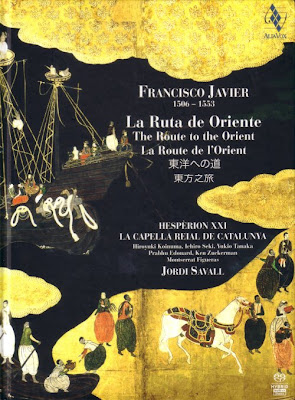
Now playing is Jordi Savall's newly released Francisco Javier 1506-1553, the Route to the Orient on Alia Vox. Yes, it comes with 2CDs of lovingly researched and performed music, but there is much more in the form of a 273 page colour book (cover above) which is a work of art in itself. In it there are fascinating and scholarly articles ranging from early music performance, to Erasmus of Rotterdam, Niccolo Machiavelli, Thomas More, and Martin Luther, as well as Francisco Xavier, who was an early Jesuit missionary, himself. And the whole package is worth far more than the sum of the parts. I paid £30 for it in Prelude Records in Norwich, and that is the best £30 I have spent on recorded music for a long time. I didn't get two CDs for my money, I got a unique musical experience. And that is what will rejuvenate the market, not giveaways.
Britten would have approved. The Route to the Orient is about as far from instant gratification as you can go. It demands preparation by reading the book, and it also demands effort to understand the non-Western music that it explores. You must leave your computer and take a journey to a special place called an independent record store to buy it, and you will also need to save up as it is not available online at a discount or as a download. The thoughtfully planned multi-cultural programme needs to be understood, and clarification of the ears and sharpening of the instincts are definitely needed for close encounters with instruments such as the shinobue, nokan, sarod and shakuhachi.
Are added value projects like Francisco Javier, the Route to the Orient and Christopher Columbus, Lost Paradises (below) the future of classical music? Or are they just small ripples in a big pond? Only time will tell. But I haven't heard Alia Vox talking about mass redundancies, and their 2008 release schedule looks pretty healthy. Which is more than can be said for EMI.
It was Philip Glass who said world music is the new classical.
Any copyrighted material on these pages is included as "fair use", for the purpose of study, review or critical analysis only, and will be removed at the request of copyright owner(s). Report broken links, missing images and errors to - overgrownpath at hotmail dot co dot uk
Dialogue of a great twentieth century composer

Francis Poulenc (above) died in Paris on January 30th, 1963. Read about his masterpiece, Dialogue of the Carmelites, here.
Any copyrighted material on these pages is included as "fair use", for the purpose of study, review or critical analysis only, and will be removed at the request of copyright owner(s). Report broken links, missing images and errors to - overgrownpath at hotmail dot co dot uk
Tuesday, January 29, 2008
Weak at the knees over this gig

28 January - a legend - concert room 7.30 - a legend
Paolo Pandolfo viola da gamba
A legend. I've had members of the public weak at the knees over this gig. You won't have heard of him as you are music students but don't let that or good natured sarcasm stop you from coming. FREE FREE FREE for MUS students
That's what the University of East Anglia School of Music internal flyer said, and for once the hyperbole was justified. Like his viol da gamba teacher Jordi Savall, Paolo Pandolfo is a legend. Pandolfo's concert last night, with its seamless transitions between the 17th and 21st centuries, confirmed his status. The evening was crowned by one of the pinnacles of classical musiuc, Bach's Fifth Cello Suite in a transcription for viol, after revelatory interpretations of music by Tobias Hume, Le Sieur de St. Colombe, Marin Marais and Pandolfo himself. The music students may not have heard of Pandolfo, but there was standing room only with the widest range of ages that I have seen at a concert since last summer's Faster Than Sound.
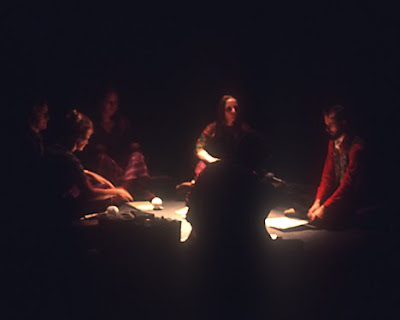
My photo above captures some of the magic of the evening, and there is more magic in the brutalist 1960s architecture of the UEA music room in which it was taken. Paul Hillier's first recording of Stockhausen's Stimmung, made for Hyperion with Singcircle, was recorded there in 1983. Which may explain the interesting similarities between my header photo and Richard Friedman's 1971 shot used in my recent Stimmung post, and no comments, please, that we were both struggling with available light.
Paolo Pandolfo is one of a a disappearing breed - a musician with views on more than his next recording contract and music directorship. Read about them in Baghdad's Spring.
Photo (c) On An Overgrown Path 2008. Report broken links, missing images and errors to - overgrownpath at hotmail dot co dot uk
Thank you for the music

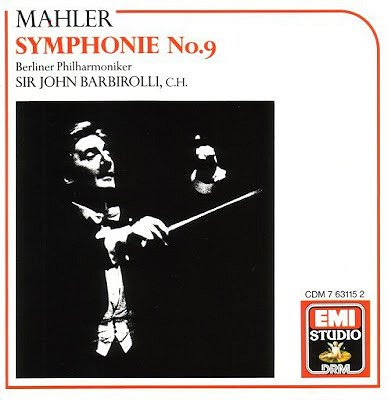
Another link with a great musical past was severed on January 25th 2008 with the death of Evelyn Barbirolli, a day after her 97th birthday. Born Evelyn Rothwell she established a reputation as an outstanding oboist before marrying Sir John Barbirolli in 1939, the couple are seen in my header photo. She continued her career after her marriage using her maiden name and was a champion of contemporary music. She played in the first performance of Bohuslav Martinů's Oboe Concerto and had works composed for her by Elizabeth Maconchy, Edmund Rubbra, Arnold Cooke, Arthur Benjamin and Gordon Jacob, and Sir John arranged concertos for her arranged concertos for her from music by Corelli and Pergolesi.
My header photo is from a facinating article on MV Daily. There is a full Guardian obituary here, read more about Glorious John in New York here.
Any copyrighted material on these pages is included as "fair use", for the purpose of study, review or critical analysis only, and will be removed at the request of copyright owner(s). Report broken links, missing images and errors to - overgrownpath at hotmail dot co dot uk
Monday, January 28, 2008
Making the case for contemporary music
In his masterly book A Concise History of Western Music Paul Griffiths explains that “The past is not a path we and our predecessor's have travelled but a labyrinth, and a labyrinth forever in flux”. Concert planners usually view the musical past as a narrow path that must be followed closely, and as a result they produce predictable programmes that overlook the many riches hidden in the labyrinth of music history.
So how wonderful to see the King of Hearts in Norwich departing from the familiar narrow path for its Autumn Festival, and challenging performers to explore the musical labyrinth. This Journey Across Time provided fascinating perspectives. Not only was it a rewarding musical experience, but it was also very enlightening to see how both audiences and performers responded to the challenge of musical diversity.
The Festival started rather unpromisingly with a recital by violinist Catherine Macintosh and harpsichordist Maggie Cole. These performers are no strangers to contemporary music, and played two works by Stephen Dodgson, including his Inventions which are dedicated to Maggie. But, despite this, the music was presented in a strangely detached way, rather like being introduced to a teenage relative with body piercings. But perhaps it wasn’t just the contemporary music. The Bach and Biber in the programme were rather like being introduced to an elderly relative with a taste for Agatha Christie. Not the most vibrant of starts, and not helped by empty seats. Teenagers with piercings may be the norm outside in Norwich's Magdalene Street, but sadly they are a lot less popular in the King of Hearts.
No lack of spark in the lunchtime Bach from King of Hearts’ regular Carolyn Gibley. There may have been a capacity audience, but her Journey Across Time stopped at 1750, apart from one singularly inappropriate pastiche item. I know Carolyn is quite upfront in her preference for eighteenth century harpsichord music. But a work such as John Palmer’s Koan from 1999 would have taken us much further into the labyrinth than P.D.Q. Bach.
Different strokes for different folks, and both The London Handel Players and Jane Chapman proved just how rewarding exploring the labyrinth can be. Bohuslav Martinů’s Promenade for flute, violin & harpsichord from The London Mozart players showed that twentieth century music need not be feared, while, in the same concert, Rachel Brown’s performance of a work for flute and tape by Barry Guy eased the King of Hearts into the age of electronica.
Either by luck or good planning Aude Gotto had left the best to last. Jane Chapman (photo above) fears nothing in contemporary music. No tokenism or apologia in her harpsichord recital, which went for the jugular with music by Gyorgy Ligeti, Tōru Takemitsu, plus a first performance, with the composer present, from Jeremy Peyton-Jones who is right there in the labyrinth as a colleague of John Cage. Those that chose the competing television coverage of England losing the Rugby World Cup final instead of Jane’s recital missed a real opportunity to celebrate.
The concerts by The London Mozart Players, Jane Chapman and others were a triumphant endorsement of the vision of a Journey Across Time. I really don’t feel that in 2007 I should be making the case for contemporary music. But the empty seats at several of the concerts suggest I should. If you only feed children baby food they never develop proper teeth, and can’t move on to a nourishing diet that allows them to grow. There is too much baby food in today’s concert programmes and radio schedules. Contemporary music is the aural equivalent of the spicy Hungarian goulash served in the King of Hearts restaurant after Jane Chapman’s inspirational recital. More please Aude.
(c) Bob Shingleton 2008, first published in the newsletter of the King of Hearts Centre for people and the arts winter 2007 newsletter. Related articles:
* Contemporary music - I really enjoyed it! - link
* More of Martinu's music please - link
* Brand new music for harpsichord - link
Any copyrighted material on these pages is included as "fair use", for the purpose of study, review or critical analysis only, and will be removed at the request of copyright owner(s). Report broken links, missing images and errors to - overgrownpath at hotmail dot co dot uk
Sunday, January 27, 2008
Then a wail for their sins

It's probably just me, but if I'm told that a piece of music is "uplifting" or "touches the core of what it is to be human", I run as fast as I can from it - comments Henry Holland on The composer without a shadow? Henry was writing in praise of Richard Strauss, and I wonder what he makes of the music of a contemporary and friend of Strauss', Edward Elgar?
This morning I attended a performance of Elgar's Piano Quintet led by pianist Ashley Wass, and, sorry Henry, but this is a work that is both uplifting and deeply human. Given the over-exposure of the Cello Concerto it is difficult to understand why Elgar's String Quartet and Piano Quintet aren't better known as all three works are from the same period.
They were written when the composer was living in a cottage called Brinkwells at Fittleworth in Sussex between 1917 and 1919. Near Elgar's cottage was a clump of dead trees that had been struck by lightning. Their branches were distorted into strange and almost human forms. Local legend said that impious Spanish monks had held black masses there, and as punishment had been struck down by lightning and turned into the withered trees. The ghostly shapes provided inspiration for both Elgar's Piano Quintet and String Quartet, and also his Violin Sonata. Elgar's wife Alice wrote of the Quintet in her diary:
'Wonderful weird beginning ... evidently reminiscent of sinister trees ... sad 'dispossesed' trees and their fate - or rather curse - which brought it on ... then a wail for their sins - wonderful.'
My header image of the trees at Fittleworth comes from the EMI recording of Elgar's chamber music by the Vellinger Quartet and Piers Lane. If you love the Cello Concerto but don't know these works you have a gap in your CD collection that needs filling.
In today's concert the Elgar was coupled with Frank Bridge's Piano Trio No. 2 from 1929. It is unfortunate that today Bridge is remembered mainly as Benjamin Britten's teacher. This late Piano Trio is a a tough, sinewy work that hovers tantalisingly between tonality and the chromaticism of Schoenberg. Forget the baggage associated with Bridge, this is one of several great works by him that should be recognised for their own merits.
Today is Holocaust Memorial Day, and Elgar's music from his Brinkwells period is a painfull reminder of the carnage of war, as is Strauss' Metamorphosen. But some victims of the Holocaust are still forgotten, read about them here.
Any copyrighted material on these pages is included as "fair use", for the purpose of study, review or critical analysis only, and will be removed at the request of copyright owner(s). Report broken links, missing images and errors to - overgrownpath at hotmail dot co dot uk
Saturday, January 26, 2008
Contemporary composer paints bigger picture

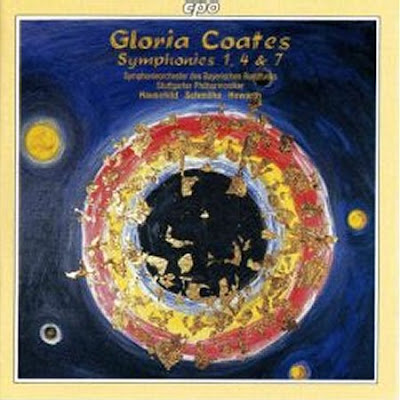
Ben.H has left a new comment on your post "A great American composer and artist besides": While we're naming names, Gloria Coates is another composer and painter, whose CDs typically use her art for the cover designs.
Ben, thanks for including the eternal feminine.
Any copyrighted material on these pages is included as "fair use", for the purpose of study, review or critical analysis only, and will be removed at the request of copyright owner(s). Report broken links, missing images and errors to - overgrownpath at hotmail dot co dot uk
Friday, January 25, 2008
Got the T-shirt? - now hear the music

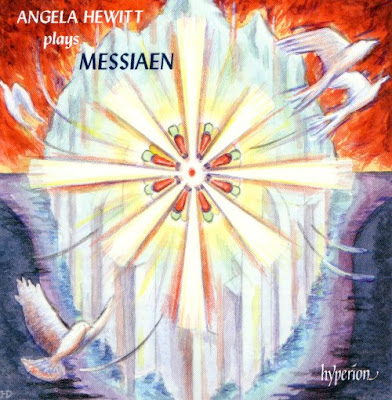
There was some healthy discussion on my recent article about pianist Angela Hewitt's Bach World Tour T-shirts. No discussion on my Future Radio programme this Sunday (Jan 27) at 5.00pm UK time, just 51 minutes 3 seconds of the perfect pianism of Angela Hewitt playing Messiaen and J.S. Bach, connected by less than 5 minutes of the usual low key links from me. The audio stream can be launched here, and is available in real time only.
There is some interesting music coming up on my Future Radio webcasts in the next few months. It includes Elliott Carter's Sonata for Flute, Oboe, Cello and Harpsichord, Michael Tippett's Second Symphony (why aren't his symphonies performed more often?), and a new recording of Lou Harrison's Concerto for Violin and Percussion Orchestra, all complete - no extracts. Through the year I will also be playing all the Vaughan Williams symphonies. Future Radio agreed to this following very positive listener responses to my broadcast of the Fifth earlier this month, and they are rearranging their schedule to accomodate the 71 minute Sea Symphony in August to coincide with the centenary of the composer's birth.
On April 6 I will be presenting Karajan and Twentieth Century Music to mark the centenary of the conductor's birth. For all his faults Karajan made some superlative records, none more so than his 1972 recording of Arthur Honegger's Third Symphony Liturgique, and I'll be playing that with his 1973 recording of Alban Berg's Three Pieces from the Lyric Suite, both with the Berlin Philharmonic. Framing all these contemporary works will be music by Bach, Tallis, Corelli and from the Sephardic Diaspora.
It's all about thinking outside the box, as Olivier Messiaen did.
Listen on Future Radio at 5.00pm UK time this Sunday, January 27th in real time here (convert to local time zones here). An Overgrown Path podcast will follow. Windows Media Player doesn't like the audio stream very much and takes ages to buffer. WinAmp or iTunes handle it best. Unfortunately the royalty license doesn't permit on-demand replay, so you have to listen in real time. If you are in the Norwich, UK area tune to 96.9FM. Report broken links, missing images and errors to - overgrownpath at hotmail dot co dot uk
What exactly is live music?

"Way more than 50% of our output is live music ..." claims BBC Radio 3 controller Roger Wright in a revealing article about a new jazz radio station in today's Guardian.
But Radio 3's definition of live is slightly different to yours and mine. As I reported here in February 2007 virtually all evening concerts on Radio 3, except the Proms, are pre-recorded. But the BBC counts these recordings as 'live' performances, and the text streamed with their FM broadcasts describes them as 'live concert recordings'.
In a wonderful example of BBC corporate-crapola Radio 3 defines 'live' as any music recorded with an audience present. Which has important implications both for musicians who earn their living from live music making, as these recorded 'live' performances can be repeated, and for audiences, who may find real concerts with living breathing musicians disappearing.
If Roger Wright turned up at a concert hall for a 'live concert', and found a pre-recorded performance being played through speakers wouldn't he feel cheated? It's not a stupid question - that's what is actually happening in my header photo. Read about it here.
Header photo (c) On An Overgrown Path 2008. Report broken links, missing images and errors to - overgrownpath at hotmail dot co dot uk
A great American composer and artist besides

Email received - Bob, I found your post about artists who also paint fascinating. As you have pointed out, there are many more than we previously thought. Schoenberg comes to mind. I thought you would be interested in another. Nicolas Flagello was really something, one of the great American composers and an artist besides. I attach these CD covers not to attract publicity for myself, but because these are the only examples of his art in my possession. Though the cover pics are details, I've seen the large originals at Flagello's wife's residence, and they are remarkable.
A day without OAOP wouldn't be a day at all.
Best, JMW
See Arnold Schoenberg's paintings and drawings here, and read about more eye-music here.
Any copyrighted material on these pages is included as "fair use", for the purpose of study, review or critical analysis only, and will be removed at the request of copyright owner(s). Report broken links, missing images and errors to - overgrownpath at hotmail dot co dot uk
Thursday, January 24, 2008
New symphony is highly infectious

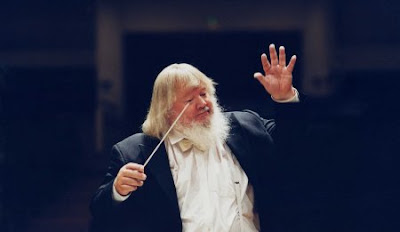
Leif Segerstam's 151st Symphony (eat your heart out Alan Hovhaness) was premiered last week by the estimable BBC Scottish Symphony Orchestra with the composer conducting. The single movement symphony lasts for less than half an hour, and Segerstam's programme note cites the recent outbreaks of bird flu as one of the inspirations for the symphony.
Leif Segerstam, seen in my header photo, is one of those musical mavericks who are a dying breed in today's world of 'Mahler cycle before you are 30' agent controlled music making. (And yes, I know he has recorded a Mahler cycle). Segerstram's students include Susanna Mälkki, and he has used aleatoric techniques and has written for conductorless ensembles. He has championed music by contemporary composers including John Corigliano and Christopher Rouse, and fellow Finn Einojuhani Rautavaara.
Rautavaara's music became fashionable in the mid-1990s, and I have several of his works in my CD collection dating from that time. Segerstam's recording of Rautavaara's Seventh Symphony (Angel of Light) plays as I write. I haven't listened to it for ten years, and coming back to it I find it deserving, beautifully crafted but ultimately unremarkable music that lacks any real sense of development - am I missing something?
Judge Leif Segerstam's 151st Symphony for yourself. It is being broadcast on BBC Radio 3 this evening (Jan 24) and will be available for a week on demand after broadcast, or so the BBC says. The photo below comes from my February 2007 article about the bird flu outbreak here in East Anglia. I never thought I'd be able to back link to it from a piece on contemporary music. Thank you Leif Segerstam for making it possible.
Lower photo (c) On An Overgrown Path 2008. Any copyrighted material on these pages is included as "fair use", for the purpose of study, review or critical analysis only, and will be removed at the request of copyright owner(s). Report broken links, missing images and errors to - overgrownpath at hotmail dot co dot uk
Inner Cities just got longer

'A painting is never finished - it simply stops in interesting places' said the Scottish artist Paul Gardner, and it is the same with contemporary music. Back in November I thought I was broadcasting Alvin Curran's Inner Cities complete, but I was wrong. The epic 4 hour 24 minute cycle for solo piano had just stopped at an interesting place called Inner Cities 11.
Pianist Daan Vandewalle tells me that two new Inner Cities have been added to the cycle, and another is in the pipeline. This week he recorded IC12 in Paris, he has performed IC13 in Italy, and is finalising a commission for Alvin Curran for IC14. I wonder what would have happened if Daan had been around when Wagner was composing the Ring?
My next project is a marathon broadcast of Kaikhosru Sorabji’s Opus Clavicembalisticum for solo piano which also lasts for hour hours. Read about it here.
Any copyrighted material on these pages is included as "fair use", for the purpose of study, review or critical analysis only, and will be removed at the request of copyright owner(s). Report broken links, missing images and errors to - overgrownpath at hotmail dot co dot uk
Wednesday, January 23, 2008
What a Karajan at the BBC

Apologies to readers, who like me, tuned in vain to BBC Radio 4 at 7.15pm this evening to hear the 'reassessment' of Herbert von Karajan's life and work that I mentioned in one of today's post.
I picked up information on the programme from today's Guardian radio listings which highlighted the Karajan programme. This information would have been supplied by the BBC publicity department. As programmes sometimes change I went to Radio 4's webpage. This clearly says:
19:15 Front Row 23 January 2008
Arts news and reviews with Mark Lawson, including a reassessment of the life and work of Herbert von Karajan as the centenary of the maestro's birth approaches.
Just to make sure doubly-sure I googled 'BBC Radio 4 Karajan' and found another page on the BBC website which confirmed that the programme was being aired today at 7.15pm. So I linked to it.
At 7.15 there was no Karajan feature, no explanation, and no apology. Like so many things the BBC does today, totally hopeless.
In the old days at least we made our mistakes with style.
Any copyrighted material on these pages is included as "fair use", for the purpose of study, review or critical analysis only, and will be removed at the request of copyright owner(s). Report broken links, missing images and errors to - overgrownpath at hotmail dot co dot uk
Stockhausen's Stimmung at summer Snape

A late night performance of Stimmung is one of the highlights of the 2008 Aldeburgh Summer Festival. It will be sung by London Voices as part of the Faster Than Sound experimental music festival within a festival. The evocative photo above was kindly provided by fellow blogger Richard Friedman. He took it at the October 1971 performance of Stimmung in the Théâtre de la Ville, Paris by the group that commissioned it, Collegium Vocale Köln. Richard is also a fellow webcaster, check out his Music From Other Minds on KALW 91.7 FM San Francisco. The footer photo was taken by me at the 2007 Faster Than Sound. Stockhausen's music is just one of many delights at the 2008 Aldeburgh Festival which runs from 13th to 29th June, here are some of the others:
* World premiere of a new opera An Ocean of Rain by Yannis Kyriakides directed by Cathie Boyd.
* Featured composer György Kurtág and his wife Marta in recital.
* Pierre-Laurent Aimard plays The Art of Fugue and conducts the Britten Sinfonia.
* Ensemble Organum sing Machaut.
* Steven Isserlis and Thomas Adès play music by Kurtág, Debussy, Janáček and a new work by Adès.
* I Fagiolini sing Byrd.
* Premiere of John Woolrich's Violin Concerto.
As I've said here before, contemporary music is flourishing in Aldeburgh. This is due to adventurous and challenging programming. And Aldeburgh is not frightened of controversy. They proudly feature the 2007 premiere of their multi-media opera Elephant and Castle on the front of their new brochure, in confident defiance of a one star Guardian review from a grumpy Andrew Clements. Here are the facts that prove music has to be an adventurous experience:
In the past twelve months Aldeburgh Music has:
* Presented more than 150 concerts and events, including music, opera, dance, visual arts, public masterclasses and talks.
* Sold 91,000 concert tickets.
* Involved 8000 people in 250 Aldeburgh Education project days.
* Nurtured musical talent from around the world through the Britten-Pears Young Artists Programme which has more than 300 alumni.
* Started building its visionary new music campus.
* Involved more than 200 established musicians in Aldeburgh Residencies.
* Coached 25 of the region's finest young musicians through the Aldeburgh Young Musicians scheme.
As Benjamin Britten said, music does not exist in a vacuum.
Header photo (c) Richard Friedman 2008, footer (c) On An Overgrown Path 2008. Any copyrighted material on these pages is included as "fair use", for the purpose of study, review or critical analysis only, and will be removed at the request of copyright owner(s). Report broken links, missing images and errors to - overgrownpath at hotmail dot co dot uk
So you thought classical music was dead?

davidderrick has left a new comment on your post "Music's unmerry widows" - Not 1981, surely? CDs only came in in March 83. This was around 89. Possibly for the genius's 80th birthday? 'Scuse pedantry ...
David, the Galleria series were originally released in LP format. I could not recall having bought any of the series. But age doesn't just make better conductors, it also plays tricks with memory. Which is why Sir John Barbirolli conducted from a score. After your comment arrived I went through my LPs and found this 1982 vinyl record, complete with Eliette von Karajan painting, which I have just photographed. The Deutsche Grammophon website confirms the dates.
Meanwhile the Karajan centenary bandwagon is really starting to roll. Tonight (Jan 23) BBC Radio 4 promises a 'reassessment' of Karajan (why not Radio 3 - not Classic FM enough for them?), while DG's centenary releases are here (but I can't see the excellent vinyl only Second Viennese School set). The Karajan industry is definitely hard currency - the Austrian Mint are to issue a 5 Euro commemorative coin in April. There are going to be books galore (but no Lauterwasser volume), re-releases of recordings, and more memorial concerts than there were for Princess Diana. If you thought classical music was dead check it all out here.
The current Karajan memorial European tour by the Berlin Philharmonic features Tchaikovsky's Sixth Symphony (but there are no T-shirts). By coincidence my first classical record was that symphony on DG conducted by Karajan. Read about it here.
Any copyrighted material on these pages is included as "fair use", for the purpose of study, review or critical analysis only, and will be removed at the request of copyright owner(s). Report broken links, missing images and errors to - overgrownpath at hotmail dot co dot uk
Tuesday, January 22, 2008
Kind of blue

Miles Davis was a very talented artist a regular reader reminds me in connection with my music and art thread. That is one of his paintings above, and there are more here. His art was just one of the reasons why Miles Davis was chosen as one of the thirty-six most influential people of the hippie era.
Image credit MilesDavis.com. Any copyrighted material on these pages is included as "fair use", for the purpose of study, review or critical analysis only, and will be removed at the request of copyright owner(s). Report broken links, missing images and errors to - overgrownpath at hotmail dot co dot uk
A picture is worth a thousand words

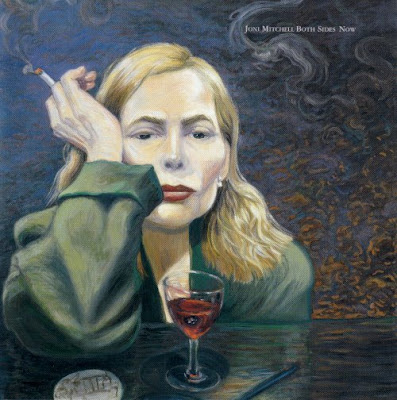
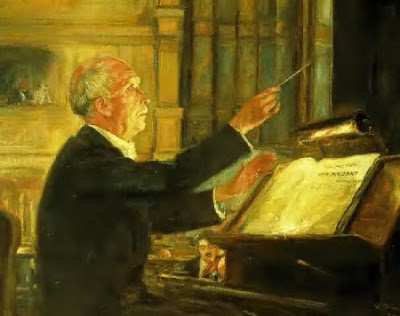
When it comes to sleeve artwork Herbert von Karajan's wife may have got it wrong. But Joni Mitchell got it right. The two images here are from her 2000 album Both Sides Now. Joni provided these superlative self-portraits for the sleeve, and she worked with Vince Mendoza, Herbie Hancock, Wayne Shorter, Peter Erskine and others to make an album which is a work of art in more ways than one.
More on Joni Mitchell the painter here, and more proof that pictures are worth a thousand words here.
Any copyrighted material on these pages is included as "fair use", for the purpose of study, review or critical analysis only, and will be removed at the request of copyright owner(s). Report broken links, missing images and errors to - overgrownpath at hotmail dot co dot uk
Music's unmerry widows

Re. Mrs von Karajan - Didn't DG issue a Karajan series featuring Eliette's own artwork? Just how wealthy and influential is this woman? BTW. What ever happend to Herbert's brother, Wolfgang? Cheers David Cavlovic
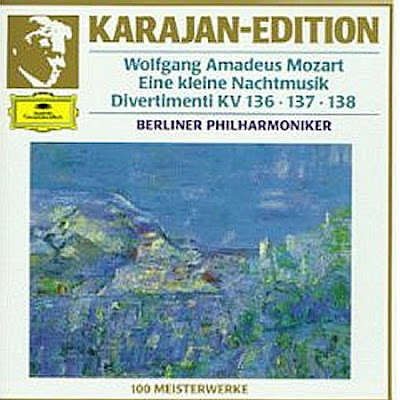
Ja wohl David. In 1981 Eliette's daubs decorated the sleeves for Deutsche Grammophon's "Karajan-Edition" in their "Galleria" series. 50 original paintings adorned as many record sleeves for music ranging from Vivaldi to Stravinsky. A sample is above, and more information and a better image is here. An estimate by Die Welt puts Eliette von Karajan's wealth at 250 million euro (£187m/$366mUS).
Wolfgang von Karajan died in November 1987. He showed considerable promise in his early career as an electrical engineer, but never really capitalised on this and later tried to make a career in music. In 1984 HvK wanted EMI to record the Art of Fugue with his brother and himself, EMI declined. There was an uneasy relationship between the two brothers as HvK disliked Wolfgang's wife intensely. Wolfgang was a very different personality to Herbert, he was reclusive and slightly eccentric. Thankfully he didn't design record sleeves.
The headline is not mine, it comes from Pierre Boulez. Read about Die Unlustigen Witwen - music's unmerry widows here.
Any copyrighted material on these pages is included as "fair use", for the purpose of study, review or critical analysis only, and will be removed at the request of copyright owner(s). Report broken links, missing images and errors to - overgrownpath at hotmail dot co dot uk