Tuesday, July 31, 2007

Youth - not a time of life but a state of mind


If you are gay, black or female the good news is your chances of making it big in classical music are definitely improving. But the bad news is if you are the wrong side of 40 your chances of hitting the big time are not looking so good.

Institutionalised age discrimination in classical music has been around for a long time. One of the most famous examples was the forced retirement of Sir Adrian Boult from the position of Chief Conductor of the BBC Symphony Orchestra when he reached the BBC's mandatory retirement age of 60 in 1949.

But more insidious is the underground age discrimination that is now starting to appear. To get a buzz going about new classical talent they must be under 40, sport an iPhone and be on Facebook, play uptown venues without seats, and have hip-hop remixes on YouTube.

The problem is all due to classical music's obsession with attracting younger audiences. (I wonder if rock musicians spend their time obsessing over how to attract older audiences?) The marketing men now say that unless the elusive youngsters can relate to the performers they won't come to the concert, or buy the CD. So, if there is a choice between a good young musician and a great older musician, the danger is the younger performer will get the nod.

This mindset appeared in a recent Newsweek interview with Christopher Roberts, chairman of Decca Label Group.

Newsweek - Have young, good-looking artists like pianist Lang Lang and opera singer Nicole Cabell helped create new audiences for classical?

Christopher Roberts - Younger artists like Nicole Cabell, Lang Lang and others move a consumer on the edges of classical music toward purchasing, especially given how easy it is to do online, with the close proximity of these artists to those from other, more traditionally mainstream genres.

We also see the mindset in statements like 'middle-aged wankers in dinner suits', in cartoon-style sleeve artwork that tries to give classical music a younger image, in young director's introducing telly talent shows into Wagner's operas, not to mention penises, and in the hyping of symphonies by 15 year olds.

When Alan Gilbert was appointed music director of the New York Philharmonic there was more media coverage of his age than of his outstanding musical credentials. The Washington Post headline summed it all up - New York Philharmonic Picks Young New Leader. If they had appointed Kurt Masur to the post again would the headline have read - New York Philharmonic Picks Old New Leader?

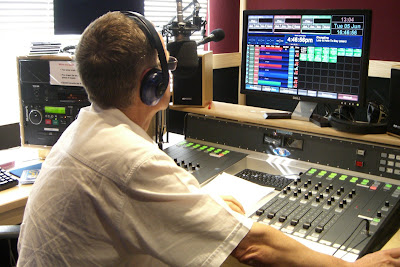
Now there are many very good young musicians around, and they have featured regularly On An Overgrown Path over the years. But there are only two conductors today who I will travel a long way to hear in concert. One is Sir Colin Davis, age 79, and the other Bernard Haitink, age 80. My header photo shows another truly great conductor, Otto Klemperer, celebrating his 86th birthday in 1971. On Sunday we marked Mikis Theodorakis' 82nd birthday here, and on internet radio. Only yesterday I wrote about the superb recordings of his own works made by Igor Stravinsky when he was in his 80s. Pierre Boulez is now 82, and last year London welcomed the 97 year old Elliott Carter, and György Kurtág celebrated his 80th birthday.

Age is also a real asset in the jazz world. Back in 2005 I wrote a profile of jazz pianist Jack Reilly when he was a youthful 73. Two years later Jack has notched up his three-quarters of a century, and his music sounds even younger. Jack's forthcoming Bill Evans inspired double CD Innocence - Green Spring Suite is some of the best jazz piano I've heard from anyone, of any age, for a long time.

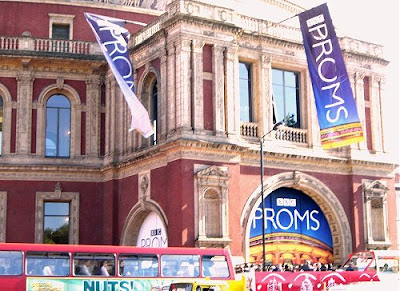
Meanwhile London is bracing itself for the tidal wave of hyperbole that Deutsche Grammophon and the BBC will unleash when the young Gustavo Dudamel, and the even younger Simón Bolívar Youth Orchestra of Venzuela, storm into town for their August Promenade Concert. I am one of the few people on the planet who didn't receive a free advance copy of their new Mahler 5 CD. But the underground buzz is that it's musical dynamite, and I'm delighted for the youngsters from Venezuela.

Personally, I have been getting a very satisfying buzz from two other Mahler recordings. Bruno Maderna's interpretation of Mahler's 9th Symphony with the BBC Symphony Orchestra is also dynamite. But Maderna made two marketing mistakes. First, he was 51 when he made the recording. Secondly he died two years later. I bet that if Maestro Maderna was under contract to a major record company today, their marketing department would never allow him to make those two elementary mistakes.

While writing this post I listened, on vinyl LPs, to another Mahler recording that really celebrates the joy of age. Otto Klemperer's recording of Mahler's Second Symphony, made in the Kingsway Hall with the Philharmonia Orchestra, is one of the classics of the gramophone. Klemperer was 78 when he made it, but it simply sweeps aside the rival recordings from young bloods such as Simon Rattle. (Rattle was 31 when he recorded Mahler 2, he is now well over the hill at 52). Klemperer's Mahler Second has never been out of the catalogue since its LP release in 1963. I wonder how many Mahler symphonies released in 2007 will still be in the catalogue in 2051?

The choice between the young and old audience is a no-brainer. Classical music needs both. But we are increasingly defining youth as a time of life, and this opens the door to age discrimination. Youth is not a time of life, it is a state of mind, as Robert Kennedy so eloquently explained:

"There is discrimination in this world, and slavery, and slaughter and starvation. The answer is to rely upon youth - not a time of life but a state of mind, a temper of will, a quality of imagination, a predominance of courage over timidity."

What better examples of that youthful state of mind than our many living musicians who have passed 40? Let's celebrate them, as well as those fortunate enough to be at the right time of life.

Now read about the perfect mix of youth and experience
Photo credit Godfrey MacDominic. Any copyrighted material on these pages is included as "fair use", for the purpose of study, review or critical analysis only, and will be removed at the request of copyright owner(s). Report broken links, missing images and other errors to - overgrownpath at hotmail dot co dot uk

Monday, July 30, 2007

Complete Stravinsky at a crazy price


Columbia have released a new compilation of the Works of Stravinsky conducted by the composer and Robert Craft. I paid £29.95 ($60) at Prelude Records for the box, you may find it cheaper online. The twenty-two CD's comprise all the stereo recordings made for Columbia with the composer conducting, one CD with Robert Craft conducting and Stravinsky in attendance, and several older recordings of works not remade in stereo by the composer. The remastering and sound is excellent, far better than earlier issues of these recordings.

When Eugene Gossens conducted Les Noces in its London premiere with the Ballet Russe in 1926, the four pianists were composers Vittorio Rieti, Georges Auric, Francis Poulenc and Vladimir Dukelsky (Vernon Duke). Stravinsky wanted to replicate this for the 1961 recording included in this set, and the pianists were the composers Samuel Barber, Aaron Copland, Lukas Foss and Roger Sessions. When invited, Lukas Foss accepted on the condition that he played Piano Number One, while Roger Sessions insisted on the easiest part. For the record (literally) Pianos One and Three were played by Lukas Foss and Samuel Barber, Two and Four by Aaron Copland and Roger Sessions.

This starry line-up was bettered by a 1966 New York performance of The Soldier's Tale which Stravinsky conducted with the speaking parts of the Narrator, the Devil, and the Soldier taken by Aaron Copland, John Cage and Elliott Carter respectively. Sadly this performance isn't in the Stravinsky box.

I'll be dipping into this set on the Overgrown Path radio programme in the autumn, Requiem Canticles (or 'Requicles' as Robert Craft called them) will be top of the list. The Works of Stravinsky are a delight from start to finish. Buy it before Sony realise they made a mistake with the price.

Now follow this path for another unmissable bargain box of CDs.
Anectdotal information from the controversial And Music at the Close: Stravinsky's Last Years by Lillian Libman (Macmillan ISBN 333143043). Photo (c) On An Overgrown Path, taken on the living room carpet a few minutes ago! Any copyrighted material on these pages is included as "fair use", for the purpose of study, review or critical analysis only, and will be removed at the request of copyright owner(s). Report broken links, missing images and other errors to - overgrownpath at hotmail dot co dot uk

Internet radio - the perfect storm


Jørgen Falck has left a new comment on the post "The political dimension of the artist":

Thank you Pliable. Your Greek birthday-concert for Mikis Theodorakis sounded beautiful here on my iTunes player, and I look forward to your next broadcasts on Future Radio (header photo). Like you I'm interested in the classical music life in general and in the radio. And yes, I am looking for alternatives.

Unfortunately we are facing a grotesque situation here in Denmark because of incompetent government policy: The Danish BBC, DR, are building a great new media house for radio and TV, including a new concert hall for the National SO by the architect Jean Nouvel. However, the financial costs of this house are so overwhelming that the government has forced DR to sack a lot of their best employee's, and to make sharp cuts in the programs as well.

The results are all to clear: Repeat broadcasts and common repertoire in huge quantities, Mozart, Beethoven and Mozart again and again.

Therefore, instead of this misery me and other Danish music lovers are tuning in to the Internet's radio world. That's how I found your Overgrown Path and the Radeo site. And thats how I became a daily listener to the excellent Norwegian station Alltid (Always) Klassisk. If not a Danish, I must have a Scandinavian favourite, after all.


Thank you Jørgen, glad you enjoyed the Skalcottas and Theodorakis. Overgrown Path radio will broadcast every Sunday at 17.00h British Summer Time. As I have said before - this is the future of radio. And the perfect storm gathers strength.
Any copyrighted material on these pages is included as "fair use", for the purpose of study, review or critical analysis only, and will be removed at the request of copyright owner(s). Report broken links, missing images and other errors to - overgrownpath at hotmail dot co dot uk

Sunday, July 29, 2007

The political dimension of the artist


'So it is a question of with whom you want to communicate. It must be a free person for an artist can only communicate with free people. Yet in order to be free that person must have solved certain problems. He must have a job, he must be educated and in good health, he must have certain rights and dignity. I, as an artist, would like to have an interchange with such a person. You can't create art with slaves, no matter whether they were forced into slavery or made to adopt a slavish attitude. At this point the political dimension of the artist comes into force. He must contribute to the rescue of mankind out of pure self-interest.'

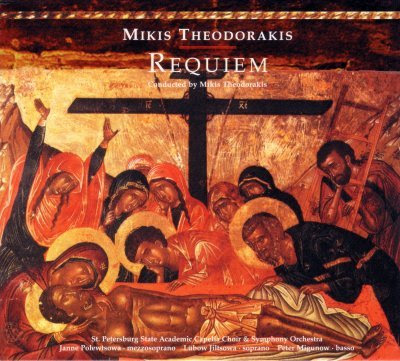
Mikis Theodorakis was born on July 29th 1925 on the Greek island of Chios, and his words above are from the sleeve notes for his own recording of his Requiem. The concept of 'free people' resonates strongly for Theodorakis. He had fought in the resistance against the occupying Fascists in World War 2, and was exiled in the subsequent Greek Civil War. He then studied music at the Athens Conservatoire, and in Paris with Olivier Messiaen.

Following the Greek military junta in 1967 Theodorakis went underground, and his music was banned by military decree. He was imprisoned for five months until an international pressure group including Dmitri Shostakovich, Leonard Bernstein, Arthur Miller, and Harry Belafonte achieved his release, and he went into exile in April 1970. Theodorakis continued his opposition in exile through concerts and by enlisting the support of international leaders.

After the fall of the Colonels, Theodorakis returned to Greece, and took an active part in politics on a left wing ticket. He was elected to the Greek Parliament twice, and became a minister in the government in the early 1990s.
He was nominated for a Nobel Peace Prize in 2000, and opposed both NATO’s involvement in Kosovo and the invasion of Iraq, and has been publicly critical of the policies of George W. Bush.

Mikis Theodorakis is best known for his music for the cinema, notably for his sound-track for Constantin Costa-Gravas' film Z which became a rallying call for opponents of the military regime, and for the film of Nikos Kazantzakis' novel Zorba the Greek which became a sound-track for tourism in Greece. But there is a lot more to Theodorakis' music, including five published symphonies, a string quartet, a Requiem, and five operas.

His 1984 Requiem sets the words of the 6th century Syrian monk John of Damascus. The structure of the work follows the Orthodox Mass for the Dead, and is quite distictinct from the more common Roman Catholic and Protestant requiems. Theodorakis is best known for his music for the theatre, and his Requiem is theatrical as well as sacred music.


Although rooted in the Orthodox rite it uses elements which are not permitted in the Orthodox liturgy - children's and women's voices and a full symphony orchestra, and builds Western polyphony and harmony on a Byzantine foundation. But this is most definitely spiritual music. Although sacred music started moving from the church to the concert hall in Haydn's time, Theodorakis' Requiem, thankfully, does not move as far into the concert hall as Leonard Bernstein's Mass - A Theatre Piece for Singers.

An excellent recording of Mikis Theodorakis' Requiem is available, with the composer conducting (photo below) the St. Petersburg Academic Capella Children's Choir, Choir and Symphony Orchestra. The recording was made in 1997 in the Capella Concert Hall, St. Petersburg, and is on the German Intuition Classics label, as are many other CDs of Theodorakis' music. You can read about Mikis Theodorakis' songs of freedom on this path.


Predictably BBC Radio 3 is not marking Mikis Theodorakis' birthday today, instead they are presenting that rarest of twentieth century music, a Shostakovich symphony. So I will make some small amends on my Overgrown Path programme on Future Radio this afternoon by playing the concluding six movements of Theodorakis' Requiem, plus the Greek Dances of Nikos Skalkottas, who studied with Schoenberg.

The programme is broadcast between 5.00pm and 6.00pm British Summer Time on Sunday July 29 (and following Sundays) and is available on web radio. Convert on-air times to your local time zone using this link. Click here for the audio stream. Windows Media Player doesn't like the stream very much and takes ages to buffer, WinAmp or iTunes handle it best. Unfortunately the royalty license doesn't permit on-demand replay, so you have to listen in real time. If you happen to be in the Norwich, UK area tune to 96.9FM

Today's broadcast and the following week (Aug 5) are test transmissions, and will be identified as such. The station launches on August 6, and here is the provisional forward schedule for Overgrown Path radio with links to the blog articles they are based on. Unless indicated all works will be played complete:

July 29 (test) - The political dimension of the artist: Nikos Skalkottas Seven Greek Dances, Mikis Theodorakis Requiem (excerpts).

Aug 5 (test) - The American Symphony: William Howard Schuman Symphony No.5 (Symphony for Strings), Aaron Copland Short Symphony, Alan Hovhaness Symphony No. 2 "Mysterious Mountain".
Aug 12 - Brain Music: Thea Musgrave Helios, Howard Skempton Lento, William Alwyn Symphony No. 5 "Hydriotaphia".
Aug 19 - Pierre Boulez - great bogeyman of 20th century music: Boulez Messagesquisse, Gyorgy Ligeti Violin Concerto, Boulez Rituel in Memoriam Bruno Maderna.
Aug 26 - Malcolm Arnold - Neglected 20th century master: English Dances, Set 1, Guitar Concerto, Four Scottish Dances, Symphony No. 5 (last movement).
Sept 2 - American minimalists: Terry Riley Cortejo Fúnebre en el Mont Diablo from Requiem for Adam, John Adams Shaker Loops, Terry Riley The Philosopher’s Hand, Terry Riley – In C (excerpt).
Sept 9 - The eternal feminine: Beata Moon Piano Sonata, Elizabeth Maconchy String Quartet No 5, Elisabeth Lutyens Wittgenstein Motet, Vanessa Lann – Dancing To An Orange Drummer.
Sept 16 - Contemporary sacred music: Judith Weir All The Ends of the Earth, Morten Lauridsen – Lux Aeterna, Salve Regina (Gregorian Chant), Bayan Northcott Salve Regina, Morten Lauridsen – O Magnum Mysterium.
Sept 23 - Music of Lou Harrison: Varied Trio, Piano Concerto, Kunsonoro kaj Gloro (excerpt from La Koro Sutro).
Sept 30 - Benjamin Britten - music does not exist in a vacuum: Concerto for Violin, The Young Person's Guide to the Orchestra.
Oct 7 - New music from the Baltic: Pehr Henrik Nordgren Equilibrium for 19 strings, Peteris Vasks Botschaft (Message), Per Nogard Constellations.

This is going to be real 'post-ratings radio 2.0. You can even see Pliable on the studio webcam, and send messages to the studio via the Future Radio website. To paraphrase Mikis Theodorakis this is my tiny contribution to "the rescue of mankind out of pure self-interest". Or as Libby Purves wrote - "ratings have to be watched, but calmly and with a sense of proportion. You have to believe that if even one person is swayed, or inspired, or changed, or comforted, by a programme, then that programme has been worthwhile". As ever comment, on both the schedule and transmissions if you can catch them, are welcome.
Any copyrighted material on these pages is included as "fair use", for the purpose of study, review or critical analysis only, and will be removed at the request of copyright owner(s). Report broken links, missing images and other errors to - overgrownpath at hotmail dot co dot uk

Saturday, July 28, 2007

BBC Proms - you thought it couldn't get worse?


Report in The Sun - 'It's gonna be classic on BBC2 - The BBC is launching “Proms Idol” — where celebs will compete for the chance to conduct an orchestra. Eight stars will learn how to wield a baton in Maestro. And the winner of the BBC2 show will take charge of an orchestra during the Last Night Of The Proms at the Royal Albert Hall next year. Channel 4 fave Jon Snow is believed to be in talks with producers to host it. A source said: “The winner will get a great prize.They’ll have to train hard, but it will be worth it.”'

I honestly had to check the Sun article several times to make sure this story wasn't a leg-pull. Is this really 'making great music available to all' as Proms director Nicholas Kenyon claims?

Any copyrighted material on these pages is included as "fair use", for the purpose of study, review or critical analysis only, and will be removed at the request of copyright owner(s). Report broken links, missing images and other errors to - overgrownpath at hotmail dot co dot uk

Middle-class wankers in dinner suits ...


Today's Guardian reports - "In the late-80s, when Factory Records launched its classical off-shoot, Tony Wilson vowed to wrestle classical music away from "middle-class wankers in dinner suits". Twenty years on, despite Factory and numerous embarrassing attempts to sell classical to the yoof and ageing rock stars dabbling in everything from opera to light chamber music, classical remains a dusty, dying art form. You can put William Orbit's orchestral work on at the Manchester International Festival or let Radiohead's Jonny Greenwood write for the BBC Concert Orchestra, but you can't make anyone under 40 care.

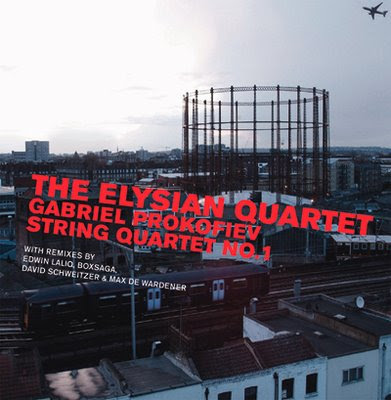
Gabriel Prokofiev is aware of this, but refuses to concede defeat. The man behind Nonclassical, a label and London club night, he is bucking the downward trend by returning classical music to its populist roots. Which means moody sleeve designs instead of laborious liner notes and live events where you can get pissed and talk over the crap bits, trading ideas - as Mozart once borrowed from folk - with dance music.

From anyone else, this - programming string quartets with electronica DJs and such - might look contrived, but Prokofiev is a uniquely credible broker. The grandson of Russian composer Sergei Prokofiev, he studied classical music to post-grad level before, frustrated with the insular world of contemporary classical music, chucking it all in to pursue various underground dance music projects. Under his patronymic Gabriel Olegavich, he heads-up the mighty disco-punk outfit Spektrum, records off-beam electro as Caspa Codina and has produced leftfield tracks for Lady Sovereign and Manchester MC Envy.

Well versed in the similar politics of classical music - "if you said anything was 'crossover' you'd be stoned to death" - and cutting-edge electro, Gabriel is determined not to produce a "patronising" hybrid of the two.

The first section of the latest Nonclassical CD contains four stark, challenging movements, written by Prokofiev and performed by the Elysian Quartet, which contain echoes of the excitable, repetitive patterns of techno. Those same tracks are remixed by Hot Chip, Conboy and US grime producer Starkey, who improvise hiccuping grooves from plucked strings and such. It's interesting, abrasive and, particularly UK hip-hop head EarlyMan's remix, outright joyous.

Currently working on Concerto for Turntables & Orchestra, a collaboration with the Heritage Orchestra and turntablist DJ Yoda, Prokofiev argues that only by engaging with popular culture can classical music attain a new common vitality.

"I'm not on a mission for classical music per se," Gabriel swerves, unconvincingly, "but it is an amazing tradition. There are things about it which are really special: the incredible instruments that have evolved, the performers who train like maniacs. Dancing to a mechanical beat is thrilling, but so is a really sensitive classical performance. Plus, so many clubs and radio stations play the same stuff, but the general public can handle complicated music."


Report from Guardian, Gabriiel Prokofiev's String Quartet No. 1 on YouTube here, listen to remixes of his String Quartet No. 2 here, and for Prokofiev for middle-class wankers in dinner suits follow this path.
Any copyrighted material on these pages is included as "fair use", for the purpose of study, review or critical analysis only, and will be removed at the request of copyright owner(s). Report broken links, missing images and other errors to - overgrownpath at hotmail dot co dot uk

The end of ghettoising contemporary music?


On An Overgrown Path July 27 Pliable writes - "August 4, 3.00pm, a fine programme of excellent 20th century music at a silly time in a silly place. Elizabeth Maconchy's Music for Strings and Gerald Finzi's Clarinet Concerto (plus Elgar and Grieg) are marginalised to an afternoon concert in the Cadogan Hall, to make way for what in the Albert Hall in the evening? - yet another Shostakovich symphony."

Guardian July 28 Andrew Clements writes - "It's Nicholas Kenyon's last year as controller of the Proms, so the end of ghettoising contemporary music at London's summer music festival may finally be in sight. Over the last 10 years Kenyon has coralled more demanding new works into the hapless late-night slot, ensuring that he can serve populism in the main concerts. This week's late-night offering illustrates the problem perfectly: the programme by Susanna Malkki with the BBC Singers and the London Sinfonietta consists of a UK premiere and a London premiere; that those works are by Pierre Boulez and Sir Harrison Birtwistle, two of today's leading composers, is apparently irrelevant. As a result only a fraction of the potential audience will hear the latest version of Boulez's work-in-progress, Dérive 2, and Birtwistle's luminous choral setting of Pablo Neruda's ode: another opportunity to champion the finest music of today has been ducked."

But will the ghettoising of contemporary music really end under under Nicholas Kenyon's successor Roger Wright? Pigs may fly.
Before anyone writes, it was Andrew Clements who turned 'ghetto' into a verb, not me. Any copyrighted material on these pages is included as "fair use", for the purpose of study, review or critical analysis only, and will be removed at the request of copyright owner(s). Report broken links, missing images and other errors to - overgrownpath at hotmail dot co dot uk

Friday, July 27, 2007

Giving classical music a younger image?


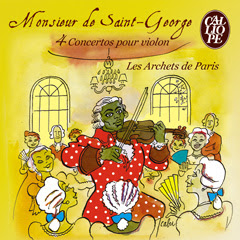
William J. Zick, who writes the excellent Africlassical.com, has taken exception to the cover art by French cartoonist Cabu on the new Calliopé release of the music of the Afro-French composer Le Chevalier de Saint-Georges (Calliope 9373). You can see the artwork above, and William describes it as 'disturbing and bordering on ridicule.'

Here is Alain Guédé replying on behalf of the French label Calliopé: - 'Our idea was to use the cover as a means of bringing Saint-George – and through him, classical music in general – to an even wider public, of people from all different backgrounds. We want to give classical music in France a younger image. And I feel that the same thing can be done in the States.'

'Bordering on ridicule' or 'giving classical music a younger image'? Over to you, readers ....
Any copyrighted material on these pages is included as "fair use", for the purpose of study, review or critical analysis only, and will be removed at the request of copyright owner(s). Report broken links, missing images and other errors to - overgrownpath at hotmail dot co dot uk

BBC Proms - a refreshingly adventurous week


Here are Pliable's personal picks for the coming week's BBC Proms. All Proms are available for seven days online, detailed programmes and broadcast times for every concert are available from the BBC web site.

* July 30, 7.30pm - a refreshingly adventurous week starts with the European premiere of Esa-Peka Salonen's Piano Concerto, the pianist is Yefim Bronfman with the composer conducting the BBC Symphony Orchestra. The BBC Symphony has two guest conductors in two concerts this week while chief conductor Jiri Behlolavek picnics at Glyndebourne.

* July 31, 7.00pm - regular readers will know I am a big fan of the BBC Scottish Symphony Orchestra and their young chief conductor Ilan Volkov. These days their music making often overshadows the flagship BBC Symphony, which probably has something to do with the fact that the Scottish band lives and works four hundred miles away from the London BBC Radio 3 offices. The BBC Scottish gives two Proms this week, and what concerts! Tonight's includes Britten's too rarely heard Piano Concerto with Scottish pianist Steven Osborne, and Varèse's Ecuatorial.

* July 31, 10.00pm - we could almost be back in the heyday of William Glock, with a late-night Prom of path man-of-the-moment Pierre Boulez's Dérive 2 (UK premiere in the revised version), and Birtwistle's Neruda Madrigales (London premiere). Susanna Mälkki conducts the London Sinfonietta and BBC Singers.

* August 1, 7.30pm - and it gets even better. Tonight's BBC Scottish Prom is an almost perfectly balanced programme of Kurtág's Stele and Mahler's Ninth Symphony conducted by Ivan Volkov. (For another interesting Mahler 9 pairing follow this link.) Not only is this concert my pick of the 2007 Proms, it also takes the Overgrown Path award for the shortest first half ever - 14 minutes.

* August 2, 7.00pm - the premiere of David Matthews' Symphony No. 6 is well worth catching. Matthews has a refreshingly low profile, but writes some fine music - catch it if you can. Jac van Steen conducts the BBC National Orchestra of Wales. I think I am right in saying Jac is the brother of the pianist Jeroen van Steen who also featured here recently.

* August 4, 3.00pm - a fine programme of excellent 20th century music at a silly time in a silly place. Elizabeth Maconchy's Music for Strings and Gerald Finzi's Clarinet Concerto (plus Elgar and Grieg) are marginalised to an afternoon concert in the Cadogan Hall, to make way for what in the Albert Hall in the evening? - yet another Shostakovich symphony.

* August 4, 6.30pm - As well as that Shostakovich Leningrad symphony Mark Elder conducts the National Youth Orchestra of Great Britain in Aaron Jay Kernis' New Era Dance. Kernis, who worked with John Adams, became known in the UK in the 1990s when Argo recorded several of his works, I have his Grammy nominated Second Symphony (Argo 4489002) which has the interesting coupling of his Musica Celestis for string orchestra; the composer cites Hildegard of Bingen as an influence on this work, but to my ears early Arvo Pärt also got into the mix. Aaron Jay Kernis' New Era Dance is very much in step with the new era proms, it lasts for just six minutes.

Any copyrighted material on these pages is included as "fair use", for the purpose of study, review or critical analysis only, and will be removed at the request of copyright owner(s). Report broken links, missing images and other errors to - overgrownpath at hotmail dot co dot uk

Thursday, July 26, 2007

Boulez - great bogeyman of 20th century music


Henry Holland has left a new comment on the post "Boulez - Rituel In Memoriam Maderna":

Ah, one my favorite Paths of yours Pliable since I started to read OAOP two (three?) years ago. I love Rituel in Memoriam Maderna, I listened to it on my iPod a few weeks ago. I wish that there was more than one official recording of it or I could find some live versions on my usual file theft sites. I know Boulez is The Great Bogeyman of 20th Century music along with Schoenberg, and while I certainly don't like all of his pieces, there are some that are among my favorite pieces of music.

I went to a performance of Pli selon Pli at the Concertgebouw when I was in Amsterdam recently and despite the excellent performance by the ASKO Ensemble and Barbara Hannigan I wasn't impressed by the piece all that much; I hadn't heard it in a while.

I keep hoping that a performance of the amazing Repons will take place in the US so I can easily afford to travel to hear it but it's obviously very complicated to do in a live situation.

About 15 years ago (?) Mr. Boulez conducted the four Notations that he had then completed the orchestral versions for here in Los Angeles with the Philharmonic and it was one of the most stunning things I've ever heard in a concert hall. The Phil back then could just barely play the pieces (they'd have no problem now that Mr. Salonen has whipped them in to shape) but what stunning music. I've really wanted Mr. Boulez to come back and conduct here, anything will do, but he hasn't been here in at least a decade. I wonder if he and Mr. Salonen had a falling out? :-(

Great picture of the set-up for the Gruppen premiere and what handsome men Boulez and Stockhausen are in the bottom picture. There's apparently going to be a book about the gay aspect of the Darmstadt group appearing soon and while I will buy it instantly, I'm also afraid that the revelations in it will be used to browbeat that group, much like if you read some of the criticism of Britten in the 40's-70's, there's a barely disguised layer of homophobia to it. As if a lot of people needed the gay angle to denigrate the Darmstadt composers, any excuse along the lines of "they killed classical music" will do! :-)


Thanks for that diversion Henry. Now follow this path for the funny side of Darmstadt, and my picture shows more handsome men there, from left to right, Luigi Nono, Pierre Boulez and Karlheinz Stockhausen.
Any copyrighted material on these pages is included as "fair use", for the purpose of study, review or critical analysis only, and will be removed at the request of copyright owner(s). Report broken links, missing images and other errors to - overgrownpath at hotmail dot co dot uk

Hip hop hooray!


Good to see the Guardian following the Overgrown Path.
Any copyrighted material on these pages is included as "fair use", for the purpose of study, review or critical analysis only, and will be removed at the request of copyright owner(s). Report broken links, missing images and other errors to - overgrownpath at hotmail dot co dot uk

European politicians catch classical music bug

In the audience for yesterday's Bayreuth Festival performance of Die Meistersinger von Nürnberg were German chancellor Angela Merkel and the president of the European commission, José Manuel Barroso. In the audience at the recent Orchestra of the Age of Enlightenment anniversary concert in London was the new UK culture secretary James Purnell. European politicians are catching the classical music bug, as two articles from the official EU website, which I have combined below, confirm:


'Among the ranks of MEPs are two concert pianists - Lithuanian Vytautas Landsbergis (above left) and Luxembourg's Erna Hennicot-Schoepges (above right). This week we speak to them both to get their views on the relative merits of piano playing and being an MEP.

Erna Hennicot-Schoepges has been a leading politician in Luxembourg since the 1970's - mainly through her involvement in cultural policy. She has also held the post of Cultural Minister of Luxembourg. She is also - like fellow MEP Vytautas Landsbergis - a highly skilled pianist. We spoke to her about her experiences in the cultural field - both on a national level and in the European Parliament where she sits as an MEP for the European People's Party and European Democrats.

Vytautas Landsbergis shot to prominence in the late 80's as the leader of Lithuania's independence movement from Soviet rule. He was the county's first post-Soviet leader before becoming an MEP. Prior to both of these he was a concert pianist.

Are musical and political skills comparable?

- Music and politics are complementary. A piece of music obliges one to start from scratch every time. This calls for a significant amount of discipline and an attitude of humility because irrespective of the music level reached, every piece is a fresh challenge each time. Playing music requires working consistently and insistently. What is lacking in politics is certainly harmony and colours, the art of looking at details and of observation and feeling. The danger of politics lies precisely in the potential loss of one's character and the acquirement of wooden language. Citizens are horrified by these empty words which consist of speaking but saying nothing.

- Skills are mental and physical. When talking about music we usually have physical abilities and their preservation and improvement in mind. Nevertheless, mental skills like memory and ideas for performance are following the music during all the moments. One can prepare a well known repertoire for a concert without practicing for a long time - performance is more than repetition. In the European Parliament sometimes you have to prepare for the meetings when you are at the meeting. Preparation is in one's head, unless the questions discussed are completely new.

Should politicians stay out of or support the arts?

- One should not confuse culture with art. One forms part of the other but culture is profound. It differentiates us from other species and gives us especially in Europe a better knowledge of others and a predisposition to dialogue. In art politics should not interfere in the content but politics must ensure the conditions to carry it out. Negative examples of political interference in art like in Nazism and Communism are still fresh in our minds. Back then art was encouraged and financed to ensure national glory, but at the cost of interference in its contents. In the EU we are now at a crossroads. Those countries of the EU which did not experience communism knew insufficient financing and poor, unstructured social conditions for artists. In other countries which knew generous financing, artists have seen a regression in their material conditions. Freedom requires a terrible sacrifice. For liberty one has less money. Thus the Union today must arrive at a balance. The other model is that of the USA where culture is completely privatised and sponsors influence the contents

- Patronage and care about conditions of creation and expression does not necessarily mean interference. We used to live in a regime that was interfering with everything, including the art, but it met insurmountable obstacles, such as music. Just remember the party's decision on good and bad music taken during Stalinist times. It wasted time and created some rubbish. Interference with art is wrong, nevertheless if politicians care about art it does not automatically mean interference.

You personally know the price of freedom and democracy - what is your message to people who are not inclined to vote?

- Non-voting means treason towards representative democracy. It is a paradox. We're re-establishing independence through democracy and won a right not to mechanically vote, but rather choose. If people do not cherish democracy, do not want to participate in it then they can loose it. Sometimes people have to pass democracy exams and defend their elected governments using direct democracy - like in Lithuania in January 1991.

What about those who compare the European Union to the Soviet Union?

- It is hard to speak to ignorant people who confidently repeat clichés. This mental barrier can be overcome by acquainting with the facts on the spot. For example by organising visits to the EU institutions, showing how debates are conducted. Have the people forgetten about the Soviet dictatorship? The Soviet Union was no union, just a falsified Orwelian entity. There was no socialism – the state became a capitalist exploiting workers.

Aside from music, culture is of great importance to you. What do you hope to achieve in this field in the Parliament?

- In Luxembourg I was a Culture Minister - in Parliament I can speak about and say things that others cannot say because they do not know the issue in depth. My goal is to ensure that culture is admitted as a policy field in its own right. It is also a wide subject like the environment. One can speak about culture in law, industry and education. Culture is everywhere.

In your experience, how compatible are artistic and political lifestyles?

- The political world is very creative and is like art in that respect. I chose politics firstly to show that a musician can bring lots of ideas to politics. Secondly, as a woman in Luxembourg a lot remained to be done back then as is still required today in the field of male-female equality and the combination work-family today.

Finally, what is your favourite piece of music?

- A delicate question indeed...but one of my many favourites includes the Goldberg Variations of Bach.

- It is hard to name a single one. My favourite composer is M. K. Čiurlionis.'


* Biography and music samples of M. K. Čiurlionis via this path - he is a real discovery. Music really can help change the world.
Any copyrighted material on these pages is included as "fair use", for the purpose of study, review or critical analysis only, and will be removed at the request of copyright owner(s). Report broken links, missing images and other errors to - overgrownpath at hotmail dot co dot uk

Wednesday, July 25, 2007

Pliable's picks at BBC Prommers' World


All credit to the BBC. On An Overgrown Path is currently featured on the BBC Prommers World website.
Any copyrighted material on these pages is included as "fair use", for the purpose of study, review or critical analysis only, and will be removed at the request of copyright owner(s). Report broken links, missing images and other errors to - overgrownpath at hotmail dot co dot uk

A fresh face in the house of Wagner


Today's Guardian reports - The 29-year old great-granddaughter of the German composer Richard Wagner will face a crucial moment in her young career tonight when her production of the nation's most controversial opera is staged for the first time. The critical success or failure of Katharina Wagner's (above) Bayreuth Festival debut will not only decide on the future of what is arguably one of the most important musical extravaganzas in the world, but also on who takes pole position in the Wagner dynasty.

Everything depends on the reactions to her production of Die Meistersinger von Nürnberg - from the critics and from those of her father and festival head, 87-year-old Wolfgang Wagner. If the opera is thought a success, she is likely to be chosen by the Wagner Foundation as the successor to the Richard Wagner throne.


The 2007 Bayreuth Festival performances, including today's Die Meistersinger von Nürnberg, are being webcast on Polskie Radio Dwoja, Warsaw. Click here to listen via the Radeo internet player, and here for schedules. And for more on the Wagner dynasty follow this path.

Picture credit MorgenWeb, and what a change to run a Bayreuth story that doesn't use a picture of Wolfgang Wagner or Hitler! Any copyrighted material on these pages is included as "fair use", for the purpose of study, review or critical analysis only, and will be removed at the request of copyright owner(s). Report broken links, missing images and other errors to - overgrownpath at hotmail dot co dot uk

BBC - deeply damaging to the brand

Music and the spirit of place On An Overgrown Path June 19 2007 - 'The BBC Proms are no longer a music festival, they are a global entertainment brand that stands for audience friendly and risk averse programming.'

House of Commons culture committee sitting reported in Guardian July 25 2007 - 'Mark Byford, deputy director general of the BBC, met the committee with a lethal blend of apology and jargon. Gosh, he was sorry. What had happened with the phone-in shows was "utterly unacceptable". Deceiving the public was "not on"; there was a line, and it could under no circumstances be crossed. The whole event had been "deeply damaging to the brand" - and we realised that the BBC, like Marmite and Nike, has become another "brand". '

And let's all remember classical music is not a brand.
Any copyrighted material on these pages is included as "fair use", for the purpose of study, review or critical analysis only, and will be removed at the request of copyright owner(s). Report broken links, missing images and other errors to - overgrownpath at hotmail dot co dot uk

Tuesday, July 24, 2007

Bring me cellos. And some cannons ...


* Media Guardian reports - 'Classic FM has signed Blur bass player Alex James to present a show looking at how classical music has influenced pop. The Britpop star turned newspaper columnist and organic farmer will front When Classic Meets Pop, a three-part series beginning on the GCap music station on August 4.

It is the latest addition to the When Classic Meets ... series, which has previously featured Rick Wakeman and Courtney Pine looking at the influence of classical music on rock and jazz music. "Why would I want to listen to Hard-Fi piffling around when there is Rossini?" said James. "Bring me cellos. Bring me French horns. Bring me a choir. And some cannons, maybe, for the end."

Classic FM, which was named station of the year at this year's Sony awards, attracted an audience of 5.71 million in the first three months of the year, according to the latest Rajars. The Classic FM managing director, Darren Henley, said: "As a founder member of one of Britain's foremost pop groups, Alex is uniquely placed to chart the influence classical music has had on the genre." When Classic Meets Pop will feature classically inspired songs such as Barry Manilow's Could It Be Magic, Eric Carmen's All By Myself and The Farm's Altogether Now.'


* BBC presenter Libby Purves writes - 'To run radio you must be like an old-fashioned publisher, a 1930s Gollancz or Faber and Faber, working on faith and idealism and wanting to share what you yourself love. All that you can do is make - and publicize - the best and most passionately well-crafted programmes you can think of. Ratings have to be watched, but calmly and with a sense of proportion. You have to believe that if even one person is swayed, or inspired, or changed, or comforted, by a programme, then that programme has been worthwhile.'

Now read about the circus opera from another member of Blur
Libby Purves quote from Radio, A true Love Story (Coronet Books ISBN 0340822422). Aa well as talking a lot of common sense this book is a wonderful chronicle of a career in broadcasting. Libby was one BBC training course ahead of me in the early 1970s. Any copyrighted material on these pages is included as "fair use", for the purpose of study, review or critical analysis only, and will be removed at the request of copyright owner(s). Report broken links, missing images and other errors to - overgrownpath at hotmail dot co dot uk

Monday, July 23, 2007

Boulez - Rituel In Memoriam Maderna


Bruno Maderna was a close friend of Pierre Boulez. In 1958 Boulez and Maderna were conductors of two of the three orchestras in the fraught premiere of Karlheinz Stockhausen's Gruppen, the third orchestra was directed by the composer. My picture above, from the Stockhausen archive, was taken at a rehearsal for the premiere in Cologne. Left clicking on the image will enlarge it. Stockhausen is conducting orchestra 1 on the left, Maderna orchestra 2 in the centre, and Boulez orchestra 3 on the right. The photo at the foot of the article shows Boulez, Maderna and Stockhausen in Darmstadt in 1956, and, interestingly, was taken by Hans Keller. .

Maderna's relationship with the BBC Symphony Orchestra was established before Boulez's period as the orchestra's chief conductor, and was one of the many fruits of William Glock's period as BBC Controller of Music between 1959 and 1972. Maderna made his debut with the orchestra in 1959 when he gave the first public performance in Britain of Schoenberg's Op. 22 Songs, together with the symphonic extracts from Berg's Lulu and Stravinsky's Les Noces.

Maderna conducted the BBC Symphony in the notorious premiere of Luigi Nono's uncompromisingly left wing opera Intolleranza at the 1961 Venice Biennale. Protests included stink bombs thrown at the orchestra in the first act, and after the interval Maderna turned up the volume of the pre-recorded chorus parts to drown out the dissenters. In those pre-Classic FM days the BBC relayed the performance live from Venice.

In his invaluable autobiography Notes in Advance (OUP ISBN 0198161921) William Glock writes ~ Maderna himself was one of the most sympathetic human beings I have known, a man of great warmth and amplitude, always generous to other musicians without being blind to their failings. A familiar sight (at Dartington) was to see him with a bottle of wine under each arm and a hamper of food, which he would then cook and devour with friends with the gusto that marked everything he did. As a conductor he achieved authority and friendliness together, and would congratulate individual players on some felicitous phrases in their performance. But, though he was a leader of the avant-garde to whom many others such as Luigi Nono owed a great deal, he did not shut himself away from the music of the past, and more than once I played the Mozart Sonata for two pianos with him, and saw the way he revelled in it".

In 1970 Maderna premiered his Quadrivium with the BBC Symphony, a performance that prompted a perceptive critic to describe the work as - "a large piece, around half an hour long, full of exuberant, romantic, well-wined music, expertly constructed, beautifully scored." Maderna was a regular guest with the orchestra while Boulez was chief conductor, and it was during this period that I was fortunate to see Maderna conduct. I have already praised his Mahler Ninth here which I heard in the 1972 Proms, an interpretation which critic Dominic Gill described as - "both convincing and moving. In human, dramatic terms often very impressive...the final pages were absolutely right." Maderna was also a champion of Elisabeth Lutyens, and programmed her Music for Orchestra 1 with the BBC Symphony.

In March 1972 Boulez conducted Maderna's Aura in place of a new work of his own which was unfinished. In the autumn of that year Maderna was to have conducted a BBC Symphony concert including his Third Oboe Concerto, but he fell seriously ill and withdrew. In November 1972 Maderna died, and this tragedy provided the inspiration for Boulez to complete his unfinished commission.


Rituel in Memoriam Maderna is one of a series of musical memorials by Boulez, which include the Tombeau added to Pli selon pli for Prince zu Fürstemberg, ..explosante - fixe... for Stravinsky, and Messagesquisse for Paul Sacher. Rituel is scored for eight separate groups of instruments, including double percussion in one group. The clarity of structure and Eastern sounding percussion makes Rituel one of the most accessible of Boulez's compositions, and William Glock described it as "the majestic processional in memory of Bruno Maderna". The photo above shows Pierre Boulez at the BBC Maida Vale studios in 1969, before a rehearsal for the premiere of Pli selon pli with the BBC Symphony.

The premiere of the BBC commissioned Rituel in Memoriam Maderna was given by Pierre Boulez and the BBC Symphony Orchestra in April 1975. In November 1976 Boulez and the orchestra recorded the work for CBS in the Henry Wood Hall, London. The fine recording, produced by Paul Myers and Roy Emerson and engineered by Bob Auger, is still in the catalogue at mid-price. It still sounds wonderful, and is highly recommended both as a valuable document of Pierre Boulez the composer, and a moving tribute to Bruno Maderna the musician. The CD couplings of Eclat and Multiples were recorded with Boulez and the Ensemble InterContemporain at IRCAM in Paris.

Staying with Pierre Boulez, IRCAM and the Ensemble InterContemporain, Deutsche Grammophon has just re-released important recordings of three of his later works, Sur Incises (1996/1998), Messagesquisse (1976-1977) and Anthèmes (1997). The CD was recorded in Paris in 1999 with the composer conducting the Soloists of the Ensemble InterContemporain in the first two works. Wonderful music, wonderfully recorded, and in today's crazy music market it is retailing in the UK for just £6.99 ($13). Both this re-release and the CD of Rituel In Memoriam Maderna are musts, both for card carrying Boulez fans, and for any readers who haven't yet been fortunate enough to discover his special sound world.


For more Bruno Maderna resources follow this path,
Picture credits. Pictures 1 and 3 Stockhausen archive, picture 2 BBC. Nicholas Kenyon's excellent book The BBC Symphony Orchestra contains invaluable listings of the premieres given by that great orchestra. Any copyrighted material on these pages is included as "fair use", for the purpose of study, review or critical analysis only, and will be removed at the request of copyright owner(s). Report broken links, missing images and other errors to - overgrownpath at hotmail dot co dot uk

Sunday, July 22, 2007

Hip hop's debt to classical music


"An interesting, possibly even dirty, little secret about hip hop is how often its producers turn to classical music when they’re trying to make whatever joker they’re producing sound, at least momentarily, like a god. From solemn East Coast legends like Nas to party MCs like Ludacris (before his disastrous Grammy makeover), plenty of rappers have skimmed grandeur off of classical music; what follows are just a few examples of this odd meeting point between two disparate art forms" - writes Jayson Greene in Stylus Magazine, and then goes on to identify the top ten classical music samples in hip hop.

Now read the unlikely story of Malcolm Arnold and the rock idols.
Image credit Orange and Blue. Any copyrighted material on these pages is included as "fair use", for the purpose of study, review or critical analysis only, and will be removed at the request of copyright owner(s). Report broken links, missing images and other errors to - overgrownpath at hotmail dot co dot uk

BBC Proms - dumbing down is contagious

Today's Observer seems determined to follow the BBC down the slippery slope to editorial oblivion. No less than two pages are devoted to a vacuous article whose title, 'From Iggy to Gigli: my journey to the Proms', says it all. Observer journalist Sean O'Hagan is given some free tickets to help puff the BBC Proms to the crossover audience, and reports: - At other times, though, I was totally baffled by what I was hearing. And some of it was simply was too much to take in, particularly, though it pains me to say it, the more modern stuff: Adams's Symphony No 4, and especially Sam Hayden's cacophonous Substratem.

If we ignore the misspelling of Sam Hayden's Substratum and a later incorrect reference to the "Soweto String Quartet", I am sure John Adams' would be surprised to learn that he has written four symphonies, and even more surprised to find one of them confused with Charles Ives Symphony No. 4, which was in fact performed in the July 17 Prom.

But as another journalist and BBC presenter, the inimitable Norman Lebrecht, recently wrote: - Esoteric as it may seem, the supposed fraud shows up the flaws of a classical blogosphere that trades in unchecked trivia. Classical blogs are spreading but their nutritional value is lower than a bag of crisps. Unlike financial blogs, which yield powerful and profitable secrets, classical web-chat is opinion-rich and info-poor. Until bloggers deliver hard facts and estate agents turn into credible critics, paid-for newspapers will continue to set the standard as only show in town.

Now read about a great journalist who wouldn't have made those kind of mistakes
Any copyrighted material on these pages is included as "fair use", for the purpose of study, review or critical analysis only, and will be removed at the request of copyright owner(s). Report broken links, missing images and other errors to - overgrownpath at hotmail dot co dot uk

Saturday, July 21, 2007

David Munrow documentary and resources

BBC Radio 4 broadcast an excellent documentary on early music specialist David Munrow this evening. You can hear the programme on demand here until July 28th. More David Munrow resources via this path.
Any copyrighted material on these pages is included as "fair use", for the purpose of study, review or critical analysis only, and will be removed at the request of copyright owner(s). Report broken links, missing images and other errors to - overgrownpath at hotmail dot co dot uk

Bach in the little town of Bethlehem, PA


The Handel and Haydn Society of Boston perform Haydn's The Seasons at the BBC Proms on Monday (July 23), and their conductor Sir Roger Norrington gives an interesting interview in today's Guardian.

The Handel and Haydn Society is a chorus and period instrument orchestra dating from 1815. They pioneered American performances of the Handel oratorios, and in the 1870s also presented Bach's oratorios in almost complete versions for the first time in America.

But the first American performances of Bach's St John and St Matthew Passions, and the B minor Mass didn't take place in Boston, or even New York. These masterpieces were first heard in the U.S. of A in 1888, 1892 and 1900 respectively under the conductor John Frederick Wolle (seen at the organ in my photo). Wolle had studied Bach's music in Munich with Joseph Rheinberger, and the American premieres of all three works were given by his Bach Choir in Bethlehem, Pennsylvania, of all places.

Now check out another great organ console photo.
Image credit WLVT.org.
Any copyrighted material on these pages is included as "fair use", for the purpose of study, review or critical analysis only, and will be removed at the request of copyright owner(s). Report broken links, missing images and other errors to - overgrownpath at hotmail dot co dot uk

Friday, July 20, 2007

The greatest American symphony?

The comment below was posted on a recent article. It deserves to be run as a separate post, and I've added the photo and some links to paths that are well worth following.


Pliable, I would love to see the BBC Proms program Paul Creston's (above) Symphony No.2, which is IMO the greatest American Symphony. Just by a hair though, because there are so many that are great! Peter Mennin's 7th also comes to mind as does Nicolas Flagello's 1st. The above along with Aaron Copland's 3rd would be my leading choices for any symphony based American program. Then maybe Walter Piston no.6, George Frederick McKay's Symphony for Seattle, and a whole bunch more. I'm sure Garth and I could go on all day like this.While they're at it, why not call me to do them? I've wanted to do a Prom since like forever! - John McLaughlin Williams

If you want to hear music by the composers mentioned above John's discography includes several CDs of music by Nicolas Flagello and George Frederick McKay.
Photo credit Paul Creston Collection UKMC. Any copyrighted material on these pages is included as "fair use", for the purpose of study, review or critical analysis only, and will be removed at the request of copyright owner(s). Report broken links, missing images and other errors to - overgrownpath at hotmail dot co dot uk

A celebration of Turkey


Excellent article by Jon Lusk in today's Guardian about contemporary Turkish music. The World London festival this weekend showcases music from Turkey. Featured artists include Ayse Tutuncu, Goksel Baktagir, Sabahat Akkiraz, and Muslum Gurses, and all those links will take you to YouTube videos.

The World London festival coincides with the tense Turkish general election on Sunday (July 22). There are many Overgrown Path readers in Turkey, and we wish that country a safe, and democratic, election.

My two photos are of polychrome underglaze Yznik tiles in the Mosque of Rüstem Paşa in Istanbul, which we visited earlier this year. You will find more about Turkey by following this path.


Any copyrighted material on these pages is included as "fair use", for the purpose of study, review or critical analysis only, and will be removed at the request of copyright owner(s). Report broken links, missing images and other errors to - overgrownpath at hotmail dot co dot uk

Thursday, July 19, 2007

BBC Prom evokes memories of 'Glorious John'


Here are Pliable's personal picks for the coming week's BBC Proms, plus a wonderfully meandering path which leads eventually to Sir John Barbirolli (photo above) and the topical New York Philharmonic. All Proms are available for seven days online, detailed programmes and broadcast times for every concert are available from the BBC web site.

* July 25, 7.00pm - Marin Alsop and Bournemouth Symphony in a programme of Beethoven's Leonore No. 3, Barber's Violin Concerto, Copland's Symphony No. 3. Worth a listen. But if you had a top conductor, top orchestra, and top concert hall for the evening, not to mention a few million radio, TV and internet listeners, would you really give them that programme?

* July 25, 10.00pm - Hummel's Alma virgo and Schubert's Mass D950 with Richard Hickox and Collegium Musicum 90. Shouldn't have been bumped into the late night slot by that Fanfare for the Common Man.

* July 26, 7.30pm - a classic British music Prom including Tippet's neglected Triple Concerto, and Vaughan William's luminous Fifth Symphony, which for my money is one of the great twentieth century symphonies. Exactly the kind of programme the chief conductor of the BBC Symphony should be performing. Only problem is he isn't. Jiří Bĕlohlávek will be pursuing his operatic career fifty miles away in Glyndebourne, and rehearsing the London Philharmonic in Tristan. Which means Andrew Davis conducts. Which is probably not such a bad thing.

* July 27, 7.30pm - yet another bizarre "find me three works that together last for 90 minutes" programme from Nicholas Kenyon - R. Strauss Macbeth, Britten Our Hunting Fathers and Nielsen's Symphony No. 4. The justification for the programme is a 'Shakespeare and Auden theme', which leaves me struggling to find the connection with Nielsen 4. Suggestions for suitably bizarre encores on a postcard to On An Overgrown Path please. Anyway, the performance should blaze with Marc Elder conducting the Hallé Orchestra, and the Nielsen is the second truly great twentieth century symphony in the week.

At least we should get to hear these works complete. Which is more than happened with the BBC Proms commission Substratum from Sam Hayden on Tuesday this week. Immediately before the first performance it was announced the BBC Symphony under David Robertson would only play the last three of the new works seven movements. The official reason given by the BBC was inadequate preparation time. But I wonder if the real reason was some audience participation in the unperformed part of the score?

Writing about Vaughan Williams Symphony No. 5 in D prompted me to play the CD of Sir John Barbirolli's classic account (EMI CDM 5651102) of that masterpiece. What a wonderful convergence of paths. Barbirolli's is one of the great readings of VW5, and 'Glorious John' was permanent conductor and music director of the New York Philharmonic from 1936 to 1941. Barbirolli was 37 when he took up the post, and the New York Philharmonic this week announced the appointment of the currently 40 year old Alan Gilbert to lead the orchestra from 2009. Sounds like a great decision, and a great antidote to the current round of complacent jet set maestros. But it won't all be plain sailing in New York, as Glorious John found out.

More on Barbirolli, Vaughan Williams and Bax's Tintagel (which is the coupling on the VW5 CD) on this overgrown path.
Sir John Barbirolli photo from EMI. Any copyrighted material on these pages is included as "fair use", for the purpose of study, review or critical analysis only, and will be removed at the request of copyright owner(s). Report broken links, missing images and other errors to - overgrownpath at hotmail dot co dot uk

Contemporary music and strong enthusiasm

Email just received - Patrick Garvey directed me to your site - I was delighted to find such a passionate advocate of my and other contemporary music forging his own path (not so overgrown!) clearly in opposition to most current trends. I've always felt that it is and will be strong enthusiasm that will change the world! Thank you so much... all best and bon courage, Jonathan Harvey
Photo of Jonathan Harvey by Rosa Harvey. Any copyrighted material on these pages is included as "fair use", for the purpose of study, review or critical analysis only, and will be removed at the request of copyright owner(s). Report broken links, missing images and other errors to - overgrownpath at hotmail dot co dot uk

Why blogging is so powerful

Read Jason Heath's double bass blog.

Wednesday, July 18, 2007

Zen and the art of new music


'Another difficulty I find with many composers of your generation is, that inspite of the considerable interest and ingenuity of the colour of the music, I often find a lack of interesting shapes in the phrases. Lack of basic ideas can become boring after a time' ~ Benjamin Britten writes in 1968 to a twenty-nine year old Jonathan Harvey.

Although Britten may have had reservations about some of the new composers of the 1960s he had no such reservations about Jonathan Harvey. On Britten's advice Harvey studied with Erwin Stein and Hans Keller, and an invitation from Pierre Boulez in the early 1980s started a longstanding relationship with IRCAM which continues to this day. Today he is one of the leading exponents of electro-acoustic music, and more than eighty CDs of his music have been recorded. His new opera Wagner Dreams was premiered in Luxembourg in May 2007 to considerable critical acclaim. The opera is based on the true story that Wagner was planning an opera, Die Sieger (The Victors), on a Buddhist theme. This was to be based on the story of Prakriti, the untouchable who falls in love with the Buddhist monk Ananda.

There are also Buddhist themes in a highly recommended new CD, Angels, of Jonathan Harvey's choral music sung by Les Jeunes Solistes directed by Rachid Safir. Angels takes its name from the the work commissioned by Kings College, Cambridge in 1994, and the CD also includes Harvey's Missa Brevis written for Westminster Abbey in 1995. The spiritual dimension of Jonathan Harvey's music is underlined by two other outstanding works on the new CD. Marahi is a hymn to the Divine Feminine in the form of the Virgin Mary and the Buddhist Goddess Varahi and sets Sanskrit mantras. The extraordinarily satisfying spiritual path is completed by How could the soul not take flight, a setting of a poem by the Sufi mystic Rumi.

Angels is released on the French Soupir label which is distributed by Nocturne. The Soupir label specialises in contemporary music and little-known classical repertoire. The performance of Les Jeunes Solistes is exemplary, and the sound quality reflects the techical philosophy of this enterprising independent label. The recording was made in the IRCAM Centre in Paris, and has a surprising amount of bloom for a studio recording. Only two microphones were used, and their output was taken directly into the digital recorder without any equalisation or sound-shaping in the signal path. Congratulations to Joël Perrot for a superbly engineered CD.

Jonathan Harvey's Angels will certaily be one of my CDs of 2007. I was delighted to pay full price for it in the UK, but note that it can be bought direct from the Nocturne website for an astonishingly cheap €9.90 - that has to be the new music bargain of the year.

Now read about Stravinsky's Tibetan connection.
Photograph copyright On An Overgrown Path - taken outside my garden shed actually! Any copyrighted material on these pages is included as "fair use", for the purpose of study, review or critical analysis only, and will be removed at the request of copyright owner(s). Report broken links, missing images and other errors to - overgrownpath at hotmail dot co dot uk

Tuesday, July 17, 2007

Read the blog? - now watch the movie


Who are the bloggers? Who are the podcasters? Why do they do it? Do they think radio is obsolete or alive and well? Are they partners or competitors? With broadband take up increasing and the rise and rise of Facebook, My Space and Twitter, social networking effects and personalised media have become mainstream. But what does it mean for radio when everyone is a publisher? Those were the questions asked at the Radio Academy Conference in Cambridge last week, and the video above was made by Nick Reynolds from the BBC to help answer them.

All three videos of bloggers shown at the Radio Festival are now available on You Tube. Radio Five Live’s Pods and Blogs did a special programme on the Radio Festival which can be heard here. Rory Cellan Jones posted some photos of backstage activity on Facebook, as did Matt Hall, while Jemima Kiss gave her thoughts afterwards on Media Guardian.

I must say it is great to see someone in the BBC encouraging debate about the future of radio. Well done Nick Reynolds and his colleagues.

Antony Pitts resources via this path, Jonathan Harvey via this one. And this path will take you to more than seventy other composers well worth investigating.
Any copyrighted material on these pages is included as "fair use", for the purpose of study, review or critical analysis only, and will be removed at the request of copyright owner(s). Report broken links, missing images and other errors to - overgrownpath at hotmail dot co dot uk

Kurt Masur and earnest Cuban festivals

Consternation yesterday as Boris Johnson announced he was seeking the Conservative party nomination for London mayor. Conservative MP Johnson (left) has some interesting political views, as you can read here. These include accusing Labour of "waging a middle-class war against "the bottom 20% of society - the group that supplies us with the chavs, the losers, the burglars, the drug addicts and the 70,000 people who are lost in our prisons ..."

Many wonder how Conservative leader David Cameron can support such a candidate, but award-winning Guardian columnist Polly Toynbee explains all - "Johnson's best asset is the devoted support of London's only proper newspaper. The Evening Standard - same stable as the Daily Mail - detests Livingstone: no surprise they gave Johnson front-page and leader-column coverage, with an article by himself (all about himself, not much policy) and lavish praise from the rightwing columnist Andrew Gilligan: 'Boris has come to save our great city from Ken's ghastly empire of bureaucrats, bendy buses and earnest Cuban festivals.'"

Norman Lebrecht is assistant editor and columnist of the Evening Standard. Last night BBC Radio 3 started a new series called The Lebrecht Interview. It was good to see that Norman's first subject was Kurt Masur, who not coincidentally is conducting a BBC Prom tomorrow. In his position as director of the Leipzig Gewandhaus Orchestra Masur was a central figure in Wende, the peaceful revolution that started in Leipzig, toppled the Communist dictatorship, and opened the door to German re-unification in 1990 . That revolution was started by the bottom 20% of East German society, many of who were lost in prison.

Read more on that 1989 revolution in Leipzig here.
Any copyrighted material on these pages is included as "fair use", for the purpose of study, review or critical analysis only, and will be removed at the request of copyright owner(s). Report broken links, missing images and other errors to - overgrownpath at hotmail dot co dot uk

Monday, July 16, 2007

Move over iPhone - here comes vinyl


"The format was supposed to have been badly wounded by the introduction of CDs and killed off completely by the ipod-generation that bought music online. But in a rare case of cheerful news for the record labels, the latest phenomenon in a notoriously fickle industry is one nobody dared predict: a vinyl revival. Latest figures show a big jump in vinyl sales in the first half of this year, confirming the anecdotal evidence from specialist shops throughout the UK.

"It comes as sales of CD singles continue to slide - and it is not being driven by technophobic middle-aged consumers. Teenagers and students are developing a taste for records and are turning away from the clinical method of downloading music on to an MP3 player.

"The data, released by the UK's industry group BPI, shows that 7in vinyl sales were up 13% in the first half, with the White Stripes' Icky Thump the best seller.Two-thirds of all singles in the UK now come out on in the 7in format, with sales topping 1m. Though still a far cry from vinyl's heyday in 1979, when Art Garfunkel's Bright Eyes alone sold that number and the total vinyl singles market was 89m, the latest sales are still up more than fivefold in five years.

"For record stores, the resurgence has meant a move from racks of vintage Rolling Stones and Beatles releases to brand new singles and younger buyers. "The student population seem to be loving the 7in," says Stuart Smith, who runs Seismic Records in Leamington Spa, Warwickshire. He sells 300-600 records a week and is preparing to launch an online store. "I'm still not sure about the MP3 generation. You can have a full hard drive and nothing to show for it. Record collections are very personal. You can view into a person's soul really," he says.


The extract above is from today's Guardian. And the header photo is a view into my soul. It was taken a few minutes ago and shows an LP from Deutsche Grammophon's 1973 Schoenberg, Berg and Webern orchestral set playing on my Thorens TD125. This Second Viennese School overview was played by the Berlin Philharmonic conducted by Herbert von Karajan, and, to my knowledge, has never made it onto CD complete, although I have the 'highlights' CD that was compiled from it in 1999. (Listen to brief audio samples here)

Producer of the set for DG was Hans Weber with Tonmeister Günter Hermanns. The Berg Drei Orchesterstücke Op. 6 was recorded in Jesus-Christus-Kirche in Berlin, all the other works were captured in the Philharmonie. The vinyl pressings are out of DG's top drawer. Mine are still pristine, and sound absolutely magnificent. For audiophiles the rest of my replay system is an Audio-Technica AT-F3/OCC moving coil phono cartridge, SME Series lllS tone arm, Arcam Alpha 10 integrated amplifier, Sennheiser HD 580 headphones, and B&W Nautilus 803 speakers.

The lavish booklet that came with the DG set can be seen in my photo. It includes a serious analysis of each work, wonderful full page photos of the composers, and a biography of Karajan that takes hagiography to an Olympic level. Special mention should me made of the cover design by Hartmut Pfeiffer. (Is that the same Hartmut Pfeiffer who is credited as one of the conductors on DG's Stravinsky overview?). The cover graphic becomes a work of art on the 12" by 12" LP box. When reduced to a 4.5" by 4.5" CD liner it becomes as disposable as an MP3 file.

Karajan's lush 1973 interpretations of these Second Viennese School classics, and DG's 'spot-lit' microphone technique, are completely out of step with today's minimalist zeitgeist. But these vinyl LPs provide a window into my musical soul, and they challenged, educated and inspired me when I bought them back in the early 1970s.

As I took the DG LP of Schoenberg's Orchestervariationen Op. 31 off the turntable I switched the Arcam amplifier over to the tuner and saw into the musical soul of BBC Radio 3. Rob Cowan was challenging, educating and inspiring listeners with an orchestral arrangement of April in Paris.

More riches from my Thorens TD125 here.
Photo copyright On An Overgrown Path. Any copyrighted material on these pages is included as "fair use", for the purpose of study, review or critical analysis only, and will be removed at the request of copyright owner(s). Report broken links, missing images and other errors to - overgrownpath at hotmail dot co dot uk

Sunday, July 15, 2007

If you like Spem in alium try this …

Read next week's Proms picks by Pliable here.

Tuesday's late night BBC Prom by the Tallis Scholars includes a little known work by Alessandro Striggio. A search on Amazon.com for Thomas Tallis’ mighty forty part motet Spem in alium returns 43 results. But a search for Striggio’s motet for the same forces, Ecce beatam lucem, returns just 2 results. The popularity of Tallis’ masterpiece is perfectly understandable, but the neglect of its progenitor is something of a mystery.

Alessandro Striggio worked in Florence and Mantua in the 1550s, and developed a luxurious and opulent style of choral writing that culminated in a Sanctus for sixty voices that has sadly been lost over the intervening centuries. The motet Ecce beatam lucem was composed in 1561 as a celebration of Catholicism. It was written to mark the visit of Cardinal Ippolito d’Este to France where he was preaching against Protestantism, and uses forty voices organised in varying groupings through the course of the work.

In 1567 Striggio travelled to London where Ecco beatam lucem was received rapturously. It is thought that a request by Thomas Howard fourth Duke of Norfolk prompted Thomas Tallis to start composing Spem in alium in 1567 as a response to the popularity of Striggio’s motet. There are some striking similarities. They both use the same forces, share the key of G, and exploit the spine-chilling impact of forty-voice polyphony. Tallis however raised the game, Spem is more overtly sacred, and the technical writing and development is more accomplished.

But as they say on Amazon.com if you like Spem in alium you will also like Ecce beatam lucem. I have the first Huelgas Ensemble version directed by Paul van Nevel (photo below). This 1994 CD was recorded was made in the St Barbara Church, Gent, Belgium with the choir standing in their signature circle (photo above). The couplings are also well worth hearing, including some more little known Renaissance polyphony from Costanzo Porta, Josquin Desprez, Johannes Ockeghem, Pierre de Manchicourt and Giovanni Gabrielli, as well as Spem in Alium itself. The same forces have recently re-recorded Ecce beatem lucem for Harmonia Mundi in SACD surround sound. Despite these two fine versions by the Huelgas Ensemble there is still a real gap in the market for choral groups with forty top flight voices to fill, and some additional recordings of Ecce beatam lucem would make a real change instead of the 44th version of Spem.

* Now hear the similarities for yourself with this brief sample from the first Huelges Ensemble recording of Ecce beatam lucem, or listen online to both works complete for seven days after the concert.

If you enjoyed this post take An Overgrown Path to Masses of early music on iPods
Image credits, Huelgas Ensemble Berliner Festpiele,
Any copyrighted material on these pages is used in "fair use", for the purpose of study, review or critical analysis only, and will be removed at the request of copyright owner(s). Report broken links, missing images and other errors to - overgrownpath at hotmail dot co dot uk

It doesn't just happen to the Queen


Following last week's royal documentary fiasco today's Observer reports that - "BBC director-general Mark Thompson, fearing that more skeletons might tumble out of the cupboard, is this weekend undertaking a purge of 'fast practice' by programme makers, offering an amnesty by which producers who offer information about past mistakes are unlikely to face a reprimand.

At 3pm on Friday he sent a memo to staff insisting: 'Nothing matters more for us than honesty, accuracy and fair dealing with the audience. We must now put our house in order. We cannot allow even a small number of lapses, whether intentional or as a result of sloppiness, to undermine our reputation and the confidence of the public.'

This followed an email from BBC executives, in the wake of the phone-in disaster, urging staff to identify programmes 'where you feel there may be a risk that in some way audiences could have been misled'.


This blog would like to identify the BBC Radio 3 choral evensong broadcast of October 25th 2006 as a programme where " in some way audiences could have been misled". During that programme two commercial recordings were quite deliberately passed off as historic BBC broadcasts. On An Overgrown Path broke the story exclusively here.

It doesn't just happen to the Queen.

And then, of course, there was the day when listeners were misled into thinking a Haydn quartet was a Mozart quartet, and vice versa. It's enough to make one storm off in a huff.
Any copyrighted material on these pages is included as "fair use", for the purpose of study, review or critical analysis only, and will be removed at the request of copyright owner(s). Report broken links, missing images and other errors to - overgrownpath at hotmail dot co dot uk

Saturday, July 14, 2007

More about style than intellectual substance


"A lively era comes to an end this summer, when Nicholas Kenyon presides over his tenth and last BBC Proms season before going off to become the managing director of the Barbican. It’s spooky that his tenure has more or less coincided with Tony Blair’s as Prime Minister, because their regimes have been quite similar. Like Blair’s New Labour, Kenyon has promoted a “big tent” policy at the Proms: strong on diversity, inclusiveness and impact. And, like Blair, he has sometimes been accused of caring more about style and presentation than intellectual substance.

"It’s undeniable that Kenyon’s decade hasn’t been as notable for avant-garde shocks or bold commissions as, say, William Glock’s Prom seasons in the 1960s were. When, as an impressionable youth, I attended the bloodcurdling Proms premiere of Peter Maxwell Davies’s Worldes Blisin 1969, I watched with astonishment as hundreds of outraged punters stampeded for the exits. Similarly, when John Drummond, Kenyon’s predecessor, provocatively programmed Harrison Birtwistle’s Panic on the Last Night in 1995 – knowing full well that it would be televised on BBC One at peak time on a Saturday evening – the BBC switchboard was jammed with calls from appalled viewers.

"Nothing in Kenyon’s era has caused such a furore – not even his faux pas of concocting an entire season last year without including a single woman composer or conductor. He is too silky-smooth an operator, and perhaps too emollient a personality; he doesn’t get a buzz from ruffling feathers.


Richard Morrison tells it like it is in this extract from The Times, although hasn't Nicholas Kenyon been director of the BBC Proms for twelve seasons, not ten? For more on those William Glock Proms, and also on a composer you won't find in the 2007 season, take this path.
Photo On An Overgrown Path. Any copyrighted material on these pages is included as "fair use", for the purpose of study, review or critical analysis only, and will be removed at the request of copyright owner(s). Report broken links, missing images and other errors to - overgrownpath at hotmail dot co dot uk

BBC - another catastrophic management failure


"The BBC has launched a wide-ranging internal investigation into the mistakes that led the controller of BBC1 to claim that the Queen had walked out of a photoshoot "in a huff". Peter Fincham was forced to apologise after wrongly claiming, while unveiling the BBC's autumn schedules, that a fly-on-the-wall documentary to be screened later in the year showed the Queen storming out of a photoshoot with Annie Leibovitz (see image above) ...

"Last night a senior BBC figure said the whole episode revealed a "catastrophic" failure of management. "If you are going to show footage of the Queen having a hissy fit to the press then you have got to make sure of what you are showing," the source
said...

"BBC Vision director Jana Bennett is understood to be overseeing the internal review of procedures. On Thursday she called Mr Fincham to a meeting with Grant Mansfield and Stephen Lambert - two executives from the independent production company, RDF, which made the documentary...

"RDF is one of the country's leading independent production houses, making shows such as Channel 4's Wife Swap. The company, which has a staff of around 700, was founded by chief executive David Frank, 48, in 1993 after he had spent four years as a business journalist with the BBC. It is led by creative director Stephen Lambert, a former editor of BBC2's documentary strand Modern Times, who was responsible for inventing the "life swap" genre with shows such as the award-winning Faking It and Wife Swap. The company is renowned within the television industry as having a firm eye on the bottom line, with its biggest hit to date, Wife Swap, generating revenues of more than £30m since it first aired in 2004."


Extract above from today's Guardian. This kind of report seems to be almost a daily occurence, and includes BBC Radio 3.
Image credit BBC. Any copyrighted material on these pages is included as "fair use", for the purpose of study, review or critical analysis only, and will be removed at the request of copyright owner(s). Report broken links, missing images and other errors to - overgrownpath at hotmail dot co dot uk

Friday, July 13, 2007

Twelve tone tournament


Photo via Larry Hodges' Celebrities playing table tennis, where there are lots more musicians practicing their back hand.

More twelve tone links here.
Any copyrighted material on these pages is included as "fair use", for the purpose of study, review or critical analysis only, and will be removed at the request of copyright owner(s). Report broken links, missing images and other errors to - overgrownpath at hotmail dot co dot uk

Thursday, July 12, 2007

Soli Deo Gardiner

The BBC Proms welcomes Sir John Eliot Gardiner on Sunday. Or do they? Former Proms director and BBC Controller of Music, the late John Drummond, takes up the story:

" John Eliot Gardiner (left) had a strong personal following. For me, both
Roger Norrington and Nikolaus Harnoncourt were much more impressive conductors, but Gardiner’s Monteverdi Choir Prom would usually sell out and give us our annual chance to have a falling out with Gardiner himself, whose lofty attitude to colleagues and the BBC did not endear. One year he proposed Gluck’s Orfeo. I took it largely to obtain the Proms debut of the American soprano Sylvia McNair, whom I had much admired since hearing her at St Louis. She made a dramatic entrance at the top of the side stairs, dressed in a brilliant lemon-yellow dress. Slowly descending the staircase, she reached the stage for her entrance aria. At this moment, Gardiner stopped the orchestra and retuned. I was furious: it was so grotesquely offensive and unmusical. When I went round to commiserate with Sylvia, she told me he had done it at every one of the preceding performances.

One year
Gardiner persuaded me to accept a performance of the Bach B minor Mass without soloists, using members of his own excellent Monteverdi Choir for the solos. Much as I admired the choir, I was not entirely sure that individual members could carry such major parts in such a big building. However, I need not have worried. Without reference to the Proms office or any regard for the financial implications, Gardiner changed his mind and booked a roster of five distinguished soloists which cost me thousands. He was quite unapologetic, and I was considered impertinent to have questioned his judgement. His judgement was probably correct; his manner of achieving it was unacceptable.

Gardiner’s extraordinary arrogance was admirably demonstrated at a
Gramophone magazine awards ceremony when, claiming he had to get back to Paris for rehearsals, he insisted that his award should be presented separately and before the celebratory lunch. He was nevertheless still in his place at table when the ceremony ended some three hours later."

As told by John Drummond's in his autobiography Tainted By Experience (Faber ISBN 0571200540).

Now playing – Haydn’s The Creation, with John Eliot Gardiner conducting the Monteverdi Choir and English Baroque soloists. He may be ‘extraordinarily arrogant’ but Gardiner can make some extraordinarily moving music. This recording won Gramophone and CD Compact (Barcelona) awards when it was released in 1997. It was recorded in All Saints Church, Tooting by producer Karl-August Naegler and Tonmeister Rainer Maillard. The performance is superb, and the sound is also superb. It has recently been re-released in Archiv’s new Grand Prix mid-price series and is highly recommended. John Eliot Gardiner went on to have a spectacular bust-up with Deutsche Grammophon, a split which resulted in the creation of his own label Soli Deo Gloria. It seems tantrums are written into the score in the early music world. As John Drummond recalls Sylvia McNair may have found Gardiner’s treatment of her in Orfeo “grotesquely offensive and unmusical”. But she went on to sing the role of Gabriel in his recording of The Creation.

Now read John Drummond on another high profile maestro.
Any copyrighted material on these pages is included for "fair use", for the purpose of study, review or critical analysis only, and will be removed at the request of copyright owner(s). Report broken links, missing images and other errors to - overgrownpath at hotmail dot co dot uk

Wednesday, July 11, 2007

Musicians of the African diaspora


Joshua Nemith blogs from Cincinnati ~ 'Via On an Overgrown Path - AfriClassical.com is a wonderful resource that presents information on classical composers and musicians of African heritage. It includes men and women from diverse populations around the globe, including Africans, African-Americans, Afro-Latin Americans, and Afro-Europeans. A broad historical range is covered from the 1700s up to the current day.

Many people do not realize the breadth of these contributions to the concert music tradition. It is true we often focus quite heavily on the “Dead White Guys” of the European art music tradition, such as Bach, Beethoven, Brahms, Strauss, Mahler, etc. But all through this history non-whites have been composing, conducting, and performing music. Sometimes their art got noticed, many times it did not.

Today it is becoming increasingly important for the concert stage to present and embrace more diverse programming from outside the standardized canon. I’ve felt quite strongly about this since I decided to become a professional musician and am happy to see that performance institutions are evolving towards inclusion of quality musical products from lesser-known composers and musicians. AfriClassical serves as a great introduction to some of these musicians. There are biographies, audio samples, and links to other pertinent sites and information. As an example, check out an excerpt of the cool performance of Margaret Allison Bonds' "Troubled Water" by pianist William H. Chapman Nyaho (photo above).

Not least important is the fact that many of these composers wrote great piano music. Over the years I’ve played some terrific pieces by African-American composers George Walker, Duke Ellington, William Grant Still, Scott Joplin, and Hannibal. Even though some of these are household names (like Joplin and Ellington), their solo and ensemble concert music is often unfairly overlooked. It is great that AfriClassical is out there to help raise awareness about their repertoire as well as the music of more (unfortunately) obscure black musicians. Many audiences would appreciate more attention paid to it.'


Thanks Joshua, and there are lots more interesting paths to the musical diaspora from my John McLaughlin Williams tag.

Text credit Joshua Nemith. Image credit Nyaho.com. Any copyrighted material on these pages is included as "fair use", for the purpose of study, review or critical analysis only, and will be removed at the request of copyright owner(s). Report broken links, missing images and other errors to - overgrownpath at hotmail dot co dot uk

Forty part feast is BBC Proms highlight

Read all BBC Proms posts via this link.


The BBC Proms season starts on Friday, July 13. Here are Pliable's personal picks from the first week's concerts. This fallible selection will be a regular weekly feature through the summer, detailed programmes and broadcast times for every concert are available from the BBC web site - enjoy.

* July 15, 7.00pm - a welcome multi-cultural performance with the Buskaid Soweto String Ensemble joining John Eliot Gardiner, the Monteverdi Choir and English Baroque Soloists in Campra's Messe de Requiem and a feast of Rameau. More on JEG in tomorrow's path.

* July 16, 7.30pm - Berio's Sinfonia from the Chorus and Orchestra of the Academy of Santa Cecilia and the Swingle Singers under Antonio Pappano.

* July 17, 7.00pm - Bernstein's Symphony No. 2, The Age of Anxiety and Ives' Symphony No. 4 from the BBC Symphony Orchestra under David Robertson.

* July 17, 10.15pm - one of my highlights of the whole season. Striggio, Lassus and Tallis sung by The Tallis Scholars. Includes Striggio's 40 part Ecce beatam lucem, which will be the subject of a separate feature here.

Now follow this path for another forty part feast
Any copyrighted material on these pages is included as "fair use", for the purpose of study, review or critical analysis only, and will be removed at the request of copyright owner(s). Report broken links, missing images and other errors to - overgrownpath at hotmail dot co dot uk

Classical musicians of color

Email just received ~ I am very impressed by the scholarly character of your post on Rudolph Dunbar (left). As you may know, a link to the post was published in the June edition of the Myrtle Hart Society Newsletter, devoted to composers and musicians of color.

Since 2000 I have had a website which is now called AfriClassical.com.
It is an introductory resource which presents the lives and music of 52 composers, conductors and instrumentalists of African descent. Several are from the U.K. I focus on updating the website, especially the pages on Le Chevalier de Saint-Georges, which I have just finished revising to include the findings of Joseph de Saint-George, le Chevalier Noir by Pierre Bardin. It is the sixth biography I have read on him.

Although my site is closed to additional profiles, I receive information on many classical composers and musicians of color from visitors. I share it with my principal advisor, Dr. Dominique-René de Lerma. He is Professor of Music at Lawrence University in Appleton, Wisconsin and is the former Director of the Center for Black Music Research at Columbia College, Chicago.

His research appears on nearly every page of AfriClassical.com.
You may be interested that my contact in London has taken a professional interest is Maxine Franklin, the Jamaican pianist.

It seems to me you may be interested in the Black History aspect of some of my profiles, particularly that of Le Chevalier de Saint-Georges. His role in saving the French Republic from "The Treason of Dumouriez" should be part of any study of 18th century European History, in my opinion.

Best wishes, Bill Zick, Webmaster, Africaclassical.com,
Ann Arbor, Michigan

Now read how music can help change the world
Any copyrighted material on these pages is included as "fair use", for the purpose of study, review or critical analysis only, and will be removed at the request of copyright owner(s). Report broken links, missing images and other errors to - overgrownpath at hotmail dot co dot uk

Tuesday, July 10, 2007

iPhone - is the hardware really dead sexy?

Michele Hanson gives us the the other take on the iPhone - 'After queueing for days outside the shops in America to get the new iPhone, out people came, waving their little iPhone shopping bags in triumph to wild applause from the waiting crowds, as if they had just won the second world war. I saw one of these maniac shoppers interviewed on telly. "The hardware is dead sexy," said he.

No it is not. And neither is he. Tell him, girls. It is not sexy to obsess over pointless little gadgets and turn yourself into a boss-eyed capon with a fat bum while sitting endlessly fiddling and pokety-poking at your little bit of equipment.

Could I advise those afflicted to lock their iPhones away in a dark cupboard and step out into the world? Why not buy a dog, boys, or a pet rat, or a pot plant? Do the gardening, tap the ground repeatedly and watch the worms wriggle to the surface. It's all far more fascinating, and cheaper.'


Don't blame me, blame the Guardian. And for more mobile (sorry, cell) phones on the path try here, and here.
Any copyrighted material on these pages is included as "fair use", for the purpose of study, review or critical analysis only, and will be removed at the request of copyright owner(s). Report broken links, missing images and other errors to - overgrownpath at hotmail dot co dot uk

Juror faces the music

A Muslim woman juror who was arrested for apparently listening to an MP3 player under her hijab during a murder trial is facing jail for contempt of court. She is said to have used the traditional headscarf to hide headphones while ignoring vital evidence from a retired businessman who bludgeoned his disabled wife to death.

Last Wednesday a defence lawyer thought she caught a glimpse of a wire under the woman's head covering. On several occasions the judge had thought he could hear the faintest "tinny music", but dismissed it as his imagination. Finally, a woman juror sent him a note, claiming her colleague had been listening to her MP3 player during the defendant's evidence
~ reports today's Guardian.

And here is a link to some great MP3 downloads, but please don't listen to them in court.
Any copyrighted material on these pages is included as "fair use", for the purpose of study, review or critical analysis only, and will be removed at the request of copyright owner(s). Report broken links, missing images and other errors to - overgrownpath at hotmail dot co dot uk

BBC - serious management failings

Ofcom yesterday fined the BBC for the first time in its 80-year history when it ordered the corporation to pay £50,000 for "serious management failings" that led to Blue Peter viewers being deceived. The BBC had admitted "serious and regrettable errors of judgment" over the incident, which shocked viewers when it emerged at the height of a series of revelations about the misuse of premium phone lines - full story in today's Guardian.

Sadly it was not just an isolated incident.
Any copyrighted material on these pages is included as "fair use", for the purpose of study, review or critical analysis only, and will be removed at the request of copyright owner(s). Report broken links, missing images and other errors to - overgrownpath at hotmail dot co dot uk


In search of the lost chord


Email received yesterday from director Tim Hopkins, whose new multi-media opera I wrote about here:

Dear Pliable, Glad you enjoyed performances of Elephant and Castle (photo above), and thank you for taking the trouble to write about it. If you would like to see some more current work, there is an exhibition called Picture House curated by English Heritage at Belsay Hall near Newcastle. I have made an installation with sound and video, called The Lost Chord. There is also a performance piece but this is staged only occasionally, between now and September. The exhibition has work by many different artists - my bit is a small part of this.

With best wishes
Tim Hopkins,
Clockwork Studios, London SE5

Now stay around Aldeburgh for Cold war - chilled music
Photograph copyright On An Overgrown Path. Any copyrighted material on these pages is included as "fair use", for the purpose of study, review or critical analysis only, and will be removed at the request of copyright owner(s). Report broken links, missing images and other errors to - overgrownpath at hotmail dot co dot uk

Monday, July 09, 2007

Brain music


Art works in public spaces, and my photos show 'Homage to Thomas Browne', a site-specific artwork that was installed here in Norwich last week. The controversial installation was created by the French husband and wife team of Anne and Patrick Poirier, and there is a musical connection. William Alwyn's Fifth Symphony was first performed in Norwich, and is dedicated to the memory of Sir Thomas Browne, with each section of the symphony headed by a quotation from Browne's best known work, Urn Burial.


Physician, philosopher, botanist and writer Sir Thomas Browne lived in Norwich, close to the site of the sculpture, from 1636 to his death in 1682. Among the authors influenced by Browne's writings are R.D. Laing, W.G. Sebald, E.M. Forster, and Jorge Luis Borges. Browne's major works are notable for their extensive references to America less than 150 years after Christopher Columbus' voyages of discovery.

In 1658 Browne published his Hydriotaphia, Urn Burial. Inspired by Bronze Age burials in Norfolk this discourse reflected on funerary customs of the world, and touched on a 21st century preoccupation, the transitory nature of earthly fame and reputation. Among the writers expressing admiration for Urn Burial were John Cowper Powys, James Joyce and Ralph Waldo Emerson. In the same year Browne published The Garden of Cyrus which examines the quincunx, a five-pointed diamond shape which he believed existed throughout nature.


This quincunx pattern determines the geometry of the artwork, with the marble eye and brain, which are seen in my photos, forming two of the points of the diamond. The work comprises twenty pieces of sculpture and twenty-two lights, and the sculptures are designed to be sat on, touched and used as furniture. Anne and Patrick Poirier are internationally renown both for their gallery installations and their public works, and they have also worked with composers of electronic music.


Composer William Alwyn was born in 1905, and lived in Blythburgh, near Aldeburgh, from 1960 until his death in 1985 . His musical style was a unique mix of romanticism and modernism, he used dissonance extensively and developed his own Indian inspired alternative to serialism which divided the twelve semitones of the scale into two groups.

Alwyn's Fifth Symphony was commissioned by the Arts Council for the 1973 Norfolk & Norwich Triennial Festival, where it was premiered with Alwyn conducting. Although the symphony is dedicated to Sir Thomas Browne and quotations from Urn Burial are used in the score the work is not programmatic. It compresses the traditional four-movement into a concise one-movement work lasting just 16 minutes.

We are very fortunate to have Anne and Partick Poirier's 'Homage to Thomas Browne' here in Norwich, and we are also fortunate to have a first-class recording of Alwyn's Fifth Symphony in the catalogue. It is available in Richard Hickox and the London Symphony Orchestra's 3 CD set (audio samples available via that link) of Alwyn's complete symphonies on Chandos. Producer Brian Couzens captures remarkably vivid sound in All Saints Tooting. This Chandos Alwyn set is highly recommended, as is the Lyrita recording of his opera Miss Julie. For budget buyers, Naxos also have Alwyn's symphonies in their catalogue, and their new release of his chamber music and songs has been well reviewed.


Now follow this path for more evidence that art works.
All pictures copyright On An Overgrown Path. Any copyrighted material on these pages is included as "fair use", for the purpose of study, review or critical analysis only, and will be removed at the request of copyright owner(s). Report broken links, missing images and other errors to - overgrownpath at hotmail dot co dot uk

Sunday, July 08, 2007

Procrustean bed scheduling and the BBC Proms


This post is on 'Links and things' ~ 'On an Overgrown Path' has the reports of the opera Edelat Square winnning an award. Proms coming up next week, but I'm finding it difficult to find enthusiasm with Radio 3's current Procrustean bed scheduling.

My thoughts entirely.
Image sample of the myth of Procrustes from Utexas.edu. Any copyrighted material on these pages is included as "fair use", for the purpose of study, review or critical analysis only, and will be removed at the request of copyright owner(s). Report broken links, missing images and other errors to - overgrownpath at hotmail dot co dot uk

Look Out! They’re Behind You


I wrote recently about the contribution that I was asked to make to the 2007 Radio Festival which takes place this week in Cambridge. Full details of the Festival via this link, here is a summary of the session my contribution is in:

Tuesday July 10th 09:40 - Look Out! They’re Behind You – podcasters and new formats
Who are the bloggers? Who are the podcasters? Why do they do it? Do they think radio is obsolete or alive and well? Are they partners or competitors? With broadband take up increasing and the rise and rise of Facebook, My Space and Twitter, social networking effects and personalised media have become mainstream. But what does it mean for radio when everyone is a publisher?
Rory Cellan-Jones, (Technology Correspondent, BBC News) introduces some of the people “formerly known as the audience”, on blogs, on pods, online and in person.
Rory Cellan-Jones, Produced by Nick Reynolds and Simon Hopkins.


If you have a FaceBook account there are more details and pictures here. Nick Reynolds says the conference video will be on YouTube after the session. I'll publish a link when available. Now click here for more evidence that blogging is doing it for our time.
Any copyrighted material on these pages is included as "fair use", for the purpose of study, review or critical analysis only, and will be removed at the request of copyright owner(s). Report broken links, missing images and other errors to - overgrownpath at hotmail dot co dot uk

Friday, July 06, 2007

How precious this human life is ...


You too must contemplate your own death, meditate upon it, learn to understand and accept it. For only when you understand that life and death are not two opposites but only different sides of one reality, will you have no fear of death. For life is a candle which burns in the wind, its light can be gone in a moment. Death comes to all that lives. We must therefore never forget how precious this human life is, with its wonderful possibility of wisdom, which we should take avantage of before death ~ Tibetan Lama

+ In memory of Frère Ferréol (1959-2007) of the Benedictine Community of L'Abbaye Sainte-Madeleine du Barroux who has died in a tragic accident. The photo above shows the Requiem Mass held for him in the Abbey. Below is my translation from the newsletter of Les Amis du Monasterie, which also supplied the photos.

Throughout this tragedy the liturgy has been a huge consolation to us. The Requiem Mass is the crowning glory of choral music, and the Gregorian setting, with its economy of gesture and transcedental beauty, is its ultimate expression. Music has never been so noble yet so humble, with the plainchant underpinning the solemn text. The Requiem Mass tells us that although death is a terrible test, there is something better beyond it. The liturgy confirms our faith, and tells us that it is the peace beyond death that is most important.

Now playing - music from a green hill far away.
Lead quote from Touching Tibet by Niema Ash (Eye Books ISBN 190307018). The Liturgie des Défunts in the Gregorian setting sung by the monks of l'Abbaye Notre-Dame de Fontgombault is available on an Arts & Musique CD. Any copyrighted material on these pages is included as "fair use", for the purpose of study, review or critical analysis only, and will be removed at the request of copyright owner(s). Report broken links, missing images and other errors to - overgrownpath at hotmail dot co dot uk

Thursday, July 05, 2007

Wonderful church - wonderful recording venue


This photo of the interior of Salle Church in Norfolk was taken this afternoon. The church of Saint Peter and Saint Paul is in a rural area of the county and is uniquely all built in one style. The construction of the massive church took just thirty years and was completed in 1430, and since then there have been no alterations or additions to the structure.

Many readers will have recordings made in this wonderful building in their CD collections. For many years it was the chosen location for Tallis Scholar recordings due to its magnificent acoustics. Their CD of Manuel Cardoso's sublime Requiem was made there, and plays as I write.

But terrorism can even affect deepest rural Norfolk.
Photo On An Overgrown Path. Any copyrighted material on these pages is included as "fair use", for the purpose of study, review or critical analysis only, and will be removed at the request of copyright owner(s). Report broken links, missing images and other errors to - overgrownpath at hotmail dot co dot uk

The BBC - making great music available to all


Last week Nicholas Kenyon accused the BBC Trust of "undermining the BBC’s historic commitment to use every enlightened means to make great music available to all." This prompted a reader to email saying it would be an enlightened step to restore minimum levels of professionalism within Radio 3. Supporting this are a many examples of sloppy radio, one of which occured on April 3 2007, and has already entered into broadcasting folklore.

The lunchtime concert on that day was listed as a Mozart quartet followed by a Haydn quartet. That was the order that presenter Louise Fryer introduced the quartets, but the trouble was that the recordings was reversed. The on-air announcement introducing the Mozart quartet was followed by a performance of the Haydn quartet, and vice versa, and even the back announcements referred to the wrong item. No-one in the studio spotted the errors, and the recording of the concert available on Radio Player perpetuated the error. An apology was broadcast later in the afternoon, presumably after listener phone calls.

A comment on the BBC Radio 3 messageboard says it all - 'I recall it happening more often on Classic FM, where a broadcast of 'Beethoven's Emperor Concerto' consisted of the finale of a Mozart piano concerto followed by the first two movements of the Beethoven, with no sign afterwards that the presenter or producer had noticed the error. '

Fixed programme lengths are also causing very sloppy radio. A central concept of the original Third Programme was that the schedule should be the servant of the music, rather than vice versa. This concept has been abandoned in recent years, and I have already written here about the bizarre concert programmes resulting from attempts to fix Promenade Concerts to a ninety minute length plus interval.

The weekday evening concert on Radio 3 is now pre-recorded and fixed at a one hundred and five minute duration. This policy has truly made the music the servant of the schedule. On June 5 the Philharmonia's Elgar anniversary concert was shorn of its opening item to fit the time slot. The broadcast launched straight into the Violin Concerto, and the Serenade for Strings which opened the concert was broadcast separately eight hours before. On June 13 the stupidity ran the other way. The encore of Ravel's Bolero from the recorded Royal Festival Hall re-opening concert was broadcast two hours after the rest of the programme.

The general feeling of despair is echoed in this email from another reader ~ Hi, I've just come across your blog while looking for comments on the recent changes in Radio 3 and noticed that you have links to various radio stations. The main cultural and classical radio station in Poland is called Dwojka (Two) or Radio 2 and is really good. It somehow managed not to give in to any commercial pressures and serves well so-called high culture. You can also listen to it through internet. It is depressing to see how things have changed. About 6 years ago when I came to Britain the Polish station was about to be closed down (lack of funds) and I started listening to Radio 3. Now Radio 3 has transformed itself into something I simply cannot accept, while the Polish one is thriving. The link is: www.radio.com.pl/dwojka/
. Regards, Dorota

Emails like this, and the huge interest in my postings about the Radeo internet player, are clear evidence that Radio 3 listeners are voting with their feet. Thankfully there does seem to be an awareness of this at a senior level within the BBC. Here is the very qualified comment about the network made by the BBC Trust in the BBC Annual Report 2006/7 published this week: Radio 3 has seen a decline in reach over the last few years although share remains stable ... In early 2007 a number of schedule changes were made and we await with interest the impact of these on the network’s overall performance.

The problem with Radio 3 is not high culture versus dumbing-down. The problem is that to serious listeners it is now a popular station pretending to be serious. For less serious listeners it is a serious station pretending to be popular. And both audiences have spotted the lie. Radio 3 has irreversibly lost the serious music high ground. This has been taken by internet stations using the very technology that the BBC so arrogantly tried, and still tries, to claim its own. But giving in to commercial pressures and relinquishing the high ground has resulted in no audience gains against Classic FM. So the impact on the network's overall performance so eagerly awaited by the BBC Trust can only be negative.

Radio 3 today is like a wounded animal, and the BBC Trust needs to put it out of its agony. Sadly, the damage has been done, and the only way to end the agony is to complete the work of making the network a lavishly funded clone of Classic FM. The BBC can then stop pretending that the evening broadcasts are concerts, start hiring disc jockeys instead of knowledgeable presenters, present more commercial records as BBC recordings, make Petroc Trelawney network controller, give Norman Lebrecht free rein, and have Michael Ball singing Die schöne Müllerin at the BBC Proms. For the rest of us there is always internet radio.

Now read about a truly great BBC Radio 3 presenter.

The Popular Wireless cover is from December 1922. Any copyrighted material on these pages is included as "fair use", for the purpose of study, review or critical analysis only, and will be removed at the request of copyright owner(s). Report broken links, missing images and other errors to - overgrownpath at hotmail dot co dot uk

Tuesday, July 03, 2007

Is this composer the future of grand opera?


As a welcome antidote to English National Opera's ill-judged Kismet (I note that Peter Bazalgette, the big cheese from Big Brother is on the ENO board - which explains a lot) this email was very welcome ~ Hello, I just wanted to inform you that 'Edalat Square' won Houston's Opera Vista Competition over the weekend. It will be staged next year at their festival in June. An MTV affiliated network, LOGO, is considering filming the opera and airing it on TV. Here is a flattering review of the opera:

"The most adventurous of the lot — in both music and libretto — was R.Timothy Brady's poignant, highly poetic Edalat Square, a disquisition on the torture and hanging of two Iranian teenage boys for homosexuality. With keening strings and an overwhelming performance by Vanessa Beaumont as the wailing, distraught mother, Brady used almost calligraphic musical motifs to limn both the intolerance of Shari'a law and man's inherent divinity. Prodigiously talented young Brady is the composer to watch. He may prove to be grand opera's future."

The full article can be found here. Thank you again for your support of the opera.

Best regards, R. Timothy Brady


For the back story on Edalat Square follow this path.
Any copyrighted material on these pages is included as "fair use", for the purpose of study, review or critical analysis only, and will be removed at the request of copyright owner(s). Report broken links, missing images and other errors to - overgrownpath at hotmail dot co dot uk

Not a good spectator sport


Erica Jeal in today's Guardian thinks Glyndebourne's new staged St Matthew Passion lacks ... passion.

Now take the path to the church where it was first performed.
Photo credit Glyndebourne. Any copyrighted material on these pages is included as "fair use", for the purpose of study, review or critical analysis only, and will be removed at the request of copyright owner(s). Report broken links, missing images and other errors to - overgrownpath at hotmail dot co dot uk

Glenn Gould - The Solitude Trilogy

Much interest in my recent article about Glenn Gould's contrapuntal radio documentary The Latecomers made for CBC. This is one of the three pioneering radio documentaries that Gould made that comprise The Solitude Trilogy. Excerpts from all three documentaries, The Latecomers, The Idea of North, and The Quiet in the Land, plus a wealth of other Glenn Gould material, are available from the CBC website.

Here is the accompanying note posted on the CBC site: These "radio documentaries", or "oral tone poems", examine both the real and imagined effects of geographical or cultural isolation on people. Glenn Gould, to whom innovation came naturally, used a technique which he called "contrapuntal radio" - a process where sound counterpoints his ideas. The programmes, viewed as revolutionary in their concept when they were first broadcast in the 1960's and 1970's, remain fresh and reflect the soul of Glenn Gould himself, the performer, the thinker, the philosopher, the composer, and indeed, someone who himself lived in isolation.

Now read about Glenn Gould's love affair with the microphone.
Photo credit CBC. Any copyrighted material on these pages is included as "fair use", for the purpose of study, review or critical analysis only, and will be removed at the request of copyright owner(s). Report broken links, missing images and other errors to - overgrownpath at hotmail dot co dot uk

Ouch!

'I would like to hear this concert for a whole host of reasons ... I hope to hear the VPO in better shape than one year ago at their Prague Spring Festival performance' ~ Jiri Belohlavek (left) previews the Vienna Philharmonic BBC Prom conducted by Daniel Barenboim on September 4 in today's Guardian.

But is the pot calling the kettle black?
Any copyrighted material on these pages is included as "fair use", for the purpose of study, review or critical analysis only, and will be removed at the request of copyright owner(s). Report broken links, missing images and other errors to - overgrownpath at hotmail dot co dot uk

Monday, July 02, 2007

Classical internet radio - a user's guide


Email received in response to my post This is the future of radio ~ First, we appreciate very much your On an Overgrown Path coverage, including Antoine’s very kind words after using Radeo. We had noticed it, with the help of Google Alerts; and we’ve noticed a number of other blogs covering you since. And, we’re having some great classical activity on Radeo, some of which is apparent on Most Listened under Search!

I was surprised by the comment posted feeling that Radeo is primarily podcasts, and appreciated your response that we are first more than 10,000 radio stations around the world. Our first priority is programmed stations, the simulcasts of broadcast stations and Internet only stations. Shows and their Episodes from Stations is our second priority. And, Podcasts included as Shows and Episodes is our third priority. We have many great podcasts, but that is not primary and some use and exploration should easily confirm that.

Regarding the BBC iPlayer, our view is that this is focused on downloading video programming, and radio is an after thought—the multiple current BBC Players get incorporated eventually. It’s limited to the BBC; and there is no personalization—no presets, interests, or sharing. Our Radeo player is focused on streaming audio programming and video is secondary (although very present). Radeo offers the largest database of audio and video programming worldwide, and encourages easy personalization—presets, interests, share and news emails. Try “The BBC” under our Search tab for essentially all of BBC Radio and much of the rest of their audio and video offerings—easily from one page.

We would like to suggest several ways for you, Antoine, and your readers to share classical music recommendations:

1. First, anyone can Signup with only name, password and email address and begin storing their personal preferences—fast, free and easy. That’s PC and Mac: Windows and Mac OS X operating systems; Internet Explorer, Firefox, and Safari web browsers; and Windows Media, Real, and QuickTime players. And, with confirmation of their email address, they can Share email their recommendations including descriptions and links which will open Radeo and begin playing the recommendation.

2. Second, anyone can Share their Listener Name and Password with others to allow access by others. Others can be signed in and playing with the same Listener Name at the same time; the preferences are saved when the last person closes.

3. Third, we can fix your preferences as a Profile for your readers, so that anyone can open and play Radeo with your preferences; but only you can Login and change the preferences. And, any Signup from within the Profile, starts with those preferences (rather than our standard Demo preferences). Most easily, this can be a Radeo link from your Blog, which opens the Radeo player with your profile preferences.

As for some recommendations, Antoine seems to be doing well working through our offerings. WGBH Classical HD 2 Station and WGBH Classical Performance Show are very good, in addition to WGBH 89.7 FM Station. Hopkinson Smith lute—recently in Most Listened—is a particular favorite of mine. Radio Latvia Three Klassika is a favorite Station. And, Naxos Classical Music Spotlight Show has great offerings. And, our MyBBC Demo includes Playlist D with latest Episodes of a dozen BBC classical music shows. Also, the Vatican Stations offer some good listening. As you are listening, check under the Related tab for additional, related possibilities—which can be previewed and websites visited, while you continue listening. For links to these stations see below.

We are involved with music. Our recommendations are sincere. It’s worth going through our Standard and MyBBC demos; everything there is considered. Maintaining and expanding our database is a continual process. In addition to our ongoing checking and sourcing, listener tuning attempts with no connection are investigated; and recommendations are appreciated.

And, we also very much look forward to internet radio being available away beyond a computer. But, some computer is now with very many of us much of our day—and radio listening is greatest in the office, followed by commuting. Tabletop alternatives are improving. And, mobile players, including Wi-Fi access, are now appearing and improving. As internet access becomes more constantly available, streaming is generally more appealing than downloading. Try our Radeo companion version beta. The 12 x 4 presets from “desktop” preferences are easily available on a mobile phone with Windows Mobile which including Windows Media Player—with no additional setup: http://www.radeo.net/mobile/.

We look forward to communicating with you further.

Sincerely, Darryl Pomicter, Ressen Design


Links to the stations mentioned above:

WGBH Classical 89.7-HD2, Boston, Massachusetts
Click to Listen

WGBH Classical Performance, Hopkinson Smith plays lute music of Robert Ballard - WGBH Classical Performance
Hopkinson Smith has been described as "one of the world's real masters of the lute". We were honored to have him visit our studio at WGBH to play music of an early 17th century French master lutenist, Robert Ballard, as well as a couple of pieces by his English contemporary, John Dowland. Robert Ballard (Works primarily from the Premier livre de luth, Paris, 1611): Entrée de Luth; Courante [...]
Click to Listen

Radio Latvia Three Klasika, Latvia
Click to Listen

Naxos Classical Music Spotlight, Classical Music Spotlight Special Editon - Class of '38 - A Conversation with Composer Ellen Zwilich
Raymond Bisha chats with composer Ellen Zwilich about her most recent work.
Click to Listen

Ultima Thule Ambient Music, UT 559
A post-classical excursion with Vangelis, Philip Glass, John Tavener and Arvo Part.
Click to Listen


Download the Radeo internet player here. Internet radio is the future, which is why we should all be very concerned about this.
Any copyrighted material on these pages is included as "fair use", for the purpose of study, review or critical analysis only, and will be removed at the request of copyright owner(s). Report broken links, missing images and other errors to - overgrownpath at hotmail dot co dot uk

Sunday, July 01, 2007

Opera - we live in interesting times


The new circus opera Monkey: Journey to the West, with music by Damon Albarn, gets a good review in today's Observer. The review is headed opera, but the reviewer is the paper's pop music critic, Kitty Empire. After its Manchester premiere the production moves to Le Châtelet in Paris, where Antoine Leboyer recently lamented the virtual disappearance of classical music. We live in interesting times...

Good that the Observer sent an open minded critic to Manchester, shame the Guardian wasn't that smart at Aldeburgh .
Any copyrighted material on these pages is included as "fair use", for the purpose of study, review or critical analysis only, and will be removed at the request of copyright owner(s). Report broken links, missing images and other errors to - overgrownpath at hotmail dot co dot uk

One of the great intelligent singing artists?


The controller of the BBC Proms fended off charges of "dumbing down" the annual event after the West End singer Michael Ball (above) was signed to perform an evening of show tunes. Nicholas Kenyon, the Proms controller, praised Ball's voice and said he felt sure a classical music audience would accept his inclusion. "I think he is one of the great, intelligent singing artists alive today," he said. "He deserves a place at the Proms just as much as performers in the great classical tradition" ~ Independent 26 April 2007

This new version is built around an irredeemably vulgar performance from Michael Ball, whose amplified crooning makes crossover king Alfie Boe sound almost like an opera singer ~ Anthony Holden reviews English National Opera's Kismet in today's Observer.

But it is possible to be naughty but nice.
Any copyrighted material on these pages is included as "fair use", for the purpose of study, review or critical analysis only, and will be removed at the request of copyright owner(s). Report broken links, missing images and other errors to - overgrownpath at hotmail dot co dot uk

The eyes have it


Having personally been on the receiving end of Riccardo Muti's evil eyes several times I appreciated a recent post on Opera Chic. For the full picture click here.
Any copyrighted material on these pages is included as "fair use", for the purpose of study, review or critical analysis only, and will be removed at the request of copyright owner(s). Report broken links, missing images and other errors to - overgrownpath at hotmail dot co dot uk