Posts

Showing posts from November, 2012

Does classical music really need an acceptable face?

Image
Speaking in defence of eye-watering salaries at top American orchestras a reader commented that star conductors earn that much because “someone is willing to pay”. Which is quite true, but begs the question of why orchestras are willing to pay such disproportionate and divisive remuneration levels when many other highly talented musicians face penury. The answer lies in classical music’s obsession with acceptable faces; which, in turn, is driven by the misconception that only celebrities can make classical music comprehensible to new audiences. This misconception is encapsulated, for example, in the industry’s obsession with a doubtless very talented but grossly over-exposed Gustavo Dudamel . As well as being viewed, wrongly, as open sesames to new audiences, acceptable faces are also seen as a way of winning favour with subscribers, sponsors and critics. And that explains why Levine, Tilson Thomas, Gilbert, Dutoit et al are paid small fortunes every year. So far so good. However...

Don't try this on your Kindle

Image
A New York PR agency was recently imploring me to bring to your attention an "adorable and amazing" eight year old Beethoven-playing piano prodigy. But I have a much more important subject to tackle today - underlining in books. Humanity can be divided into two groups, those who believe underlining selected passages in books is a heinous crime, and those who couldn't care less. I fall into the former category, and so, I know, do some readers . But embellishing books does have its uses, as the accompanying images show. Shortly after his death in 1977 I bought several books from the library of Harold Rutland. Born in 1900, Rutland was a pianist, composer, BBC music producer and editor of Musical Times . He was also a lifelong friend of the composer Kaikhosru Sorabji who dedicated three works to him including the massive Fourth Symphony for solo piano, and the Fragment Written for Harold Rutland, for piano which Rutland premiered in 1927. Some of Sorabji's legen...

Dangerous people who make our problems insoluble

Image
High-earning conductors 2010: James Levine, Metropolitan Opera & Boston Symphony - $3.27 million, Michael Tilson Thomas, San Francisco Symphony - $2.41 million, Alan Gilbert, New York Philharmonic - $1.56 million, Charles Dutoit, Philadelphia Orchestra - $1.47 million ~ Los Angeles Times In making this analysis Fritz [Schumacher] did not exclude the additional pressures to put up prices, which came from the struggle over limited resources… but he insisted that both sources of pressure could only be contained through ‘justice’, and ‘justice’ involved setting a limit, knowing when enough was enough. In practical terms Fritz suggested that meant a limit to salaries and had strong words to say to those who argued that limits to pay make it difficult to attract the ‘best’ people into the most important jobs. "This argument misses the point. Those who cannot accept that enough is enough are not the best people; they are dangerous people who make our problems insoluble and we can...

Why let the facts get in the way of a good industry myth?

Image
From Gaddafi guerrillas to Grammy winners and on to, of all places, the Suffolk town of Bury St Edmunds – that is the career of trending Tuareg blues band Tinariwen who are seen above. Before their concert in the medieval market town yesterday I went in to a branch of Waterstones , the only multiple retailer left in the UK with any pretensions of being a serious bookseller. Large retailers use unit sales data from electronic point of sales systems to allocate display space in their stores - unlike classical music industry executives who base their repertoire decisions on industry myths about a lucrative mass market . In the Bury branch of Waterstones the section for books about ‘ Religions, Beliefs & Spirituality ’ occupies twelve metres of display space, while ‘Classical Music’ titles occupy less than one metre - which must say something about the relative appeal of the esoteric and the exoteric . Bury St Edmunds is just 38 miles from Aldeburgh, and it is not the first time...

Is debate about Britten's boys "censorious hysteria"?

Image
John Bridcut's book Britten's Children is quite one of the silliest and most misleading studies of a public figure I can remember. Why? Well the clue is in the title. Flick through it and try and find the references to girls. Britten's Boys would have been a better title. I haven't read it for a couple of years, but when I did my overwhelming impression was of a determined attempt to exonerate Britten. Bridcut interviewed a number of people who were "taken up" by Britten, including the actor David Hemmings, and recorded that nothing untoward had taken place between them. Hemmings stated that he was well aware, as the original Miles in The Turn of the Screw , how attracted to him Britten was; it was just that Britten never did anything about it. Bridcut concludes from his failure to find any evidence against Britten that the composer never did anything wicked. This naive conclusion must be read in the light of the Harry Morris affair. In 1937 Britten, then ...

Nobody owns a dead composer

Image
The quantity and tone of comments on Martin Kettle’s brave Guardian column titled 'Why we must talk about Britten’s boys' highlights the problem of the ownership of dead composers. It seems every Guardian reader believes they own Britten, or rather believes they own an idealised image of him, and heavens help anyone who challenges that image. In this discussion ‘ownership’ is a metaphor for the biases, agendas, conditioning, illusions, dualisms, allegiances and other emotional baggage that we all carry, and which are barriers to objective assessment. The ownership of dead composers is not confined to broadsheet readers. Radio stations claim ownership with marathon anniversary coverage, bloggers contend for ownership by championing favoured composers , authors assert ownership with biographies, and musicians make their own bids by specialising in a composer’s music. Others have commercial claims to ownership, including the estates of dead composers that benefit from royalt...

JSB on LSD

Image
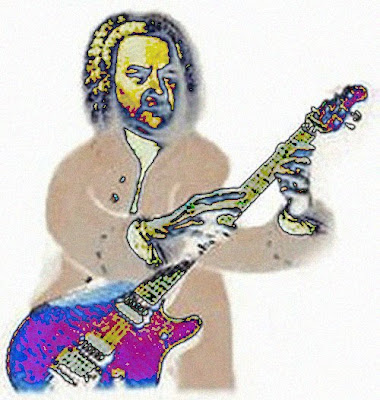
Huxley was keen to repeat the LSD experience and did so two months later with Gerald Heard and Al Hubbard . They listened to music, something millions of recreational LSD users have since found to be a source of amazement. Huxley found Bach's B-minor suite to be "a revelation". He was so impressed he later wrote to [Humphry] Osmond : "Meanwhile, let me advise you, if you ever use mescaline or LSD in therapy, to try the effect of the B-minor suite. More than anything, I believe, it will serve to lead the patient's mind (wordlessly, without any suggestion or covert bullying by doctor or parson) to the central, primordial Fact, the understanding of which is perfect health during the time of the experience, and the memory of the understanding of which may serve as an antidote to mental sickness in the future". That passage comes from Andy Roberts' Albion Dreaming: A Popular History of LSD in Britain . Its subject, Aldous Huxley , died peacefully on November...

Stormy weather forecast for Britten anniversary

Image
Stormy weather approaches from the Guardian . Also on Facebook and Twitter . Any copyrighted material on these pages is included as "fair use", for the purpose of study, review or critical analysis only, and will be removed at the request of copyright owner(s). Report broken links, missing images and errors to - overgrownpath at hotmail dot co dot uk

For Saint Cecilia

Image
Many in the world take music as a source of amusement, a pastime: to many music is an art, and a musician an entertainer. Yet no one has lived in this world, has thought and felt, who has not considered music as the most sacred of all arts. For the fact is that, what the art of painting cannot clearly suggest, poetry explains in words, but that, which even a poet finds difficult to express in poetry, is expressed in music. Tomorrow, November 22nd, is the feast day of St. Cecilia , the patroness of musicians. In recognition of this, and in celebration of musicians of all cultures and colours, I offer that remarkably prescient quote from 1922 by the Sufi master and musician Hazrat Inayat Khan , together with Richard Hickox’s 1979 Argo LP of Gerald Finzi’s Ode For St. Cecilia , a work which was premiered on November 22nd 1947 with René Soames, the Luton Choral Society and the BBC Symphony Orchestra conducted by Sir Adrian Boult; there is more on Sir Adrian and Finzi here . An app...

The very short viola in my life

Image
An email from a listener prompted me to listen again to ECM’s CD of Morton Feldman’s The Viola in My Life . While the disc was playing my attention was diverted elsewhere, and when I returned I found the music had finished. At first I thought I had miscued the disc, then I remembered that the ECM CD plays for just 39 minutes 39 seconds. Is this the shortest full price classical CD ever released? Also on Facebook and Twitter . Report broken links, missing images and errors to - overgrownpath at hotmail dot co dot uk

‘Condescending classics’ do not attract new audiences

Image
Just a few days ago I pointed out that many of classical music’s current problems can be attributed to futile attempts to herd minority interest groups spread across many small niches into a single mass market. And now classical music has done it again with the newly launched Sinfini Music website which is bankrolled by Universal Music , although the site itself doesn't tell you that . Universal's classical labels, of course, include Deutsche Grammophon and Decca, and the group distributes ECM releases in many major markets . As can be seen from the accompanying examples, Sinfini Music is a product of the ‘condescending classics’ school of marketing pioneered by producers at BBC Radio 3, and by editors at the Gramophone and at the defunct Classic FM Magazine - the latter publication, incidentally, spawned Sinfini . They have all adopted the ‘condescending classics’ approach in their attempts to create a mass market, and, as independent audience data proves, they have...

Seal symphony

Image
Basking seals were photographed on the Norfolk coast this morning. I have spent much time recently listening to Sir Adrian Boult’s 1960s/70s cycle of the Vaughan Williams symphonies in the most recent EMI CD transfers , and they sound quite magnificent – particularly the choral Sea Symphony . Transfer from analogue master tape to digital CD format should, in theory, be a straightforward process; but in practice it seems to be a black art with some transfers of recordings sounding noticeably better than others from the same period. Christopher Bishop , who produced all the original VW symphony recordings except for the Sixth, which was the work of Ronald Kinloch Anderson, visited us last week, and he commented on the outstanding sound from the latest EMI transfers when we auditioned them on my Arcam Alpha 9 & 10 and Bowers & Wilkins Nautilus 803 audio system. Although in his 80s, Christopher still has very sharp ears and a commendable sense of self-criticism. When we auditioned...

Contemporary reboot of a radio classic

Videos do not feature here very often because they strike me as rather a lazy way of filling a blog and also slow down access to the home page. But I thought it worthwhile sharing the example above from video artist David Theobald - he describes it as "a contemporary reboot" of the morale raising BBC radio show Workers' Playtime which brought live music to factory floors around the UK between 1941 and 1964. The video is a digital animation of rendered objects, and the mathematics behind the animation that allows the robot to hit the balloons must be fairly complex. Calling All Workers by Eric Coates, which was the signature tune of Workers' Playtime , supplies the soundtrack. I came across David Theobald's work in a recent exhibition at the excellent Ruskin Gallery on the Cambridge campus of Anglia Ruskin University . Good to see that whereas the traditional Cambridge colleges actively discourage visitors, the upstart Anglia Ruskin does exactly the opposite...

Classical music must return to its esoteric roots

Image
"My column on the problem with classical music and how a large proportion of R3’s audience should hurry up and die - independent.co.uk/arts-entertain..." Let’s ignore the curious anomaly that on Twitter you can be ageist but not racist , and instead let’s drill down into that tweet . Arts commentator Fiona Sturges tweeted it recently to trail her column in the Independent which was headlined "Radio 3 needs an audience beyond this tiny elite" and which ended with this sentiment: “...we can only hope... classical music will emerge from the dusty cupboard where it has long resided. And perhaps, by some miracle, it will persuade [BBC Radio 3's] longstanding, determinedly short-sighted, Twitter-loathing listeners to get with the programme and quit their bloody moaning”. You might not think so, but the irony is that Fiona Sturges and myself are saying the same thing – we both think BBC Radio 3 needs to change. But the difference is that, unlike me, Ms Sturge...

Raga a good bargain

Image
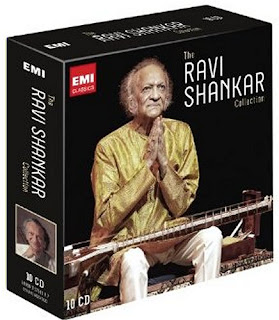
It is difficult to keep up with EMI's bargain boxes, and this 10 CD Ravi Shankar Collection - which is selling in the UK for under £20 - slipped under the radar. These highly desirable compilations are genuine limited editions and some are already deleted, so hurry. Collin Walcott was a disciple of Ravi Shankar's who went on to be the guiding spirit of the uncategorisable Codona - read more here . Also on Facebook and Twitter . Any copyrighted material on these pages is included as "fair use", for the purpose of study, review or critical analysis only, and will be removed at the request of copyright owner(s). Report broken links, missing images and errors to - overgrownpath at hotmail dot co dot uk

Ghetto music celebrates the festival of lights

Image
Tibetan Buddhist prayer flags stream outside our house in syncretic celebration of today's Hindu festival of lights - Diwali , and music of the moment is Alan Hovhaness' Symphony No. 22 ' City of Light ' in the Delos recording by Gerard Schwarz and the Seattle Symphony . Born in Boston in 1911, Alan Hovhaness's father was Armenian and his mother of Scottish descent. He studied at the New England Conservatory, and was organist at an Armenian Church in Watertown, Massachusetts where his eclectic influences included the composer/priest Komitas Vartapet and, later, the Indian musicians Uday - brother of Ravi - Shankar and Vishnu Shirali . In 1942 Hovhaness won a scholarship to study at Tanglewood with Bohuslav Martinů. But he did not gel with the Tanglewood clique dominated by Aaron Copland and Leonard Bernstein, and the official Hovhaness web site reports that his music was ridiculed by the Tanglewood set, with, allegedly, Bernstein calling it "ghetto music...

Sample John Cage's famous 4ft 3in piece

Image
Some light relief is definitely needed right now . So, both as proof that the paid-for media has been getting it wrong for many years and in reluctant recognition of the Cage centenary, I reblog the gem above. It first appeared here in 2008 under the title Music for prepared organ , and thanks go to reader John Shimwell for sharing it with us. And staying with things Cageian, which topical composer when asked, "What do you think of John Cage?" replied " I don't think of John Cage ."? Also on Facebook and Twitter . Any copyrighted material on these pages is included as "fair use", for the purpose of study, review or critical analysis only, and will be removed at the request of copyright owner(s). Report broken links, missing images and errors to - overgrownpath at hotmail dot co dot uk

There's a lot of space in your music, but it's all you need

Image
I remember at Tassajara [San Francisco Zen Centre] once talking to a classical composer and musicologist named Lou Harrison. I apologised to him for the lack of music there and for the fact that there was even a rule against having musical instruments. "Nonsense!" he said. "This place is full of music. You have all the musical instruments and music you need. I hear your bells, that thick hanging board and the drum going from morning to night. There's a lot of space in your music, but it's all you need". I was reminded of that passage from David Chadwick's book Thank you and OK! An American Zen Failure in Japan by last night’s resignation of the BBC director general George Entwistle . This blog's criticism of the BBC predates the current tabloid press witchhunt by some years , and On An Overgrown Path has repeatedly expressed concerns about the management controls within the BBC – the very factor that precipitated the present crisis. But I feel ...

She made her life a bridge for others to cross

Image
Chance, or probably a more powerful benign force , has triggered some of the most moving and rewarding overgrown paths. But never more so than the current one, which started last year when I travelled to Marseille on the path of that cultural explorer, Sufi adept and libertine Isabelle Eberhardt . During that visit I hunted for the house Isabelle stayed at en route to North Africa, where she was to die aged just twenty-seven. It took several attempts to locate the house where she lived with her brother Augustin at 12 rue Merentie, high in Marseille's Old Town. When I finally found the street I saw that one of the houses had the plaque seen below displayed, and at first assumed it marked Isabelle's residence. But on closer inspection the plaque proved to be next door to number 12, and was dedicated to another remarkable woman. It honours the British secret agent Elaine Plewman and two of her male colleagues who were arrested in the house in 1944, and then afer being tortured ...

Great art has come forth from masters of public relations

Image
The ongoing claims that government support is necessary to shield true artists from the commercial world’s philistine demands is a hangover from the Romantic vision of the creative genius. Certainly much great art has been produced by artists who thought of themselves as solitary geniuses, warring against an unenlightened public, and great art has at least as often come forth from masters of public relations and in response to demand. As classical music's funding crisis deepens that quote certainly provides food for thought. It comes from Roger Evans' newly published biography of Xavier Montsalvatge , and the Catalan composer - who lived from 1912 to 2002 - was a past master of public relations. In contrast to fellow Catalan Pau Casals , Montsalvatge chose appeasement and not exile when Franco came to power in 1936. He composed for film’s sympathetic to the Franco regime but also consorted with Catalan patriots, and balanced a career as a high profile music critic with his r...