Posts

Showing posts from November, 2011

Beginner's mind

Image
'In the beginner's mind there are many possibilities, but in the expert's there are few... This is also the real secret of the arts: always be a beginner.' Those are the words of Zen master Shunryu Suzuki and the calligraphy for 'beginner's mind' is also by Suzuki. I am away now for a while rediscovering my beginner's mind. Please support other music blogs while I am offline, but do beware of experts. There is Buddhism of a different flavour in New music in the paradise garden . Quote is from Zen Mind, Beginners Mind by Shunryu Suzuki. Note that this is a different Suzuki to the Zen master D.T. Suzuki who influenced John Cage and many others . Any copyrighted material on these pages is included as "fair use", for the purpose of study, review or critical analysis only, and will be removed at the request of copyright owner(s). Report broken links, missing images and errors to - overgrownpath at hotmail dot co dot uk Also on Facebook and Tw...

One orchestra you will not find at a music festival

Image
L'Orchestre National de Barbès takes its name from the Boulevard Barbès in the 18th arrondissement de Paris, an area known as "little Algeria". It is here that much of the sediment stirred up by France's colonial misadventures in North Africa has settled, and in musical terms that sediment is remarkably fertile. The ten piece band had its early roots in Belcourt, a working class section of Algiers, and several founder members including a Sufi percussionist left Algeria for France as exiles . The residents of Barbès jokingly consider the area to be an independent state and the title track from the self-styled national orchestra's latest CD Rendez-vous Barbès is a hymn of praise to a little bit of Africa stranded in the heart of Paris, a concept that does not meet with universal approval . Traditional North African instruments such as the guembri and karkabou blend with synthesizers and electric guitars to produce L'Orchestre National de Barbès ' unique m...

Who cares about the wishes of a dead composer?

Image
'I believe that the Eighth Symphony was not the only work which Sibelius destroyed... He spoke again and again about the unpublished works of his youth, with evident disquiet. He was oppressed by the though that after his death they would be taken out of their hiding place and made public'. Those are the words of Santeri Levas who was secretary to Sibelius from 1938 until the composer's death in 1957, which includes the period when he worked on the Eighth Symphony. The sketches which have recently surfaced may not be youthful works, but am I the only one to feel rather sad that the composer's explicit wishes are viewed as less important than the media opportunity offered by a playthrough of " the possible initial draft of the Eighth Symphony "? Will the next advance in Sibelius scholarship be to ignore the composer's wishes as expressed in the scores of his extant symphonies? * The header photo of Sibelius at home was used in an earlier post about my visi...

Folk music dances to a dangerous tune

Image
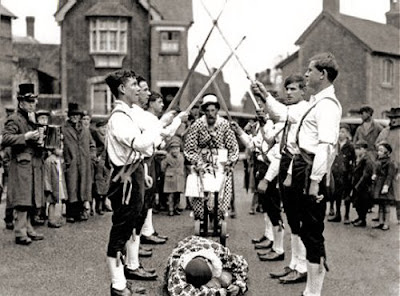
Rolf Gardiner, front right, with folk dancers in Dorchester 1939. Herbert von Karajan , Wilhelm Furtwängler and Elisabeth Schwarzkopf are some of the musicians known to have links with fascism, and classical music's various dalliances with the Nazis are well documented. But folk music is considered to be a left-wing artform and little is known about its connections with the political right. November 26th 2011 is the fortieth anniversary of the death of Rolf Gardiner, who in addition to being a leading English folk music and rural revivalist and father of conductor John Eliot Gardiner , was also a right-wing activist. Here is his story. After leaving St John's College Cambridge in 1924, where he studied modern languages and performed calisthenics naked on the banks of the Cam, Rolf Gardiner started performing with his Travelling Morrice dance troupe. Although Gardiner was one of the pioneers in the folk music revival, his political and occultist agendas were not shared by m...

Elisabeth Schwarzkopf's favourite records

Image
Alex Ross has a new My Favourite Records thread which starts with Björk's choice . So I am entering into the spirit of things by sharing the eight favourite records that Elisabeth Schwarzkopf chose when she appeared on the BBC's Desert Island Discs in July 1958 . In the photo above I am talking to Elisabeth Schwarzkopf in 1979 at the Royal Festival Hall. Here are her favourite records. 1. Johannes Brahms Ihr habt nun Traurigkeit (from German Requiem) Soloist: Elisabeth Schwarzkopf Choir: Singverein der Gesellschaft der Musikfreunde in Wien Orchestra: Vienna Philharmonic Orchestra Conductor: Herbert von Karajan 2. Johann Strauss II Vienna Blood Waltz Soloist: Elisabeth Schwarzkopf, Nicolai Gedda Orchestra: Philharmonia Orchestra Conductor: Otto Ackerman 3. Richard Wagner Selig wie die Sonne (from Die Meistersinger von Nürnberg ) Soloist: Elisabeth Schwarzkopf, Otto Edelmann, Hans Hopf et al Orchestra: Bayreuth Festival Orchestra Conductor: Herbert von Karajan 4 Wolfgang Amadeu...

Classical music either speaks for itself or it does not

Image
'It is unnecessary and indeed presumptuous to come between the author and the reader of Cosmas or the Love of God . The book either speaks for itself or it does not.' That quote from translator Peter Hebblethwaite's introduction to the French novel Cosmas or the Love of God should be displayed boldly in every classical radio presentation studio . Pierre de Calan's novel is notable for several reasons. It provides an accessible introduction to the tensions of the monastic vocation, and it is the only novel from a financier who ended his career as president of Barclay Bank's French operation. Soundtrack for this post is The Great Offertories sung by Les Chantres du Thoronet . This new CD from French independent label Psalmus is itself notable for several reasons. Les Chantres du Thoronet recreate the sound of early plainsong as heard before the ornamentations of virtuoso cantors were proscribed by Gregory the Great (590-604), who went on to homogenise Christian l...

How to see the music industry in a different light

Image
The connection between the sale of EMI to Universal Music and a 14th century Arab historian and philosopher may not be immediately obvious, but please stay with me. According to Ibn Khaldūn , who lived from 1332 to 1406, the fate of the population of North Africa and the Middle East is determined by the tension between nomads and sedentaries. The unchanging desert areas are the territory of wandering nomads who are forced by harsh conditions to be independent, brave and finely attuned to their environment. As excess population which cannot be supported by the desert accumulates there is migration to the cities which are built in more fertile areas. The city is the territory of the sedentaries with an infrastructure geared to growth by supporting the arts, sciences and commerce. But the city is also where culture and society begin to decay and in the final part of the cycle the decaying city is eventually overwhelmed by more adaptable predatory nomads. Ibn Khaldūn concluded that the p...

Portrait of the cellist as an old man

Image
When, at the age of eighty-one, Casals decided to marry the twenty-year old Marta, his doctor attempted to warn him of the grave consequences this might present for his health. 'It could even,' he suggested, 'be a matter of life or death.' The lively octogenarian sucked slowly on his pipe, reflecting on his dilemma before replying: 'Well, I look at it this way. If she dies, she dies .' Photo shows Pablo Casals and Marta . It should be noted that Martita Casals Istomin went on to a distinguished career in music in her own right and is still with us. Story is from the indispensable but sadly out of print Song of the birds - Sayings, stories and impressions of Pablo Casals edited by Julian Lloyd Weber. Any copyrighted material on these pages is included as "fair use", for the purpose of study, review or critical analysis only, and will be removed at the request of copyright owner(s). Report broken links, missing images and errors to - overgrownpath at ...

Classical music beyond the pleasure principle

Image
'Music must serve a purpose, it must be something larger than itself, a part of humanity, and that, indeed, is at the core of my argument with music of today - its lack of humanity.' Pablo Casals may have been speaking fifty years ago , but his ideas are still very relevant. The current trend to reposition classical music as entertainment bleaches it of humanity and purpose, and ultimately removes its raison d'être . The diagram above from a recent post attempted to capture this graphically and music teacher Liz Garnett has taken my theme and developed it admirably in a post on her own blog titled The 4 Es of classical music . At the core of classical music's present problems is an obsession with duality . A work is either a masterpiece or it is consigned to oblivion . A musician is either a ludicrously rewarded superstar or is consigned to the rank and file . Similarly music is either pure enlightenment or pure entertainment . Perhaps the solution is a middle ...

At odds with classical music's middlebrow audience

Image
With Remembrance Sunday approaching there are attempts elsewhere to breathe life back into John Foulds' World Requiem , a work that was certified dead four years ago . Quite why resuscitation is being attempted is a mystery, particularly as there is another neglected large scale choral work that deals with similar Gnostic themes , and which also has the distinct advantage of being rather a good piece of music. The neglect of Frederick Delius' A Mass of Life ( Eine messe des Lebens ) is one of classical music's many mysteries. Like the World Requiem and that other twitterati favourite , Havergal Brian's Gothic Symhony , A Mass of Life is very loud with a score that calls for full orchestra, chorus and four soloists. In fact the forces match those in that über fashionable work, Mahler's Eighth Symphony. And talking of musical icons, the final section of Delius' Mass sets Nietzche's 'O Mensch! Gib Acht!' , as does Mahler's Third Symphony. In fac...

It's Gershwin! It's Glorious! It's Ghettoization!

Image
John McLaughlin Williams sent the following email about yesterday's post Do I need to spell 'Neger production'? Great picture [see below]. Are things much different now? At that time they had Chocolate Kiddies ; now they have the hilariously over-exposed Porgy and Bess . Examining the largely negative roles in that opera (cocaine dealer, disabled, uneducated pauper, drug-addled woman of compromised virtue and slack loyalty) makes one wonder if we've come very far since then. Porgy and Bess usually sports an all-black cast, and touring productions have become the primary source of income for many singers of African descent. Could that be seen as a kind of ghettoization? Or worse? Porgy and Bess does make a great contrast to William Grant Still's opera Troubled Island , which also utilizes an all-black cast to portray a drama about the fight for the independence of Haiti. These roles are positive. Could that be why it's only been staged once, and even though it...

We've got a groovy thing going at the BBC

Image
Yesterday brought something very rare, a television programme worth watching. BBC TV screened The Harmony Game - American director Jennifer Lebeau's portrait of the making of Simon and Garfunkel's Bridge Over Troubled Waters . Made with the full co-operation and participation of the duo plus contributions from producer Roy Halee and others involved in the album's production, this documentary informed while avoiding the all too common pitfall of a presenter gratuitously interposing himself between subject and audience, Well, at least Jennifer Lebeau avoided the presenter trap . But the BBC did not. The Harmony Game was bought from the States as a 72 minute stand alone package. Despite which the BBC topped and tailed it with a three minute intro by presenter Alan Yentob, star of 'Noddygate' , shot on location in Forest Hills, New York City. Which added nothing at all to Jennifer Lebeau's documentary but must have cost BBC license payers an arm and a leg. But t...

The land not quite without music

Image
If this blog has achieved anything at all over the past seven years it is to place Edmund Rubbra and John Ireland on The Rest is Noise . Now let's hear it for Arnold Bax . It was the German, Oscar Adolf Hermann Schmitz who wrote that England is ' Das Land Ohne Musik ' — the land without music and to keep the record straight Schmitz is not mentioned in either of Alex's books . Report broken links, missing images and errors to - overgrownpath at hotmail dot co dot uk Also on Facebook and Twitter

Do I need to translate 'Neger Production'?

Image
Ernst Krenek's multicultural and at one time banned jazz influenced opera Jonny Spielt Auf is back in the catalogue at budget price as a Decca reissue of the excellent 1993 Leipzig recording . Read how the title role was sung by a 'blacked-up' white singer in the Metropolitan Opera's 1928 production in my post Multicultural, multimedia and banned . Header photo is from 1925 when New York bandleader Sam Wooding's all-black jazz revue Chocolate Kiddies toured to Berlin. Among those in the audience was Ernst Krenek, who was inspired to compose Jonny Spielt Auf (Johnny Strikes Up). Heads up for Prelude Records where I noticed the Decca reissue. Any copyrighted material on these pages is included as "fair use", for the purpose of study, review or critical analysis only, and will be removed at the request of copyright owner(s). Report broken links, missing images and errors to - overgrownpath at hotmail dot co dot uk Also on Facebook and Twitter .

The secret life of an English pastoralist

Image
'In filleting out these lines from Machen's prose, Ireland gestures towards what, as a gay man, he was forced to conceal: the ecstasy of physical love. He would often allude to his (male, younger) lovers by citations from classical literature or Housman's A Grecian Lad , one of several poet's works that Ireland set to music. He kept a statuette of Pan as a goat-god on his piano, a reminder of the pagan association with rapacious lust. The Forgotten Rite (1913), conjutes up Pan mischievously disrupting a solemn churchy atmosphere. 'I am far from repelled by an admixture of the occult and magic, of a genuine kind,' he wrote to one correspondent in typically understated style.' That passage from Rob Young's indispensable Electric Eden sheds a different light on John Ireland, a composer usually damned by the faint praise of "English pastoralist". Arthur Machen was a Welsh author and mystic whose novella The Great God Pan is considered a classi...

BBC - never mind the quality, feel the tweets

Image
'...I am slightly puzzled as to the problem.... there are no official limits on how much BBC people can tweet in a personal capacity at work. I myself do so frequently. My approach as a manager is that as long as this is not interfering with BBC work then there is no problem...' That contribution to my Awful lunch break at the BBC thread comes from Nick Reynolds who is social media executive at BBC, future media and technology . Twitter may well be an unavoidable part of contemporary life. But with Radio 3 currently hemorrhaging more than 10,000 listeners a week and BBC director general Mark Thompson presiding over a cost fuelled financial crisis I will amicably disagree with Nick about the extent of the problems at the BBC. * My header quote is extracted from an email that the ever helpful Nick Reynold's sent in response to my question about the personal use of Twitter by BBC staff. In that response Nick includes a useful link to the BBC's guidance on 'Social...

Here is my (English) song for the asking

Image
In a recent post fellow blogger David Derrick expressed the opinion that Noel Coward, together with Britten and the Beatles, was the greatest English songwriter of the twentieth century. Which is a refreshing view, but a new ECM release highlights another pretender to the title. On her CD If Grief Could Wait Norwegian indie rock singer Susanna Wallumrød punctuates eight airs from the greatest English songwriter of the 17th century Henry Purcell with a song by Nick Drake and examples from Leonard Cohen plus one from her own pen - Nick is seen above at a photo opportunity with Henry Purcell, I wonder if they used the same hair stylist? Nick Drake's reputation as a great English songwriter is now at the post-cult phase, but there is another Joe Boyd protégée whose time has still to come. Vashti Bunyan, seen below, was discovered by Joe Boyd in 1968 while travelling by gypsy caravan to the Isle of Skye and she joined Fairport Convention, The Incredible String band and Nick Drake ...

Awful lunch break at the BBC

Image
Received a jolly nice email from Jo Harris-Cooksley who is the Assistant Content Producer at the BBC TV Blog inviting me to join in the general puffery for the BBC's TV and radio Symphony extravaganza . As Ms. Harris-Cooksley found me via a social media search I reciprocated and spent an absorbing afternoon reading her Twitter feed . Surrounded by tweets about BBC programmes was the one seen above . All of which reminded of the line by Wilfred Owen which Britten used in his War Requiem - 'Now men will go content with what we spoiled'. Also on Facebook and Twitter . Report broken links, missing images and errors to - overgrownpath at hotmail dot co dot uk

Never underestimate the public's intelligence

Image
Martin Scorsese has a knack of capturing the musical zeitgeist . He has directed biopics of George Harrison and Bob Dylan, and his film Kundun , which portrays the flight of the Dalai Lama from Tibet in 1959, was scored by Philip Glass . But another Scorsese movie, his controversial 1988 adaption of Nikos Kazantzakis' novel The Last Temptation of Christ , features music that is considerably less well known. The Last Temptation of Christ uses the track Ya Sah by the Moroccan group Nass El Ghiwane. While working in a political theatre in the late 1960s the founder members of Nass El Ghiwane started using traditional North African music to communicate their views on political and social issues, and such was the success of their experiments that they went on to form their own group in 1969. The band's name translates as 'disciples of the Ghiwanes' - a reference to the Ghiwane Sufi brotherhood of musicians and story tellers . Nass El Ghiwane's music, which couples ...

Beethoven plays Europe's longest champagne bar

Image
There will be plenty of coverage today on the BBC and elsewhere of the pop-up symphony being performed by the BBC Symphony Orchestra at St Pancras International station. And so there should be because accessiblity lies at the heart of this pop-up Beethoven symphony - accessiblity that is to the mainstream media and political decision makers. Let me explain... St Pancras International is the London terminal of the Eurostar rail service connecting England to Europe. The station was opened in 2007 after an £800 million restoration and its passenger profile is heavily biased towards business travellers, particularly civil servants and politicians travelling to Brussels and other EU centres. The station's shopping mall hosts prestigious stores and independent boutiques, the newly opened St Pancras Renaissance London Hotel has a restaurant run by celebrity chef Marcus Wareing, and among the twenty-four bars and restaurants is the longest champagne bar in Europe , which is seen above....

This new CD deserves a $1 million prize

Image
Elizabeth Maconchy's The Land, a suite for orchestra was given its world premiere by Henry Wood and the BBC Symphony Orchestra at a Promenade Concert in August 1930 and the twenty-three year old composer's Prom debut received Dudamelesque press coverage including the headline 'Girl Composer's Triumph'. It may have been Elizabeth Maconchy's first Proms performance but it definitely was not the first performance by a woman (sorry girl) composer. But what was? My money would be on the October 1902 performance of the Dance from Ethel Smyth's opera Der Wald . But I have never been very successful at betting and I await correction by collaborative readers. With the exception of Nicholas Kenyon's notorious female free 2006 Proms season , for which the Queen made him a night of the male composers , women composers are better accepted than women conductors - both at the BBC Proms and elsewhere. Is it because the Karajan-style macho male stereotype still domi...