Posts

Showing posts matching the search for weiss

Why music is called the divine art

Image
Philip Glass , Karol Szymanowski , John Tavener and Jonathan Harvey are among the composers who have set the poetry of Jalāl ad-Dīn Muhammad Rūmī . Books of Rumi's poetry as reimagined by Coleman Barks have sold more than half a million copies, and in 1994 Publishers Weekly announced that Rumi was the bestselling poet in America. But the marketing of Rumi to Western audiences all too often severs him from Islam, and Stephen Schwarz has lamented the reduction of the Sufi master's metaphysics to the idiom of a gift card. Other less sanitised settings of Rumi that have featured On An Overgrown Path over the years include Ali Reza Ghorbani's Songs of Rebirth , the Firebird ensemble's L’Oiseau de Feu , Doulce Mémoire's Laudes , Ali Keeler's Ruh , Sheikh Hassan Dyck's The First and the Last and Trio Chemirani's Dawâr . Rumi is, of course, celebrated as the founder of the Mevlâna Order of Whirling Dervishes. My header photo shows Julien 'Jalal...

Music beyond the Western straitjacket of twelve notes

Image
That photo was taken in Sidi Ifni during my recent travels in southern Morocco. Prominent on my playlist during those travels were recordings by Ensemble Al Kindi and its founder Julien Weiss . After a period on the fringes of the counterculture, French born Julien Weiss converted to Islam in 1983 and took the name Jâlal. In 1995 he made his home in a 14th century Mamelouk residence in Aleppo, which is one of the oldest inhabited cities in the world and was, until the recent terrible civil war , an important cultural center. Latterly Julien Weiss was based in France, appearing with Ensemble Al Kindi at many prestigious festivals and making acclaimed recordings for Le Chant du Monde. Despite this the Syrian musicians of Ensemble Al Kindi - but not their French founder - were refused entry visas for the UK to perform at a festival in 2013. A priceless 2005 interview with Jâlal Weiss quotes him as saying his conversion to Islam was "partly social - I wanted to be more than a...

Thoughts on a tweet-sized Verdi Requiem

Image
Yesterday I switched on BBC Radio 3 and found myself listening to an extract from Verdi's Requiem . To my astonishment the back announcement at the end of the Libera Me told me the extract was part of a concert , not a record programme. The concert was  billed as "Music to Die For - a heavenly mix of devilishly popular classics"  and performed by the BBC Concert Orchestra, with extracts from the Mozart and Fauré Requiems and from Mahler's Das Lied von der Erde  also featuring in it. Single movement extracts have become the norm on Radio 3 record programmes, but this is the first time I have come across a concert of single movement excerpts from the mainstream repertoire. Which set me thinking about the following passage from Peter Mayne's A Year in Marrakesh , a book, incidentally, which dates from 1953. '...it is also the way the Qu'ran is learnt, the 'perspicuous book' of Islam. Muslim children sit swaying back and forth in their tiny windowle...

An absurd complex of inferiority to the symphony orchestra

Image
Much trumpeting from Sony about a Billboard classical chart number one for Iranian composer Hafez Nazeri 's Rumi Symphony which "crosses cultural boundaries through a new universal blending of Eastern and Western classical music". That PR speak sets the alarm bells ringing, because as one of the leading exponents of traditional Middle Eastern music, Julien Jaleddin Weiss , explains: "European stringed instruments (violin, viola, cello, double bass) were integrated relatively recently into oriental ensembles, to the point where they have acquired a dominant, indeed overwhelming position. I have always taken care to eliminate them as far as possible, for they were designed to play our polyphonic music. In my view their introduction is tainted with an original sin, namely an absurd complex of inferiority to the symphony orchestra. Not to mention, of course, the total incompatibility of the language of the maqām with the equal temperament of the piano, the guitar...

A European Requiem

Image
An earlier post quoting Muhammad Asad (aka Leopold Weiss) on the danger of avoiding dangers reached a very wide audience. So now I am posting the complete passage from The Road to Mecca which contains the quote. It was written in the early 1950s, but is so relevant to recent events both in and outside the Albert Hall. The photo was taken by me outside the Musée Mohammed VI d'Art Moderne et Contemporain , in Rabat, Morocco. When a European travels in any country of Europe which he has never seen before, he continues to move within his own, though perhaps somewhat widened, environment and can easily grasp the difference between the things that habit has made familiar to him and the newness that now comes his way. For, whether we are Germans or Englishmen, and whether we travel through France, Italy of Hungary, the spirit of Europe unifies us all. Living as we do within a well-defined orbit of associations, we are able to understand one another and to make ourselves understoo...

Lucy in the sky with classical music

Image
How then, does one achieve gnosis , that spontaneous awakening which permanently shifts one consciousness? It can come unbidden at any time, through ordinarily normal activities such as listening to a piece of music, seeing a particular landscape at a certain time of day, or experiencing a sudden moment of clarity and silence into which something else makes its presence known. That passage from Sean Martin’s The Gnostics  recommends music as a chemical-free way of raising consciousness levels , and also reflects the recurring theme On An Overgrown Path that classical music should aspire to higher levels instead of regressing to the ordinarily normal . While travelling in the Mahgreb last month I was spontaneously reminded me of the power of great music, and that experience prompted the following notes on recent sonic flirtations with that elusive “something else”. Valentin Silvestrov’s Requiem for Larissa is a permanent fixture on my iPod and has featured in at least one previou...

Sibelius remastered or reimagined?

Image
Classical music has a schizophrenic relationship with sound quality. On the one hand there is an obsessive preocuppation with hideously expensive 'acoustically perfect' concert halls . On the other hand recorded classical music has been chased down the rabbit hole of lo-fi by MP3s, streaming, ear buds, and mobile listening, and rarely - if ever - is sound quality mentioned in reviews of CDs . So it is not surprising but still disappointing that a major initiative by one of the largest classical labels to open the debate about recorded sound quality has passed unremarked, while classical's great and good continue their demands for yet another 'acoustically perfect' concert hall.  Warner Classic's rerelease of Sir John Barbirolli's legendary Sibelius recordings are labelled as 'remastered'. But what is remastering? Mastering and remastering are two very different processes. When a recorded is mastered to CD very little is done to the sound ...

Face to face with jazz legends

Image
We Want Miles at La Cité de la Musique in Paris was packed when we visited it recently. Those are some of the graphics above and the multimedia Miles memorobilia was certainly stunning, but the average age of those packing into the exhibition was even more stunning. There are not many countries where you see young people paying 8 euros (11 US dollars) to queue for a celebration of a jazz musician who died before some of them were born. That is French bebop pianist René Urtreger above, and I was particularly pleased to find an extended video interview with him as one of the We Want Miles exhibits. René Urtreger studied classical piano before making his reputation in the famous Club Saint-Germain on Paris' Left Bank with his Bud Powell influenced style. He has played with many jazz greats including Miles Davis, and recorded the the soundtrack to Louis Malle's film Ascenseur pour l'échafaud (Elevator to the Gallows) with Miles' band in 1957. René Urtreger has also wo...

A song of peace for lands afar and mine

Image
From James Primosch: Sent 08 January 2007 06:12:19 To overgrownpath@hotmail.co.uk : Subject - Finlandia: Hello, in reference to your recent Finlandia post - the words Joan Baez (right) sings are actually by Lloyd Stone, and date from 1934. For more details follow this link . May I say that I enjoy your blog very much, with good wishes, Dr. James Primosch, Robert Weiss Professor of Music, Department of Music, University of Pennsylvania - composer website James, many thanks for clarifying that. Below are the words by Lloyd Stone that Joan Baez sings to the music of Sibelius. These are words that are terribly relevant today: This is my song, Oh God of all the nations, A song of peace for lands afar and mine. This is my home, the country where my heart is; Here are my hopes, my dreams, my sacred shrine. But other hearts in other lands are beating, With hopes and dreams as true and high as mine. My country's skies are bluer than the ocean, And sunlight beams on cloverleaf and pine. Bu...

How sleeve artwork changes the sound of CDs

Image
Arab scholarship played an important part in the European Renaissance, with a major contribution coming from the ninth century polymath al-Kindī whose erudition encompassed philosophy, mathematics, physics and music. Much of al-Kindī's scholarship is enshrined in contemporary sciences such as cryptography ; but one of his more intriguing theses  remains unaccepted, namely that all objects and beings emanate radiations that affect all other beings. Such an idea is difficult for contemporary minds conditioned by post-Enligtennment science to accept, until it is realised that there are scientifically proven examples of the inanimate affecting the sentient; just one example being the remarkable homing instinct of cats which is thought to be the result of electromagnetic radiation . Al-Kindī's thesis may also explain one of my more bizarre theories, namely that CDs with graphically compelling sleeve artwork sound better that those with mediocre graphics - a theory that also exp...

The terrible danger of avoiding dangers

Image
In this book I am describing a journey into a region whose 'differences' from Europe are too great to be easily bridged: and difference is, in a way, akin to danger. We are leaving the security of our too uniform environment, in which there is little that is unfamiliar and nothing that is surprising, and entering into the tremendous strangeness of 'another' world... But are we really excluded from that world? I do not think so. Our feeling of exclusion rests mainly on an error peculiar to our Western way of thinking: we are wont to underestimate the creative value of the unfamiliar and are always tempted to do violence to it, to appropriate it, to take it over, on our own terms , into our own intellectual environment. It seems to me, however, that our age of disquiet no longer permits such cavalier attempts; many of us beginning to realize that cultural distances can and should be overcome by means other than intellectual rape: it might perhaps be overcome by surrend...

The Tao of acoustics

Image
Frederic Chiu 's new recording of the piano music of G. I. Gurjieff/T. de Hartmann Hymns & Dervishes was recorded at Manifold Studios , Pittsboro, NC. In Russia Gurdjieff's circle included Prokofiev, Stravinsky, Diaghilev and Nicholas Roerich , while in America Frank Lloyd Wright was an early enthusiastic evangelist for the multi-faceted mystic. The music of Gurdjieff/Hartmann has a number of distinguished advocates including Keith Jarrett . But Frederic Chiu gives a refreshingly different interpretation that emphasises the music's lyrical rather than calisthenic nature. I already have many recordings of Gurdjieff's music, but I will be returning to Hymns & Dervishes frequently, thanks I suspect in part due to the Tao of acoustics*. Photos 1 to 4 show Manifold Studios, which was designed around the sound and dimensions of a concert grand piano by Wes Lachot , who based his design on the acoustic architecture theories of Gurdjieff's student Frank Llo...

Multiculturalism beyond Big Music

Image
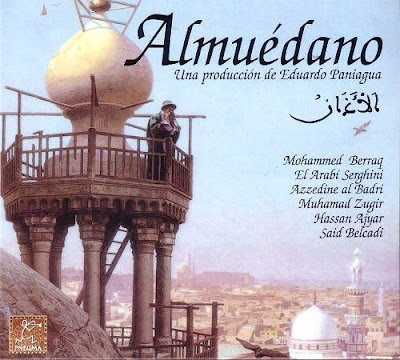
But the storm of cries over the city reassured me. It made the single human voice, particularly the one inside one’s head, sound petty and unimportant. Meanwhile, the universal, stereophonic sound, bouncing from one side of the valley to the other, constricted space. It made the towering escarpments that surrounded the city seem to loom and drape, as if they had picked up and advanced a little bit during the day while the citizens napped and chewed their qat . That evocation of the Muslim call to prayer by the muezzin comes from a new book by Theo Padnos . It introduces a post which both celebrates the start of Ramadan and offers an alternative to Big Music's upcoming multicultural media fest at the BBC Proms . I recently described Jordi Savall and Montserrat Figueras’ new Jeanne d’Arc – Batailles & Prisons as being more audio verité than music CD , and that description also applies to the disc seen above. Almuédano is an atmospheric portrayal of the adhān, the call to pr...