Posts

Showing posts with the label steve reich

This LP is dedicated to Richard Wagner

Image
Composer Klaus Schulze has said 'I still love my Richard Wagner, who influenced me heavily. The way Wagner’s music introduced me to the use of dynamics, subtlety, drama, and the possible magnitudes of music in general remains unparalleled to me. There can’t be any doubt about it'. Schulze's 1975 release Timewind seen above* carries the message 'This LP is dedicated to Richard Wagner', and the two tracks of truly Wagnerian proportions on the original vinyl release were titled Bayreuth Return and Wahnfried . So why doesn't the name Klaus Schulze mean anything to the vast majority of classical listeners? The answer is because Klaus Schulze, who also uses the the alias Richard Wahnfried, is a creative maverick who was a leading figure in the development of the kosmische musik  known popularly as Krautrock, which he then morphed into the proto-ambient Berlin School of electronica, and is today best known as the Godfather of Techno and the Pope of Electronic...

When the Beatles' guru produced an album

Image
Like many in the late 1960s the jazz flautist and saxophonist Paul Horn was a devotee of the Transcendental Meditation (TM) guru Maharishi Maheshi Yogi. In early 1967 Paul Horn travelled to Rishikesh to attend the Maharishi's academy of meditation. Due to the heat in the Ganges plain the last weeks of the academy were based in Srinagar in Kashmir. Participants were entertained there by Kashmiri musicians who also practised transcendental meditation. The Maharishi became a fan of Paul Horn's playing and brought him together with the Kashmiri musicians and, to quote Horn: "He proceeded to plan an album with the insight of an experienced record producer. He arranged for album cover photos to be taken early the next morning" - see above. Maharishi Maheshi Yogi was, like many religious leaders, a controversial figure. He was allegedly a kundalini opportunist, and the Beatles broke with him because of his reported advances to Mia Farrow during a TM retreat, a break...

Different trains for different times

Image
In Different Trains Steve Reich juxtaposed his music with reminiscences about the Holocaust to create a contemporary masterpiece. In Letters from Iraq the Iraqi-American composer and oud player Rahim AlHaj takes the reminiscences of those - including himself - who have suffered in Iraq since the 2003 U.S. led invasion as inspiration for eight instrumental tone poems; sample below. Letters from Iraq draws on both Middle Eastern and Western musical traditions and is scored for oud, percussion and a string quintet which for the newly-released recording was drawn from members of the New Mexico Philharmonic . The album is on the Smithsonian Folkways label and the 40 page booklet includes striking paintings by Iraqi visual artist Riyadh Neam. Rahim AlHaj explains that: “Music can make us laugh, make us cry, make us march into war. I want to make music to make us realize peace”. Letters from Iraq is protest music par excellence with one of the tone poems depicting the carnage of a c...

In our past lies our present

Image
Peasant girl turned warrior who became folk heroine of France and a Catholic saint – the story of Joan of Arc is common knowledge. But two other aspects of the Maid of Orleans, her supernatural powers and her appropriation by the French political right, have long fascinated me, and both feature in Jordi Savall’s CD-book Jeanne d’Arc – Batailles & Prisons . In this newly released double CD Jordi Savall uses music to evoke three contrasting sides of Joan’s character - her peasant origins are represented by popular tunes of the time by Dufay and others, her military vocation by Jordi Savall’s own development of the melody L’homme armé , and her divine voices by Dufay’s Veni Sancte Spiritus . When the young Joan first heard voices and apparitions in 1425, she was inspired to be pious and charitable, and was also motivated to go into battle to save the “holy kingdom of France”. A central dogma of the Catholic Church is that it is the sole intermediary between God and believers, and ...

Are top musicians sharing the financial pain?

Image
Everyone in classical music is talking about funding cuts. But no one is talking about how dwindling budgets continue to be top-sliced by the fees charged by high profile musicians. In my recent post I used an estimate of Gustavo Dudamel's fee for a BBC Prom taken from an identified and reliable source . But it remains an estimate because the musicians, agents and concert promoters involved keep such information a closely guarded secret; even when , as is the case with the BBC Proms , they are paid from public funds. But now a concert promoter who has suffered savage funding cuts and considers some of the current fees "outrageous", has supplied details of what top musicians charge. And, more importantly, has agreed I can publish them anonymously. So here are the fees and associated on-costs. They are as requested by the artist's management for a single concert appearance unless otherwise stated. It should be emphasised this is simply available information and ...

We could be looking at thousands of dollars

Image
Yes, that is Glenn Gould. But this path starts with another musician. Steve Reich's Come Out is an electronic composition created from the voice of an African-American youth. No conventional instruments or musical notation are used in the pioneering work. But if I want to broadcast/webcast Come Out there is no problem. Future Radio is party to a performing rights agreement which directs royalty payments to the composers and publishers of music works. Despite not being a conventional music work Come Out is covered by that agreement. So far so good: Come out is broadcast, the listener has access to a seminal 20th century work and the copyright owner is rewarded. Glenn Gould's Solitude Trilogy is a series of three radio documentaries made for the Canadian Broadcasting Corporation (CBC) between 1967 and 1977. Two of the documentaries use short music excerpts but, like Come Out which dates from the same period, they are voice compositions. But, despite using speech as his r...

Reich on Reich

Image
“If you looked at the tax returns of every composer in America, somewhere between 90 and 95% would be at universities. And I’m not looking down on those – it’s merely the job that’s most open to you. But people say you teach during the day and you’re free at so-and-so, but there’s a certain energy that goes into teaching people, it seems to me…and if you don’t give them that energy, then you’re immoral. And if you do give them that energy, then you’re wiped out. Because there’s only so much energy anyone has. From Steve Reich talking at the Red Bull Music Academy . With thanks to Future Radio Station Manager Tom Buckham for the heads-up. As well as being the boss Tom spins the discs in the station's electronica, downbeat, electro and electronic music programme . That interview links nicely to my recent Contemporary music at the Reich price post. Photo credit FactMag . Any copyrighted material on these pages is included as "fair use", for the purpose of study, review or c...

Contemporary music at the Reich price

Image
If there are gaps in the Steve Reich section of your CD collection you can fill them very cheaply at amazon.co.uk where Nonesuch's five CD Reich retrospective is currently available for the silly price of £14.58 including UK delivery. Music for 18 Musicians, Music For Mallet Instruments, Voices, & Organ and Drumming are just some of the works in the collection which gives an excellent overview of the composer's career to date. More on Nonesuch here and here. But is recorded classical music too cheap ? Any copyrighted material on these pages is included as "fair use", for the purpose of study, review or critical analysis only, and will be removed at the request of copyright owner(s). Report broken links, missing images and errors to - overgrownpath at hotmail dot co dot uk

The Tao of music

Image
However, back to the beat - something it seems we must return to with regularity in some form or another, if we wish to cooperate with the natural regulatory forces of existence. I instinctively knew at the age of four that rhythm was the palpable expression, at the deepest level, of the universe in motion... Understand the rhythm of life - not intellectually but by feeling it in your body - and you understand the rhythm of the way the forces of expansion and contraction, the yin and yang of Taoist philosophy , the zeroes and ones of our present technological reality, alternate with each other. Understand that and you understand the rise and fall of fortune. Understand that and you have a chance of seeing through the everyday game to the eternal state behind it. Those words come from the newly published The Man Who Drove With His Eyes Closed by the idiosyncratic Taoist Stephen Russell , who was an early exponent of group drumming as music therapy. Now for a question: which famous mus...

The Duke Meets Darius Milhaud

Image
Two of the compositions introduced on 'Brubeck plays Brubeck' are now recognized as jazz standards: They have been recorded and performed many times by many different artists, most notably by Miles Davis with Gil Evans' orchestral arrangements and by Bill Evans solo piano . My publisher has informed me that at last count there were over 60 different versions of 'In Your Own Sweet Way' recorded by various jazz artists. 'The Duke ,' which might be the first jazz composition to have the bass line go through all 12 notes of the musical scale in the first 8 bars, has been a challenge for many musicians. My original title for the piece was 'The Duke Meets Darius Milhaud' . Dave Brubeck writes in his supplementary 1998 note for the CD release of ' Brubeck plays Brubeck' . Dave Brubeck was a pupil of Darius Milhaud, as were Philip Glass, Steve Reich and Karlheinz Stockhausen. They all put in an appearance in On the path of Stockhausen's teach...

The shock of the popular

Image
This 1967 LP from my collection draws together several current paths . The conductor is Antal Dorati, and we mark the twentieth anniversary of his death on November 13. The orchestra is the London Symphony, which reminds us of the recent contribution by a reader lamenting the decline of that orchestra under the leadership of Valery Gergiev . And the main work on the LP is Darius Mihaud's Le Boeuf sur le Toit , an early example of jazz meeting classical . Milhaud's score dates from 1919 and was used to accompany a farce created by Jean Cocteau and set in an American bar during Prohibition. Today, Milhaud's ranking as a minor composer belies his influence; his students included Karlheinz Stockhausen, Steve Reich and Philip Glass . The jazz meets classical path was started by Radka Toneff's exquisite album Fairytales . This 1982 classic of the gramophone features just two musicians, Radka Toneff and pianist Steve Dobrogosz . The latter also composed two of the songs, i...

Classical music YouTubified

Thanks to The Improvising Guitarist for taking us to the clip below of Steve Reich's Clapping Music which he describes as ' YouTubified'. This clip is becoming something of a cult classic among my readers. So is YouTubified classical music the way to reach new audiences? If not it is a wonderful cure for insomnia . Any copyrighted material on these pages is included as "fair use", for the purpose of study, review or critical analysis only, and will be removed at the request of copyright owner(s). Report broken links, missing images and errors to - overgrownpath at hotmail dot co dot uk

Clapping music

Image
Does applause between movements at concerts detracts from the music? Yes, according to 71% of my readers in a poll that was voted on by a representatively large sample. So, if you are one of the serial clappers at the BBC Proms and elsewhere it is worth remembering that your aural contribution is spoiling the music for almost three quarters of the audience. Steve Reich wrote his Clapping Music in 1972. It is not on the Warner CD Maximum Minimalists but other music featured here recently is, including one of the movements from his Different Trains . There are also works by Philip Glass (String Quartet No 5 complete), Terry Riley and John Adams . An excellent budget priced minimalist sampler for those who haven't yet grasped that less is more . Now listen to some new music for bells . Any copyrighted material on these pages is included as "fair use", for the purpose of study, review or critical analysis only, and will be removed at the request of copyright owner(s). ...

Lise Meitner - the forgotten Lady Atomic

Image
Today's successful switch-on of the Large Hadron Collider at the CERN laboratory in Switzerland takes us down an overgrown path that leads from a masterpiece of contemporary music via the Manhattan Project to the forgotten lady seen in my header photo. Legend has it Manhattan Project scientists working on the atomic bomb at the uranium-enrichment plant at Oak Ridge, Tennessee listened repeatedly to Nicolas Slonimsky's recording of Edgard Varèse's Ionisation . Scored for thirteen percussionists Ionisation , like many of Varèse's works, takes its title from science. Today ionisation, which is part of the process of nuclear fission, is irrevocably linked with weapons of destruction and the work of Robert Oppenheimer , the so-called Doctor Atomic . But the study of radioactivity and nuclear physics predated the Manhattan Project by decades and many of the key research figures were committed to the peaceful application of their work. One such figure was Lise Meitner wh...

Different trains

Image
Norman Lebrecht can get it horribly wrong or horribly right. Back in 2006 he wrote that music blogs have 'nutritional value ... lower than a bag of crisps' . Which doesn't stop the Royal Academy of Music quoting this one in their 2009 prospectus . But Norman's interview with Steve Reich , which was aired on BBC Radio 3 last night, was a quite superb example of the interviewer knowing when to keep his mouth shut and letting the subject talk. These moments are rare in radio - listen to it on the BBC iPlayer or as a podcast . But hurry because it is only there until August 4. And talking of Norman here is an interesting website . Now playing - The Smith Quartet performing Reich's Different Trains . This Signum Classics CD also includes the composer's Triple Quartet which is recomended to readers who haven't yet 'got' Reich. Follow the Different Trains thread here and here. Any copyrighted material on these pages is included as "fair use...

Contemporary composers' Notre Dame habit

Image
'The Orlandos hadn't met the Tuvans when I spoke to them, but were confident they'd find common ground, since this is the strategy they employ as a way of drawing in audiences to the forbidding medieval music they specialise in. Forbidding is my word, not theirs: as tenor Angus Smith points out, composers such as Steve Reich , Harrison Birtwistle and Peter Maxwell-Davies are now ploughing the same melodic furrow of the monks of Notre-Dame, 800 years ago. "We don't like to programme early music in isolation – we like to find ways of giving it a resonance today," says Smith. "And the music of medieval Notre-Dame is, in many ways, similar to the music being written today"' - from Michael Church's Independent preview of the East Neuk Festival in Scotland. The festival includes a premiere by Tarik O'Regan whose Scattered Rhymes, inspired by Machaut's Messe de Notre Dame, featured in my recent 'Mixing it' post and the CD ...

Music of Black Africa on Future Radio

Image
'If something is boring for one minute try it for two, and if it is still boring, try it for four minutes; eventually one discovers it is interesting' - Zen saying. Find out whether the Zen masters are right this holiday weekend when my Future Radio programme scores another first with the broadcast premiere of a complete African trance ritual recorded in the Medina of Marrakech , Morocco. The performance is by traditional gnawa musicians (photo above) and has been made possible by a collaboration between the Norwich community station Future Radio 96.9FM and KamarStudios who are based in Marrakech and New York. Marrakech is known as the Gate of Black Africa and gnawa music came to Morocco from sub-Saharan Africa with the slave trade. For centuries gnawa has only been played in secret spirit-possession and healing ceremonies called lilas that evolved from ancient African animistic and Islamic Sufi rituals. In these religious rites healing spirits are said “to mount” the po...

Short ride in a fast machine

Image
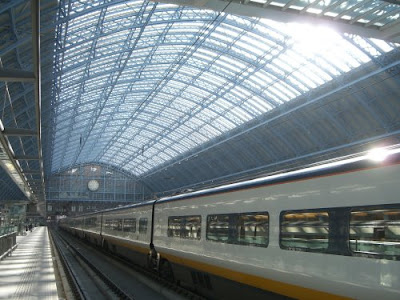
'Question is - what's more environmentally friendly - going to an independent store, by anything else than on foot, or ordering a CD online?' - asked the irrepressible violainvilnius in a comment on a recent post. I don't know the answer, but we've just arrived back from Belgium with a bunch of CDs bought from an independent dealer and managed to travel by walking, a bicycle, train, bus and just one short taxi ride on the whole trip. The main part of the journey was by Eurostar train which now leaves London from the splendidly restored St Pancras station, seen in my photo above, and stops at Lille before arriving in Brussels just one hour and fifty three minutes later. It may not be environmentally perfect, but it's a step in the right direction. Now playing - MGV ( Musique à Grand Vitesse ) by Michael Nyman . This 27 minute orchestral work was commissioned by the Festival du Lille for the inaugaration of the TGV North-European line which we travelled on to...