Posts

Showing posts with the label jonathan harvey

Swamped by a tsunami of classical populism.

Image
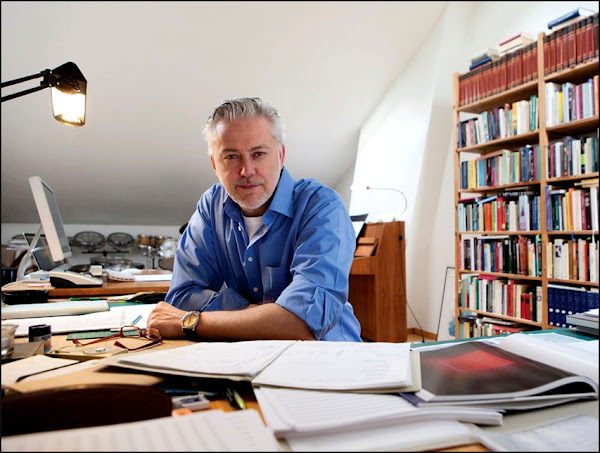
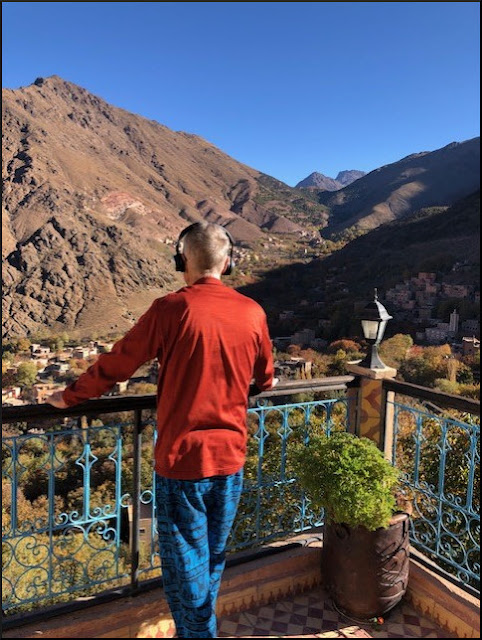
These photos show me with Jonathan Harvey in 2010 recording an interview for Future Radio. As I will be away from blogging for a while I am leaving you with a long listen. My broadcast interview is available via this link from the archive website of the then Future Radio station manager Tom Buckham. The 87 minute broadcast ends with a performance of Jonathan's masterpiece for large orchestra and electronics Speakings with Ilan Volkov conducting the BBC Scottish Symphony Orchestra. (For those with 2025 attention spans a transcript is available via this link .)   Jonathan Harvey was a composer with Buddhist tendencies . His composition ... towards a Pure Land for large orchestra evokes the state of mind in Buddhism beyond suffering where there is no grasping. Two years after I recorded the interview Jonathan left us far too early to travel towards the Pure Land - Nibbāna . Since then his eclectic vision of a new music for a new audience has been swamped by a tsunami of cl...

Why new audiences are deaf to classical music

Image
One important reason why classical music is failing to attract a new young audience is being ignored - today's much sought-after digital natives are fast becoming tomorrow's hearing loss natives. As the Clínic de Barcelona explains , until recently, hearing loss had always been related to age: the older you are, the worse your hearing is. This situation, however, has changed in recent years, as increasingly younger people are suffering from hearing loss. There are many reasons for this widespread hearing loss. There are now high levels of ambient noise - for instance the average daytime ambient noise  without PA announcements inside a US airport terminal is 66 decibels which approaches that of a a washing machine. Then there is the noise from the headphones, earbuds, etc used for long periods with digital devices. In addition the overlooked widespread  use of ototoxic drugs , including macrolide drugs and non-steroidal anti-inflammatory drugs (NSAIDs), contributes to heari...

Our terrible time makes the choices clear for us

Image
'You want a philosophy that says, "Man will get better. Man will change his world. There is hope." That philosophy would be a lie. This world is illusion. But within this world and within man there are great powers - powers of love, of healing, of clarity, than can lead man to liberation. The worse the time, the more we should look for those powers within ourselves, the more deeply we should strive to obtain them and live them , for our own sake and the sake of others. Our terrible time makes the choices clear for us. We will not be able to pretend that we can go on living without taking thought for our salvation and that of others. We will have to invoke the deepest strengths of our spirit to survive at all'.  That is Buddhist monk Nawang Tsering quoted in Andrew Harvey's A Journey in Ladakh . Jonathan Harvey's  Other Presences   is a work for solo trumpet and live electronics written by Jonathan Harvey for   Markus Stockhausen . It is inspired by ritual ...

Everything falls under the law of change

Image
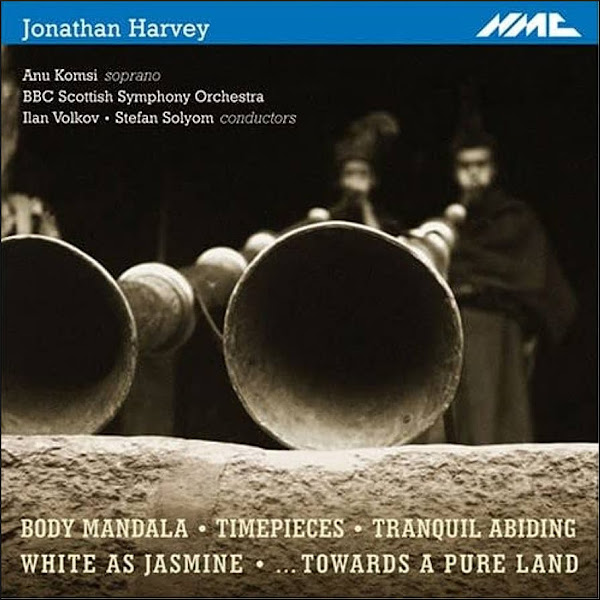
Everything falls under the law of change,  Like a dream, a phantom, a bubble, a shadow,  Like dew or a flash of lightning;  You should contemplate like this.   - Conclusion of The Diamond Sutra Recent listening and reading: Body Mandala, Jonathan Harvey - BBCSO, Ilan Volkov & Stefan Solyom Muse, Odalisque, Handmaiden - Rose Simpson Toru Takemitsu, Complete Works for Solo Piano - Paul Crossley Monolithic Undertow, In Search of Sonic Oblivion - Harry Sword On the Threshold of a Dream - Moody Blues Moroccan Atlas, The Trekking Guide - Alan Palmer Zones, Drones & Atmospheres - Steve Roach An Ugly Truth, Inside Facebook's Battle for Domination - Sheera Frenkel & Cecilia Kang

....towards a Pure Land

Image
....towards a Pure Land for small string ensemble and orchestra by Jonathan Harvey describes, in the words of the composer, "a state of mind beyond suffering where there is no grasping... a model of the world to which we can aspire".  In the photo above I am interviewing Jonathan Harvey in August 2010. When the interview was finished I drove down from his house on the Sussex Downs and ate alone in a restaurant in Lewes. During my meal I listened to the interview again on headphones, and as I listened it became apparent that something rather special had been captured. This was confirmed when the interview was subsequently broadcast on Future Radio : how many contemporary composers have made the news - not arts - sections of the Guardian and the Telegraph in the same week? Very sadly, the interview was made even more special by Jonathan's untimely death two years later. Jonathan Harvey was a true Renaissance man, and in the interview he ranges from Britten, Stockhause...

Negativity is positive

Image
'The Internet I'd grown up with, the Internet that had raised me, was disappearing...The very act of going online, which had once seemed like a marvellous adventure, now seemed like a fraught ordeal. Self-expression now required such strong self-protection as to obviate its liberties and nullify its pleasures. Every communication was a matter not of creativity but of safety.... When I came to know it, the Internet was a very different thing.  It was a friend and a parent. It was a community without border or limit, one voice and millions, a common frontier that had been settled but not exploited by diverse tribes living amicably enough side by side, each member of which was free to choose their own name and history and customs.... Certainly, there was conflict, but it was outweighed by goodwill and good feelings - the true pioneering spirit.... You will understand, then, when I say that the Internet of today is unrecognizable ' - Edward Snowden Permanent Record 'I...

He wrote uncompromising yet accessible music

Image
One of the many worrying trends in our digital culture is the blurring - or indeed elimination - of the dividing lines between private and public lives . Probably because my advanced years mean I am not a digital native I have resisted that trend, which may account for why OAOP has just a modest but select readership.  But the personal does have a role to play. I can see no point in parroting news that is readily available in the public domain rubberstamped with a YouTube clip that is, of course, also in the public domain. But I do see the value of writing about events that touch me personally.  Which is why I am commenting on the sad news of the death of the Belgian composer Wim Henderickx at the far too early age of 60. Last year I wrote about Wim Henderickx , whose music was influenced by Jonathan Harvey's . Writing about the recording of his works for string orchestra I explained "Wim Henderickx's music is notable for being uncompromisingly contemporary yet acces...

Is this the concert hall of the future?

Image
Classical music is irrevocably and fatally tied to place. Geocentricity dictates that the only place to hear classical music is an acoustically perfect concert hall . It dictates that this concert hall must be in a city centre , and also mandates that city centres are the only place to hear classical music. And geocentricity dictates that the only music to hear in the acoustically perfect city centre halls is from the European classical tradition. New technologies have created a mobile generation - mobile computing, mobile communications, mobile listening , and mobile workplaces. Yet classical music remains wedded to immobility and geocentricity.  In his memoir Silences So Deep John Luther Adams explains how "I began to feel that my music was no longer about place, but had in a real sense become a place of its own". Aspects of the recent Arts Council England proposals may be wrong-headed. But the underlying message of the proposals was profound and, predictably, overloo...

Towards infinite potential

Image
The Copenhagen interpretation of quantum mechanics postulates that "atoms form a world of potentials and possibilities, rather than of things and facts". Following a parallel path Ajahn Sumedho , a teacher from the Thai Forest Buddhist tradition , has proposed that: We do not know the future. But we do not need to know. We can let the future be the mysterious unknown, the infinite potential - the possibility for pleasure, the possibility for pain, the possibility for peace. As we let go of the fear of the unknown, we find peace. My photo of a stormy sky over Colombo in Sri Lanka hints at that infinite potential. There are many ways to experience it, and music is one of them. For me two examples particularly relevant to this post are Claude Vivier's Siddhartha and Jonathan Harvey's Body Mandala . It is now time for me to defy my advancing years and travel into the mysterious unknown of the future. Which means On An Overgrown Path  will fall silent, When, or indeed i...

What do new young audiences want from classical music?

Image
Mortuos Plango, Vivos Voco for pre-recorded eight-track tape was commissioned for IRCAM by the Centre Georges Pompidou. It was created by Jonathan Harvey at IRCAM in 1980 by digitally manipulating the sound of the great tenor bell of Winchester Cathedral and the singing voice of Jonathan's son Dominic, who was then a chorister at the Cathedral. Jonathan embraced digital sound shaping in many of his compositions, notably in Speakings composed in 2008 which uses an electronic transformation application developed at IRCAM to make an orchestra ‘speak’. (See my 2010 interview with Jonathan in which he introduces Speakings with a detailed description of that transformation process.)    Despite using none of the instruments found in a conventional Western classical orchestra,  Mortuos Plango, Vivos Voco is Jonathan Harvey's best known work. The reason for this is suggested by a Google search for Mortuos Plango, Vivos Voco . The first of the 20,800 results lists the stream...

Four great albums that are victims of clickbait correctness

Image
Clickbait correctness - if ain't clickable, don't hype it on social media - means some great albums are not receiving the attention they deserve. My recent rewarding listening has included the new Alice Coltrane release Kirtan: Turiya Sings . Kirtans are sacred Vedic chants, and  Turiya Sings  was originally released exclusively on cassette in 1982 for the students of Alice Coltrane's ashram at the The Vedantic Center, northwest of Los Angeles. For this cassette release synthesizers, strings, and sound effects were added to Alice Coltrane’s voice and organ. Although this mix was never commercially released, it achieved cult status as a bootleg recording. The reason for the absence of a commercial release remains unclear, but the most plausible explanation is that the complete master tapes were not retained, making quality remastering impossible. But in 2004 Ravi Coltrane , who is Alice’s son by John Coltrane and producer of this new release, discovered tapes of just Ali...