Showing posts with label blythburgh church. Show all posts

Monday, December 24, 2007

Happy Christmas to all my readers


Photo taken at the festival of lessons and carols in Blythburgh Church sung by the Blythburgh Singers on December 22nd, 2007, a church which has many connections with Benjamin Britten. Have a peaceful Christmas everyone, and a musical New Year.
Any copyrighted material on these pages is included as "fair use", for the purpose of study, review or critical analysis only, and will be removed at the request of copyright owner(s). Report broken links, missing images and errors to - overgrownpath at hotmail dot co dot uk

Wednesday, April 18, 2007

How long is long enough?


Three wonderful concerts in just over a week left me wondering how long is long enough? At Norwich Cathedral last Friday Stephen Layton with Polyphony, Trinity College Choir and the Britten Sinfonia offered a concert of glorious Poulenc and Messiaen lasting 64 minutes excluding the interval. The second half comprised just the Poulenc Gloria, which lasted 27 minutes. The duration of 64 minutes is, of course, the length of a CD, which is no coincidence as the programme will be recorded by Hyperion in the next few days for future CD release.

But 27 minutes doesn't take my prize for the shortest programme half. Just eight days before at Snape, the up and coming Russian Alexander Polianichko conducted the Britten Pears Orchestra in a stunning second half of just the 1919 version of Stravinsky's Firebird. Now at little over 20 minutes that takes my prize for the shortest ever programme half. Can any readers beat it?

Just hours after the fleeting Firebird we experienced programme planning going too far the other way at nearby Blythburgh Church. Now this is a very famous venue, not the least for Benjamin Britten's performances which I wrote about here. Blythburgh is a glorious church with glorious acoustics, but it does have its problems as a concert venue. There are no, what they call at Disney Hall, amenities. The car park is a grass field which becomes a bog in wet weather. And the rest rooms, as they call them over on Sequenza21, are two agricutural sheds down a grass slope at the rear of the church. But the fact that that Ben and Peter used these very urinals gives a whole new meaning to the word resonance.


To historic Blythburgh and its agricultural amenities came the brilliant young vocal group Exaudi (who featured in my Elisabeth Lutyens article) and viol consort Fretwork with a suitably sombre programme of sacred music for the Saturday between Good Friday and Easter Day. Now Good Friday is a fine time to do penance. But twelve o'clock on a Saturday is not so good for 90 minutes of Christian Geist, Heinrich Schütz and Arvo Pärt (his exquisite Stabat Mater in the arrangement by Macolm Bruno for viols) without an interval.

As the excellent performance progressed it was clear that the great and good among the Aldeburgh Easter Festival goers had booked lunch in nearby Southwold's trendy restaurants. In order not to lose their tables the audience was slowly slipping away, just like the North Sea tide that you see in my accompanying photos. Exaudi's young director, James Weeks, rose to the occasion like a true professional, and announced that the eight verses of Christian Geist's Es war aber would be truncated to two in the interests of gastronomy, and we were released into the glorious Easter sunshine with Schütz's mercifully short motet Die mit Tränen säen ringing in our ears.

But this Overgrown Path has a happy ending. We would never leave a concert early for something as mundane as a restaurant booking. After relishing the superb Blythburgh concert to its proper conclusion we enjoyed our tasty picnic (and just a little wine) at nearby Aldeburgh. The photos of Iken Church (the village of Iken is the setting for Britten's The Little Sweep) and the Alde estuary which accompany this article were taken near our picnic site. With views like this long can never be long enough.


Now talking of sacred music, read about L'Orgue Mystique
Any copyrighted material on these pages is included as "fair use", for the purpose of study, review or critical analysis only, and will be removed at the request of copyright owner(s). Report broken links, missing images and other errors to - overgrownpath at hotmail dot co dot uk
Sunday, August 20, 2006

Britten's musical mind map

What a blog! A big hurdle to be overcome: music's use to further distinguish, even exalt, a given class distiction. Even in ancient Greece, there was 'elitist' music. Today, rap a genre of primarily non-eltitist society, occupies a powerful vantantage point for influence. Well funded and world wide, rap is turning music, eltism, and influence, on its head. But what is built on sand gets pumelled by the storm of time.

Posted by Sostenuto (sic) to my article Music and politics. Whenever a thoughtful comment like that is added I click through to the poster's own blog. Sostenuto describes himself as 'a violinist in his early stages as a composer. I consider my musical influences to be Bach, Messiaen, Monteverdi (early music in general,) Schoenberg, Hindemith, Stravinsky, Mozart, Glass and the like. I'm currently studying music performance with Mathias Tacke of the Vermeer Quartet along with compositional studies.' With those musical influences he'd probably qualify for a mention here anyway, but it was the name of Sostenuto's blog that caught my attention - A musical mind map.


That produced one of those blazing 'why didn't I think of that moments?' for me. I tried in one of my first ever posts, Serendipity and Collaborative Filtering, to articulate what On An Overgrown Path is about. For anyone that hasn't come across mind maps they are a form of non-linear radiant presentation that allows the fast exploration, and development, of an idea while simultaneouly maintaining clear focus on the central themes.

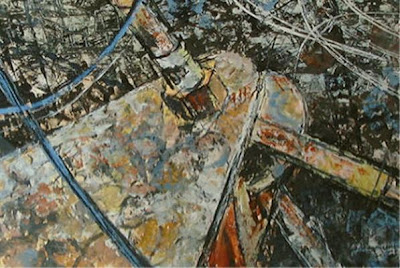
Interestingly, although mind maps have been around since at least the 1970s their topography approximates closely to the navigation map of a website, and as the illustration here shows a mind map has striking similarities to the architecture of some contemporary music. Now I've used mind maps extensively in my day job, and in fact my current project started from just one mind map. But I had never seen the blindingly obvious - On An Overgrown Path is a non-linear interlinked exploration of themes, just like Sostenuto's blog it is a musical mind map.

This non-linear path leads me to yet another musical destination. Last night was one of those very rare moments when the musical and theatrical planets aligned to transcend what Wilhelm Furtwängler described as 'the hoar frost of routine'. Benjamin Britten's church parable Curlew River is an elusive work that is dauntingly difficult to pull off in a live performance. The role of the Madwoman will always prompt comparison with the singer it was written for, the incomparable Peter Pears. The modest scoring for just seven instruments, with its remorselessly exposed passages, makes extraordinary demands on the players, while the composition is so venue specific (see Britten – music does not exist in a vacuum) that it only works in an acoustic very similar to that of the East Anglian church of Orford where it was first performed. And an excellent recording, production photographs and living memories mean Britten's original presentation is always there for comparison, and my photograph above shows the original production with Pears as the madwoman prostrating himself at the foot of the cross.

Mahogany Opera are not a company to shirk challenges, and they chose a venue closely linked to Britten to premiere their new production of Curlew River. Holy Trinity Church, Blythburgh is not only an architectural wonder in its own right, it is also a short distance from Aldeburgh and Orford, and it is a church Britten himself knew well as it was here that the 1969 Aldeburgh Festival was transferred to, including an aclaimed production of Idomeneo, after the original Snape Maltings concert hall was destroyed by fire - see Music will rise from the wreckage.

Of course Curlew River is a musical mind map par excellence, a non-linear exploration of plainsong, Japanese Noh theatre, medieval religous drama and 20th century musical vocabulary. Mahogany Opera's Director and Producer Frederic Wake-Walker grasped these disparate threads and welded them together to deliver one of the most memorable evenings of music drama that I have ever been priviliged to attend. From the moment the opening plainsong 'Te lucis ante terminum' drifted in from the churchyard and the performers processed in through the west door of the darkened 15th century church it was clear that this performance was going to be an 'out-of-body' experience, and the next 70 minutes did not disappoint.

This was Britten delivered by an inspired group of young performers who shared much with the original 1958 performers. Frederic Wake-Walker is just 25, he was brought up in Suffolk and sung as a treble in Britten operas at Snape. He recently graduated from Edinburgh University with a Masters in Philosophy and Systematic Theology, is now a staff director at Glyndebourne, and has worked in other opera houses with Franco Zeffirelli, John Cox, and David McVicar. Musical Director Nicholas Collon recently graduated from Clare College, Cambridge where he was the Organ Scholar reading music. His performers consistently maintained the high standards demanded by Britten's writing. John McMunn, the excellent Madwoman, is an alumnus of Harvard, and he has just graduated from King's College, Cambridge where he was a choral scholar.

Designer of the visually stunning production, from which the two production shots above are taken, is Mara Amats who was born in Latvia, was apprenticed to the monk and iconographer, Gregory Krug, at the monastery of Our Lady of Kazan near Fontainbleu in France, trained restoring icons and frescoes in Ethiopia, and spent many years working with craftsmen and artists in impoverished areas of Africa, India, Nepal, the Caribbean and Central Asia. The production poster by Maria Amats which I reproduce below uses reeds which grow in the rivers and marshes around Britten's Aldeburgh.

Mahogany Opera is a company to watch out for. They will be following Curlew River with Noye's Fludde in 2007, and their future plans include the UK premiere (plus a performance in Berlin) of Boris Blacher's Abstrakte Oper Nr 1, the world premiere of Capital Transfer by Kenneth Platts, a choreographed production of Schoenberg's Von Heute auf Morgan, and a new Greek opera by Evangeli Rigaki called The Last God with a libretto by the muti-talented Frederic Wake-Walker.

This new production of Curlew River is an important milestone from an exciting new professional company. Catch it if you can in the much bigger performing space of Southwark Cathedral, London on August 22, Holy Trinity, Melford, on August 24, and All Saint's, Burnham Thorpe, Norfolk, August 26 & 27. For more details follow this link.

Thank you Mahogany Opera for a truly magical evening of music making, and thank you Sostenuto for sparking this particular musical mind map. And do return here tomorrow for an article on racial elitism in music.

Image credits: Noh mask from Austrian Theatre Museum, Lobkowitzplatz, Vienna, Curlew River from The Musical Times. Production shots Mahogany Opera. Any copyrighted material on these pages is included as "fair use", for the purpose of study, review or critical analysis only, and will be removed at the request of copyright owner(s). Report broken links, missing images and other errors to - overgrownpath at hotmail dot co dot uk
If you enjoyed this post take An Overgrown Path to Is classical music too fast?

Sunday, September 11, 2005

Music will rise from the wreckage.....

Steel works, Snape Maltings fire: mixed media by Cavendish Morton linked from Island Arts

It was a dark night, but as we came over the brow of the hill the sky was lit up by an orange glow, with a trial of thick smoke. If this was dramatic, seen from close to it was positively theatrical. Above our heads the black shell of the Maltings loomed like the flank of a stricken liner..... In the foreground, silhouetted against the bright lights, members of the English Opera Group chorus were collapsing into each other's arms. It was a devastating event, of course, but one whose aftermath - the triumphant rescue of the Idomeneo premiere at Blythburgh, and the Maltings rebuilding for the very next Festival - swiftly became part of the Aldeburgh legend.

In 1965 the expanding Aldeburgh Festival urgently needed a purpose built concert hall. After much searching Benjamin Britten and Peter Pears found a disused maltings at Snape on the River Alde four miles upstream from Aldeburgh. Architects Arup Associates were commissioned to oversee the conversion of the old agricultural building into a state of the art auditorium. The new hall was opened by Her Majesty The Queen in June 1967 (photo right) to universal acclaim, both for its outstanding acoustics and sympathetic conversion.

The opening concert of the 1969 season was an afternoon performance of Schubert's Trout by Britten and the Amadeus Quartet. During the evening fire broke out beneath the stage and quickly spread to the whole hall, resulting in the conflagration described above by an eyewitness, the pianist and accompanist Roger Vignoles. (The quote is from Autograph Books excellent Time & Concord - Aldeburgh Festival Recollections). The fire completely destroyed the roof, stage, seating, and flooring. All that remained of the main building were the structural walls which were damaged but still standing. (The photo to the right shows Britten and Pears standing in the wreckage). As serious as the structural damage was the artistic loss was even greater. Two of the precious instruments used in the Trout were burnt beyond recognition - Britten's own Steinway concert grand, and cellist Adrian Beer's priceless Grancino double-bass. Adrain Beer heart-wrenchingly describes how all he found were "some ashes and metal parts of that lovely instrument." Also totally lost were the costumes for the new production of Idomeneo that was to be premiered by Britten's English Opera Group in the Maltings three days later.

Through superhuman efforts by Britten, Pears and the Festival committee, Idomeno was transferred to a hastily constructed stage in Blythburgh Church. Costumes were borrowed from the London opera houses, and the premiere went ahead to critical acclaim. Of the other eighteen performances in the 1969 Festival only one was lost, the others all took place in alternative venues.

As if all that work was not enough, on the day following the devastating fire Britten and Pears started planning the rebuilding of the gutted Maltings. Miraculously this herculean task was completed for the first concert of the following season. On 2nd June 1970 the Queen returned to re-open the Maltings (and reportedly said she hoped not to be invited back for a third time). The rebuilt hall that rose phoenix-like from the wreckage proved to have acoustics identical to the original. (In fact some claimed the acoustics of the rebuilt auditorium were superior as Britten had authorised subtle changes).

That three week long 1970 season included three performances in the rebuilt hall of Idomeneo. There were also two performaces of a new production of Britten's opera The Rape of Lucretia, and three of the church parable Curlew River. The rebuilt Maltings was also saw venue for the first performance of Shostakovich's Fourteenth Symphony outside Russia. It was conducted by its dedicatee Britten, and performed with the two soloists for whom it was written, Galina Vishnevskaya and Mark Rezhetin. (Photo above is Britten with Rostropovich, Vishnevskaya and Pears). Other Festival concerts included the world premiere of Hans Werner Henze's vivid theatre piece about a runaway Cuban slave, El Cimarron, conducted by the composer, and Dvorak's Requiem directed by Philip Ledger. Composer and guitarist Leo Brouwer continued the Cuban theme with a concert that gave both an overview of the history of the music of his native Cuba, and a parallel account of political developments there.

The rebuilding of the Snape Maltings concert hall, and the quality of the 1969 and 1970 Aldeburgh Festivals are enduring proof that music will rise from the wreckage. In 1964 Benjamin Britten was awarded the first Robert O. Anderson Aspen Award in the Humanities for 'the individual anywhere in the world judged to have made the greatest contribution to the advancement of the humanities.'

Britten's acceptance speech was subsequently published by Faber as a slim volume (right). It is an important document in which Britten sets out his beliefs and convictions as an artist. The speech has been an inspiration to many others over the years. Not only does it throw light on a great artist and visionary, but it also identifies the crucial issues which are still the concern of all those with an interest in the arts in the 21st Century.

E.M. Forster wrote the following eulogy to the Aspen acceptance speech. It can equally be applied to Britten's miracle of making music rise from the wreckage:

"A confession of faith from a great musician which should awake a response in the hearts of the rest of us, whether we are musicians or not, and whether we are great or small."


I am fortunte to live close to the Maltings, and can savour the legendary sound first hand. For CD listeners the peerless acoustics of the Snape Maltings (photo above) are well served by Britten's legacy of recordings made there for Decca. While I have been typing this article one of my favourites has been playing. Britten is not the immediate conductor that comes to mind for the Dream of Gerontius. But the combination of the date of this post, Elgar's divine music, Britten's inspited conducting, Peter Pear's sublime singing, the radiant Maltings acoustic, and the retelling of the miracle of the Maltings rising from the wreckage has brought tears to my eyes. Alas, like that peerless 1970 Aldeburgh Festival, Britten's recording of Gerontius is a thing of the past - it is deleted.

The definitive life is Benjamin Britten,A Biography by the late lamented Humphrey Carpenter who I paid tribute to in Death of a renaissance man. Thankfully Humphrey Carpenter's sharply observed book cuts through the syncophancy with which Britten surrounded himself in Aldeburgh. Three out-of-print books are well worth seeking out; Benjamin Britten, A Life in Pictures 1913-1976 compiled by Donald Mitchell and John Evans, the previously mentioned Time & Concord - Aldeburgh Festival Recollections from Autograph Books, and On Receiving The First Aspen Award by Britten himself.

All archive photos are linked from the excellent Britten-Pears Foundation web site.

If you enjoyed this post take an overgrown path to Dresden 1945 - London 2005