'In the beginner's mind there are many possibilities, but in the expert's there are few... This is also the real secret of the arts: always be a beginner.'
Those are the words of Zen master Shunryu Suzuki and the calligraphy for 'beginner's mind' is also by Suzuki. I am away now for a while rediscovering my beginner's mind. Please support other music blogs while I am offline, but do beware of experts. There is Buddhism of a different flavour in New music in the paradise garden.
Quote is from Zen Mind, Beginners Mind by Shunryu Suzuki. Note that this is a different Suzuki to the Zen master D.T. Suzuki who influenced John Cage and many others. Any copyrighted material on these pages is included as "fair use", for the purpose of study, review or critical analysis only, and will be removed at the request of copyright owner(s). Report broken links, missing images and errors to - overgrownpath at hotmail dot co dot uk Also on Facebook and Twitter.
L'Orchestre National de Barbès takes its name from the Boulevard Barbès in the 18th arrondissement de Paris, an area known as "little Algeria". It is here that much of the sediment stirred up by France's colonial misadventures in North Africa has settled, and in musical terms that sediment is remarkably fertile. The ten piece band had its early roots in Belcourt, a working class section of Algiers, and several founder members including a Sufi percussionist left Algeria for France as exiles. The residents of Barbès jokingly consider the area to be an independent state and the title track from the self-styled national orchestra's latest CD Rendez-vous Barbès is a hymn of praise to a little bit of Africa stranded in the heart of Paris, a concept that does not meet with universal approval. Traditional North African instruments such as the guembri and karkabou blend with synthesizers and electric guitars to produce L'Orchestre National de Barbès' unique mix of contemporary rai and centuries old gnawa blues. The band connects with audiences in venues as varied as stadiums and the Queen Elizabeth Hall, London, gaining a glowing review at the latter from the classically oriented Arts Desk.
There is a lot that classical music can learn from how L'Orchestre National de Barbès has its four Es firmly in place. They engage with socially relevant lyrics that portray what life is really like in immigrant communities in Europe today - what a contrast to the tourist brochure image of Europe currently being portrayed in BBC TV's Symphony series. They educate by singing about polititical issues: for instance one of their songs highlights the plight of North African soldiers who fought for France in World War II but who now receive no recognition from the French government. They enlighten with the mystical power of healing rhythms while avoiding fashionable but tacky East meets West routines. Finally they entertain through their passionate commitment to live music. No classical musician has made the case for live music more eloquently than L'Orchestre National de Barbès did at a recent London concert when they declared from the stage "you can cook by yourself, but you can't make love by yourself". Yet more support for Pablo Casals' view that "music must serve a purpose".
* Founder member Aziz Sahmaoui left L'Orchestre National de Barbès to form the University of Gnawa. Read more about him in the memorably titled Who needs self-righteous bullshit artists?
Rendez-vous Barbès was bought in France. Any copyrighted material on these pages is included as "fair use", for the purpose of study, review or critical analysis only, and will be removed at the request of copyright owner(s). Report broken links, missing images and errors to - overgrownpath at hotmail dot co dot uk Also on Facebook and Twitter.
'I believe that the Eighth Symphony was not the only work which Sibelius destroyed... He spoke again and again about the unpublished works of his youth, with evident disquiet. He was oppressed by the though that after his death they would be taken out of their hiding place and made public'.
Those are the words of Santeri Levas who was secretary to Sibelius from 1938 until the composer's death in 1957, which includes the period when he worked on the Eighth Symphony. The sketches which have recently surfaced may not be youthful works, but am I the only one to feel rather sad that the composer's explicit wishes are viewed as less important than the media opportunity offered by a playthrough of "the possible initial draft of the Eighth Symphony"? Will the next advance in Sibelius scholarship be to ignore the composer's wishes as expressed in the scores of his extant symphonies?
Header quote is from Sibelius, a personal portrait by Santeri Leavas. Any copyrighted material on these pages is included as "fair use", for the purpose of study, review or critical analysis only, and will be removed at the request of copyright owner(s). Report broken links, missing images and errors to - overgrownpath at hotmail dot co dot uk Also on Facebook and Twitter.
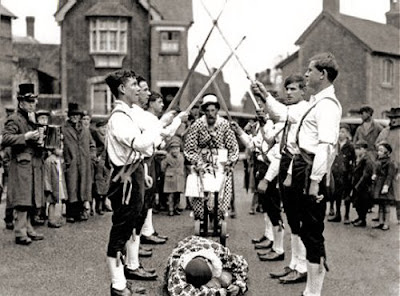
Rolf Gardiner, front right, with folk dancers in Dorchester 1939. Herbert von Karajan, Wilhelm Furtwängler and Elisabeth Schwarzkopf are some of the musicians known to have links with fascism, and classical music's various dalliances with the Nazis are well documented. But folk music is considered to be a left-wing artform and little is known about its connections with the political right. November 26th 2011 is the fortieth anniversary of the death of Rolf Gardiner, who in addition to being a leading English folk music and rural revivalist and father of conductor John Eliot Gardiner, was also a right-wing activist. Here is his story.
After leaving St John's College Cambridge in 1924, where he studied modern languages and performed calisthenics naked on the banks of the Cam, Rolf Gardiner started performing with his Travelling Morrice dance troupe. Although Gardiner was one of the pioneers in the folk music revival, his political and occultist agendas were not shared by more traditional revivalists such as Cecil Sharp. Gardiner believed morris dancing was a form of earth magic that connects the universe to the soil through the conducting rod of the human body and as female participation would disrupt these elemental energies he advocated that dancing should be restricted to virile males. In the late 1920s Gardiner, who had typically blond Aryan colouring, became involved in international youth projects. His agenda was to promote understanding between Britain and Germany by organising work camps and leading folk dancing and lecture tours in England, Germany and the Baltic States.
Gardiner was involved with several of the diverse Scouting movements that originated in the 1920s and was 'gleemaster' of the Kibbo Kift. This was a youth organisation that mixed outdoor survival skills with neo-pagan spirituality and which numbered Nobel laureate Rabindranath Tagore, H. G. Wells and eugenics pioneer Julian Huxley on its advisory committee. In the 1930s Gardiner organised Whitsun choral festivals at his Springhead Estate in Dorset and he set up the Gore Kinship group on his estate modelled on German youth groups - see the photo below.
Later Rolf Gardiner joined the English Mistery and English Array organisations. The former was a political and esoteric group that has been described as "reactionary ultra-royalist and anti-democratic". After a split in the English Mistery in 1936 the English Array was formed with a more overtly pro-Nazi agenda which aligned it with Oswald Moseley's British Union of Fascists. Gardiner was an admirer of the Jugendbewegung (German Youth Movement) and later a supporter of Nazi pro-ruralist policies. From the late 1920s he publicly advocated policies to counter what he saw as the "impoverishment" of the national racial stock, and from 1933 published anti-Semitic views, initially in German.
When the full extent of the Nazi programme became known Gardiner modified his idiosyncratic interpretations of folk ritual After the Battle of Britain in 1940 he made a broadcast on BBC radio in which which he distanced himself from Nazism and justified his support for prominent German ruralist whose policies he claimed had been misappropriated by the Nazis. In 1941 Gardiner became a founder member of Kinship in Husbandry, a precursor to the influential Soil Association, which today has HRH the Prince of Wales as its royal patron.
However, after World War II Gardiner maintained contact with Richard Darré who he had visited in Germany before the war. Bearing the rank of SS-Obergruppenführer Darré served as Reich Minister of Food and Agriculture from 1933 to 1942. He was tried and found guilty at the Nuremberg Trials but was released in 1950 after serving part of his sentence and died three years later. Darré was the Nazi genetics expert who made the infamous "all men remaining in Britain as slaves will be sterilised" speech in 1940.
Rolf Gardiner died in 1971 and is remembered today mainly for his pioneering approach to organic farming which lives on in the work of the Soil Association. His reputation has been variously summarised as "an enigmatic and complex English paternalist and patriot whose intellectual and practical influence on later generations of organicists has been profound" and "the English neo-Nazi". His work with music and dance is almost forgotten but it did surface in the 2008 book Youth Culture in Modern Britain. In it Cambridge University academic David Fowlerargues that the Beatles "were young capitalists who, far from developing a youth culture, were exploiting youth culture by promoting fan worship, mindless screaming and nothing more than a passive teenage consumer" whereas "people like Rolf Gardiner were true cultural subversives - pop stars before pop stars even existed." So folk music pioneer, organic visionary, neo-Nazi or culturally subversive pop star? - you pays your money and you take your chance. But one thing is certain, Rolf Gardiner was complex.
A meeting of the Gore Kinship at the Gardiner family estate in Dorset..
* It should be noted that the German lawyer Manfred Pfister said the following in an interview: "John Eliot Gardiner may farm organically on the same acres and his ideas of polyphony and rhythm may in some way still be connected to the musical outlook of his father, but he long ago took his distance from the dodgy organicism of his father's political vision".
* John Eliot Gardiner's great-uncle was the composer Henry Balfour Gardiner who retired from music to manage his farm in Dorset.
* Cambridge University Library's Department of Manuscripts and University Archives hold Rolf Gardiner's papers and the biography on the University's website is notable for its omissions.
Also on Facebook and Twitter. Upper photo credit Dorset Life. Lower credit Utopia Britannica. Any copyrighted material on these pages is included as "fair use", for the purpose of study, review or critical analysis only, and will be removed at the request of copyright owner(s). Report broken links, missing images and errors to - overgrownpath at hotmail dot co dot uk
Alex Ross has a new My Favourite Records thread which starts with Björk's choice. So I am entering into the spirit of things by sharing the eight favourite records that Elisabeth Schwarzkopf chose when she appeared on the BBC's Desert Island Discs in July 1958. In the photo above I am talking to Elisabeth Schwarzkopf in 1979 at the Royal Festival Hall. Here are her favourite records.
1. Johannes Brahms Ihr habt nun Traurigkeit (from German Requiem) Soloist: Elisabeth Schwarzkopf Choir: Singverein der Gesellschaft der Musikfreunde in Wien Orchestra: Vienna Philharmonic Orchestra Conductor: Herbert von Karajan 2. Johann Strauss II Vienna Blood Waltz Soloist: Elisabeth Schwarzkopf, Nicolai Gedda Orchestra: Philharmonia Orchestra Conductor: Otto Ackerman 3. Richard Wagner Selig wie die Sonne (from Die Meistersinger von Nürnberg) Soloist: Elisabeth Schwarzkopf, Otto Edelmann, Hans Hopf et al Orchestra: Bayreuth Festival Orchestra Conductor: Herbert von Karajan 4 Wolfgang Amadeus Mozart An Chloe (K. 524) Soloist: Elisabeth Schwarzkopf, Walter Gieseking 5. Hugo Wolf Elfenlied (from Mörike Lieder) Soloist: Elisabeth Schwarzkopf, Gerald Moore 6. Giuseppe Verdi Tutto nel mondo è burla (from Falstaff) Soloist: Elisabeth Schwarzkopf, Fedora Barbieri, Nan Merriman et al Orchestra: Philharmonia Orchestra and Chorus Conductor: Herbert von Karajan 7. Engelbert Humperdinck Hänsel und Gretel: Elisabeth Schwarzkopf, Elisabeth Grümmer Orchestra: Philharmonia Orchestra Conductor: Herbert von Karajan Richard Strauss 8. Der Rosenkavalier Prelude Philharmonia Orchestra Conductor: Herbert von Karajan
In the Desert Island Discs interview Elisabeth Schwarzkopf said she did not watch very much Youtube, but nominated this as her favourite video.
Also on Facebook and Twitter. Photo is (c) On An Overgrown Path 2011. Any copyrighted material on these pages is included as "fair use", for the purpose of study, review or critical analysis only, and will be removed at the request of copyright owner(s). Report broken links, missing images and errors to - overgrownpath at hotmail dot co dot uk
'It is unnecessary and indeed presumptuous to come between the author and the reader of Cosmas or the Love of God. The book either speaks for itself or it does not.'
Also on Facebook and Twitter. Any copyrighted material on these pages is included as "fair use", for the purpose of study, review or critical analysis only, and will be removed at the request of copyright owner(s). Report broken links, missing images and errors to - overgrownpath at hotmail dot co dot uk
The connection between the sale of EMI to Universal Music and a 14th century Arab historian and philosopher may not be immediately obvious, but please stay with me. According to Ibn Khaldūn, who lived from 1332 to 1406, the fate of the population of North Africa and the Middle East is determined by the tension between nomads and sedentaries. The unchanging desert areas are the territory of wandering nomads who are forced by harsh conditions to be independent, brave and finely attuned to their environment. As excess population which cannot be supported by the desert accumulates there is migration to the cities which are built in more fertile areas.
The city is the territory of the sedentaries with an infrastructure geared to growth by supporting the arts, sciences and commerce. But the city is also where culture and society begin to decay and in the final part of the cycle the decaying city is eventually overwhelmed by more adaptable predatory nomads. Ibn Khaldūn concluded that the political destiny of North Africa and the Middle East is governed by this recurring cycle of states and empires being founded in the desert and declining in the city.
Now replace tribes with record companies and apply the same cycle to the music industry. EMI was, many years ago, a nomadic group of independent and brave people who were finely tuned to their environment. But then came the migration to the city, in more ways than one. With it came the inevitable decline at the hand of predatory and adaptable nomads in the form of new technology and distribution methods. And the only escape route was to be absorbed by an even larger city state called Universal Music, which is also a sedentary organisation in an advanced state of decay and vulnerable to nomadic predators.
Ibn Khaldūn's theory of nomads versus sedentaries does not just apply to record companies. It also applies to orchestras, conductors, broadcasters, and the media. Regular readers will know I am not a great fan of sedentaries and most of the names that feature here, such as Jordi Savall, Pablo Casals, Jonathan Harvey, Titi Robin, David Munrow, the Britten Sinfonia and Philippa Schuyler, are nomads. That is because I am all too familiar with the path that leads from desert to city from my time working for EMI. So try thinking in terms of nomads and sedentaries. Because I guarantee it will make you see the music industry in a different light.
With acknowledgement to Titus Burckhardt's Fez, City of Islam. Report broken links, missing images and errors to - overgrownpath at hotmail dot co dot uk Also on Facebook and Twitter.
When, at the age of eighty-one, Casals decided to marry the twenty-year old Marta, his doctor attempted to warn him of the grave consequences this might present for his health. 'It could even,' he suggested, 'be a matter of life or death.' The lively octogenarian sucked slowly on his pipe, reflecting on his dilemma before replying: 'Well, I look at it this way. If she dies, she dies.'
Photo shows Pablo Casals and Marta . It should be noted that Martita Casals Istomin went on to a distinguished career in music in her own right and is still with us. Story is from the indispensable but sadly out of print Song of the birds - Sayings, stories and impressions of Pablo Casals edited by Julian Lloyd Weber. Any copyrighted material on these pages is included as "fair use", for the purpose of study, review or critical analysis only, and will be removed at the request of copyright owner(s). Report broken links, missing images and errors to - overgrownpath at hotmail dot co dot uk Also on Facebook and Twitter.
'Music must serve a purpose, it must be something larger than itself, a part of humanity, and that, indeed, is at the core of my argument with music of today - its lack of humanity.'
Pablo Casals may have been speaking fifty years ago, but his ideas are still very relevant. The current trend to reposition classical music as entertainment bleaches it of humanity and purpose, and ultimately removes its raison d'être. The diagram above from a recent post attempted to capture this graphically and music teacher Liz Garnett has taken my theme and developed it admirably in a post on her own blog titled The 4 Es of classical music.
With Remembrance Sunday approaching there are attempts elsewhere to breathe life back into John Foulds' World Requiem, a work that was certified dead four years ago. Quite why resuscitation is being attempted is a mystery, particularly as there is another neglected large scale choral work that deals with similar Gnostic themes, and which also has the distinct advantage of being rather a good piece of music.
The neglect of Frederick Delius' A Mass of Life (Eine messe des Lebens) is one of classical music's many mysteries. Like the World Requiem and that other twitterati favourite, Havergal Brian's Gothic Symhony, A Mass of Life is very loud with a score that calls for full orchestra, chorus and four soloists. In fact the forces match those in that über fashionable work, Mahler's Eighth Symphony. And talking of musical icons, the final section of Delius' Mass sets Nietzche's 'O Mensch! Gib Acht!', as does Mahler's Third Symphony. In fact A Mass of Life is a setting of passages from Nietzsche's Also sprach Zarathustra, which makes it a first cousin not only of a Mahler symphony but also of one of the most popular works in the repertoire, Richard Strauss' eponymous tone poem.
In Electric Eden Rob Young suggests that the neglect of A Mass of Life is because Delius' "visionary setting of Nietzsche's Also Sprach Zarathustra, and its uncompromising atheism, are at odds with the verities of classical music's middlebrow audience". Peter J. Piries' 1979 book The English Musical Renaissance, which provided a much more accurate preview of John Foulds' World Requiem than the social media pundits, is also worth reading on A Mass of Life. Pirie judges it to be "a mixture of styles" but declares that "the whole is greater than the sum of the parts" and suggests that it should be taken up by "a young university choir of today, who would take the sensuous and libertarian sentiments and sing in the uninhibited way Delius wanted..."
Header image is Hans Olde's Nietzsche on his Sickbed (1899). Any copyrighted material on these pages is included as "fair use", for the purpose of study, review or critical analysis only, and will be removed at the request of copyright owner(s). Report broken links, missing images and errors to - overgrownpath at hotmail dot co dot uk Also on Facebook and Twitter.
Great picture [see below]. Are things much different now? At that time they had Chocolate Kiddies; now they have the hilariously over-exposed Porgy and Bess. Examining the largely negative roles in that opera (cocaine dealer, disabled, uneducated pauper, drug-addled woman of compromised virtue and slack loyalty) makes one wonder if we've come very far since then. Porgy and Bess usually sports an all-black cast, and touring productions have become the primary source of income for many singers of African descent. Could that be seen as a kind of ghettoization? Or worse?
Porgy and Bess does make a great contrast to William Grant Still's opera Troubled Island, which also utilizes an all-black cast to portray a drama about the fight for the independence of Haiti. These roles are positive. Could that be why it's only been staged once, and even though it was wildly cheered by the audiences at its premiere performances, the critics (ah, the conscience of the elite) unanimously patronized and panned it?
John makes some very good points. We wil be hearing a lot of Porgy and Bess in 2012 as it is the 75th anniversary of George Gershwin's death. Time for a fresh look at a "hilariously over-exposed" work?
* William Grant Still's Afro-American Symphony was performed at the historic 1945 concert when Rudolph Dunbar became the Berlin Philharmonic's first black conductor - read more here.
Also on Facebook and Twitter. Any copyrighted material on these pages is included as "fair use", for the purpose of study, review or critical analysis only, and will be removed at the request of copyright owner(s). Report broken links, missing images and errors to - overgrownpath at hotmail dot co dot uk
Yesterday brought something very rare, a television programme worth watching. BBC TV screened The Harmony Game- American director Jennifer Lebeau's portrait of the making of Simon and Garfunkel's Bridge Over Troubled Waters. Made with the full co-operation and participation of the duo plus contributions from producer Roy Halee and others involved in the album's production, this documentary informed while avoiding the all too common pitfall of a presenter gratuitously interposing himself between subject and audience,
Well, at least Jennifer Lebeau avoided the presenter trap. But the BBC did not. The Harmony Game was bought from the States as a 72 minute stand alone package. Despite which the BBC topped and tailed it with a three minute intro by presenter Alan Yentob, star of 'Noddygate', shot on location in Forest Hills, New York City. Which added nothing at all to Jennifer Lebeau's documentary but must have cost BBC license payers an arm and a leg.
But then Alan Yentob is no stranger to hitting the license payers where it hurts. At one time he was reportedly being paid £325,000 as BBC creative director while receiving additional fees for presenting the Imagine series, which last night's documentary was shoehorned into. On top of these two income streams Yentob was drawing a BBC final salary pension. In 2010 the post of creative director was axed, with a suitably comforting pay off. Which means the 64 year old Yentob is now struggling to survive on his fees as a presenter plus a BBC pension.
Also on Facebook and Twitter. Any copyrighted material on these pages is included as "fair use", for the purpose of study, review or critical analysis only, and will be removed at the request of copyright owner(s). Report broken links, missing images and errors to - overgrownpath at hotmail dot co dot uk
It was the German, Oscar Adolf Hermann Schmitz who wrote that England is 'Das Land Ohne Musik' — the land without music and to keep the record straight Schmitz is not mentioned in either of Alex's books. Report broken links, missing images and errors to - overgrownpath at hotmail dot co dot uk Also on Facebook and Twitter
Header photo is from 1925 when New York bandleader Sam Wooding's all-black jazz revue Chocolate Kiddies toured to Berlin. Among those in the audience was Ernst Krenek, who was inspired to compose Jonny Spielt Auf (Johnny Strikes Up). Heads up for Prelude Records where I noticed the Decca reissue. Any copyrighted material on these pages is included as "fair use", for the purpose of study, review or critical analysis only, and will be removed at the request of copyright owner(s). Report broken links, missing images and errors to - overgrownpath at hotmail dot co dot uk Also on Facebook and Twitter.
'In filleting out these lines from Machen's prose, Ireland gestures towards what, as a gay man, he was forced to conceal: the ecstasy of physical love. He would often allude to his (male, younger) lovers by citations from classical literature or Housman'sA Grecian Lad, one of several poet's works that Ireland set to music. He kept a statuette of Pan as a goat-god on his piano, a reminder of the pagan association with rapacious lust. The Forgotten Rite (1913), conjutes up Pan mischievously disrupting a solemn churchy atmosphere. 'I am far from repelled by an admixture of the occult and magic, of a genuine kind,' he wrote to one correspondent in typically understated style.'
That passage from Rob Young's indispensable Electric Eden sheds a different light on John Ireland, a composer usually damned by the faint praise of "English pastoralist". Arthur Machen was a Welsh author and mystic whose novella The Great God Pan is considered a classic of horror writing. Several of Ireland's works are dedicated to Machen including one of his best known, the Legend for piano and orchestra. Like Yeats, Aleister Crowley and Elgar's librettist Algernon Blackwood, Machen was a member of the secret occultist Hermetic Order of the Golden Dawn.
The reference to the statuette of the goat-god Pan on Ireland's piano takes us down an intriguing path that travels across time as well as continents and cultures. In the early twentieth century the eminent Finnish sociologist Edvard Westermarck suggested that the wild music of the Master Musicians that accompanies the erotic dance of the goat-man Bou-Jeloud at Jajouka in Morocco's Rif Mountains has its roots in ancient Greek Dionysian rituals. This led Rolling Stone Brian Jones to title the classic album he produced with the Master Musicians in 1968 The Pipes of Pan at Jajouka. Which means there is a direct path which starts 5000 years ago at the site of a fertility ritual in Greece. First it leads west from Greece to the mystical and some say homoerotic trance ceremony at Jajouka in Morocco's Rif mountains. Then it heads north across Europe to a converted windmill overlooking the reputed site of a witches coven on the Sussex Downs, where John Ireland spent his last days and died in 1962. Finally it reaches its destination at the house in Hartfield where Brian Jones drowned in 1969 after taking a cocktail of drugs and drink. Pan the goat-god is omnipresent, and by a strange, or perhaps not so strange, coincidence the houses where John Ireland and Brian Jones died within seven years of each other are just twenty-five miles apart.
Dutton have recently released a new transfer of Eileen Joyce playing John Ireland's Piano Concerto coupled with EJ Moeran's Symphony in G minor. Walter Legge, no less, was the producer of the sessions at which Leslie Heward conducted the Hallé Orchestra in the Houldsworth Hall Manchester in 1942. Heward succeeded Adrian Boult as conductor of the then City of Birmingham Orchestra in 1930 and seemed set for a permanent post at the Hallé, where he would have preempted the appointment of John Barbirolli. But ill-health culminating in tuberculosis intervened and the sessions for the Moeran Symphony in November and December 1942, at which the composer was present, were Heward's last and he died in May the following year aged just 45.
Artistic standards on the new CD are everything you would expect from a Walter Legge production, while Michael Dutton's remastering is, as usual, sonically impeccable. Leslie Heward's composer endorsed interpretation of the Moeran Symphony is widely regarded as definitive while Eileen Joyce's advocacy of John Ireland's sadly neglected Piano Concerto is totally winning. If that is not enough Leslie Heward Conducts retails for £6.
* Walter Legge's Gramophone tribute to Leslie Heward is essential reading. There is a path to the Moeran Symphony here and to the Master Musicians of Jajouka here.
Leslie Heward Conducts was bought at Prelude Records and Electric Eden was borrowed from Norwich Library. Header image credit to Boydell & Brewer's John Ireland Companion. Any copyrighted material on these pages is included as "fair use", for the purpose of study, review or critical analysis only, and will be removed at the request of copyright owner(s). Report broken links, missing images and errors to - overgrownpath at hotmail dot co dot uk Also on Facebook and Twitter.
'...I am slightly puzzled as to the problem.... there are no official limits on how much BBC people can tweet in a personal capacity at work. I myself do so frequently. My approach as a manager is that as long as this is not interfering with BBC work then there is no problem...'
* My header quote is extracted from an email that the ever helpful Nick Reynold's sent in response to my question about the personal use of Twitter by BBC staff. In that response Nick includes a useful link to the BBC's guidance on 'Social Networking, Microblogs and other Third Party Websites: Personal Use'. I decided against publishing Nick's reply in full for two reasons. First, this debate is about the BBC generally and I wanted to shift the focus away from individual employees. And secondly, some points in Nick's email deserve a further response. These are best handled offline both for reasons of brevity and because they refer to specific employees. However, if it is felt really necessary, Nick's email and my further response can be published in full. Please report broken links, missing images and errors to - overgrownpath at hotmail dot co dot uk And yes, this post is also on Facebook and Twitter.
In a recent post fellow blogger David Derrick expressed the opinion that Noel Coward, together with Britten and the Beatles, was the greatest English songwriter of the twentieth century. Which is a refreshing view, but a new ECM release highlights another pretender to the title. On her CD If Grief Could Wait Norwegian indie rock singer Susanna Wallumrød punctuates eight airs from the greatest English songwriter of the 17th century Henry Purcell with a song by Nick Drake and examples from Leonard Cohen plus one from her own pen - Nick is seen above at a photo opportunity with Henry Purcell, I wonder if they used the same hair stylist? Nick Drake's reputation as a great English songwriter is now at the post-cult phase, but there is another Joe Boyd protégée whose time has still to come.
Vashti Bunyan, seen below, was discovered by Joe Boyd in 1968 while travelling by gypsy caravan to the Isle of Skye and she joined Fairport Convention, The Incredible String band and Nick Drake in Boyd's Witchseason stable of artists. On her first album Just Another Diamond Day she was backed by members of Fairport and the Incredibles while Nick Drake's arranger Robert Kirby also contributed. Despite this sprinkling of stardust the album bombed at the tills and Vashti departed the music industry. She lived the alternative life in Scotland and Ireland for thirty years while, unknown to her, the deleted record became a cult item with examples reputedly selling on eBay for up to $2000.
Things started to change with the dawn of the new millenium. In 2000 Just Another Diamond Day was transferred to CD, in 2005 Vashti's second album Lookaftering was released and in 2006 a New York Press profile dubbed her 'the godmother of freak folk'. Both her studio albums are well worth seeking out. It is easy to dismiss Just Another Diamond Day as a hippie chick's hopelessly naïve paean to the hermetic lifestyle, but the naïvety is no more hopeless that that of our Murdoch hugging and Gadaffi consorting politicians. Lookaftering has an appealing mellowness born of extended exposure to the wiles of the record industry. In recent years the hermetic has met the commercial with Vashti Bunyan songs providing soundtracks for T-Mobile, Reebok and Samsung commercials - I am sure Noel Coward would have approved.
Also on Facebook and Twitter. If Grief Could Wait was a requested review sample. Any copyrighted material on these pages is included as "fair use", for the purpose of study, review or critical analysis only, and will be removed at the request of copyright owner(s). Report broken links, missing images and errors to - overgrownpath at hotmail dot co dot uk
Martin Scorsese has a knack of capturing the musical zeitgeist. He has directed biopics of George Harrison and Bob Dylan, and his film Kundun, which portrays the flight of the Dalai Lama from Tibet in 1959, was scored by Philip Glass. But another Scorsese movie, his controversial 1988 adaption of Nikos Kazantzakis' novel The Last Temptation of Christ, features music that is considerably less well known.
The Last Temptation of Christ uses the track Ya Sah by the Moroccan group Nass El Ghiwane. While working in a political theatre in the late 1960s the founder members of Nass El Ghiwane started using traditional North African music to communicate their views on political and social issues, and such was the success of their experiments that they went on to form their own group in 1969. The band's name translates as 'disciples of the Ghiwanes' - a reference to the Ghiwane Sufi brotherhood of musicians and story tellers. Nass El Ghiwane's music, which couples ethnic instruments and gnawa-style trance rhythms with rebellious lyrics delivered in dialectical Arabic, met with immediate success in Morocco and their popularity soon spread to neighbouring Algeria. Despite the death of two founder members the band continued and they are credited as being an influence on the development of North African raï music.
Such was the preeminence of Nass El Ghiwane that in the 1970s they were dubbed 'the Rolling Stones of Africa'. They succeeded because they put social engagement and spiritual enlightenment ahead of entertainment, and that is worth dwelling on at a time when classical music is agonising over how to connect with new audiences. Classical music can be plotted as a Venn diagram constructed on the four axes of engagement, enlightenment, education and entertainment - see example below. Received wisdom says that in order to connect and survive classical music must be heavy on entertainment and light on enlightenment, education and engagement, which locates it in the bottom right corner of the diagram below. But dwindling ageing audiences and the dramatic drop in listeners suffered by the new entertainment oriented BBC Radio 3 provide hard evidence that this received wisdom is wrong. Nass El Ghiwane are worth listening to in more ways than one. Or as Virgil Thomson said "Never underestimate the public's intelligence, baby".
* Nass El Ghiwane's El Maana is an engaging, enlightening and educating earworm. It is on the highly recommended 'Double Best' compilation album seen above. Despite the relatively high profile of Gnawa music and the Master Musicians of Jajouka the more accessible 'Rolling Stones of Africa' are little known outside the Maghreb. Hopefully this 2 CD compilation will help change that.
Nass El Ghiwane's Double Best CD was bought at Leclerc in Saint Gilles, France. Any copyrighted material on these pages is included as "fair use", for the purpose of study, review or critical analysis only, and will be removed at the request of copyright owner(s). Report broken links, missing images and errors to - overgrownpath at hotmail dot co dot uk Also on Facebook and Twitter.
There will be plenty of coverage today on the BBC and elsewhere of the pop-up symphony being performed by the BBC Symphony Orchestra at St Pancras International station. And so there should be because accessiblity lies at the heart of this pop-up Beethoven symphony - accessiblity that is to the mainstream media and political decision makers. Let me explain...
St Pancras International is the London terminal of the Eurostar rail service connecting England to Europe. The station was opened in 2007 after an £800 million restoration and its passenger profile is heavily biased towards business travellers, particularly civil servants and politicians travelling to Brussels and other EU centres. The station's shopping mall hosts prestigious stores and independent boutiques, the newly opened St Pancras Renaissance London Hotel has a restaurant run by celebrity chef Marcus Wareing, and among the twenty-four bars and restaurants is the longest champagne bar in Europe, which is seen above.
On the orchestra's website we are told that the "BBC Symphony Orchestra will be treating commuters to a live performance at St Pancras International Station". Which is a cynical manipulation of the truth: because the performance takes place at 1.00pm. The few commuters who use St Pancras International have long since passed through the concourse, but 1.00pm is perfect timing for the media to place the story in the evening TV news and following day's newspapers. And of course the station is easily accessible from the offices of journalists and politicians, not to mention the BBC's headquarters. Journalists will doubtless enjoy a drink at Europe's longest champagne bar - "the largest selection of Grand Marque houses in the UK" - before deciding how to reheat the press release puffing the linked BBC TV and radio series.
Please note, I am not anti-Eurostar. Image credit Searcys. Any copyrighted material on these pages is included as "fair use", for the purpose of study, review or critical analysis only, and will be removed at the request of copyright owner(s). Report broken links, missing images and errors to - overgrownpath at hotmail dot co dot uk Also on Facebook and Twitter.
Elizabeth Maconchy's The Land, a suite for orchestra was given its world premiere by Henry Wood and the BBC Symphony Orchestra at a Promenade Concert in August 1930 and the twenty-three year old composer's Prom debut received Dudamelesque press coverage including the headline 'Girl Composer's Triumph'. It may have been Elizabeth Maconchy's first Proms performance but it definitely was not the first performance by a woman (sorry girl) composer. But what was? My money would be on the October 1902 performance of the Dance from Ethel Smyth's opera Der Wald. But I have never been very successful at betting and I await correction by collaborative readers.
With the exception of Nicholas Kenyon's notorious female free 2006 Proms season, for which the Queen made him a night of the male composers, women composers are better accepted than women conductors - both at the BBC Proms and elsewhere. Is it because the Karajan-style macho male stereotype still dominates conducting? But let's continue down that path. A few years ago I pointed out that Nicholas Kenyon's official BBC Proms history omitted any mention of the first woman conductor, and subsequently Odaline de la Martinez confirmed on these pages that her 1984 Prom was indeed the first by a woman conductor at the Proms. Which means there was a an eighty-two year gap between Ethel Smyth's first Proms performance and Odaline de la Martinez's pioneering appearance on the podium. At which point paths felicitously converge as Odaline de la Martinez is the conductor of a new recording of Elizabeth Maconchy's music, which includes The Land, a suite for orchestra.
Box ticking is the plague of the 21st century. Which is not going to stop me saying that this new release of Elizaeth Maconchy's orchestral music ticks every conceivable box. A truly distinctive musical voice bearing hints of Bartok, Janacek and even Berg. A programme that includes Maconchy's arguably greatest achievement, her 1952/3 Symphony for Double String Orchestra. Passionate advocacy from the free-spirited BBC Scottish Sympony Orchestra under Odaline de la Martinez. Gloriously full-bodied and vivid sound captured in the City Halls, Glasgow. And released on the musician owned Lorelt label that specialises in contemporary and particularly women composers.
* I bought the CD of Elizabeth Maconchy's orchestral music online. The survival of independent retailers is very close to my heart. But what chance that survival when HMV offer prices like this online?
* Mention must also be made of Lyrita's work on behalf of Elizabeth Maconcy's music. Below is my 1982 LP from Vernon Handley and the London Symphony Orchestra which includes her Symphony for Double String Orchestra. The LP is available as a supplemented CD transfer. Visual trivia - the watercolours on the Lorelt and Lyrita sleeves are not by the same artist despite their visual similarity. The Lyrita artist is John Sell Cotman (1782-1842) while the Lorelt artist is by Elizabeth Maconchy's husband the medical librarian William LeFanu (1904-1995).
Also on Facebook and Twitter. Any copyrighted material on these pages is included as "fair use", for the purpose of study, review or critical analysis only, and will be removed at the request of copyright owner(s). Report broken links, missing images and errors to - overgrownpath at hotmail dot co dot uk