Sunday, April 30, 2006

Googling the Goldbergs

The internet is a wonderful and extraordinary world. Google ‘goldberg variations’ if you will. At the time of writing there were 580,000 results (nearly 3 times as many as for Beethoven’s Missa Solemnis, and over twice as many as for his 9th symphony).

From Richard Egarr's notes for his new recording of the Golbergs played on a reproduction Ruckers instrument voiced with quill, tuned to musicologist Bradley Lehman's 'Bach temparement', and including all the repeats, plus the rarely heard 14 Canons on the Ground from the Goldberg Variations, BWV 1087. These were discovered in 1974, and Egarr plays both voices in the canons using double-tracking. The sound, from the Dutch venue of the Vereenigde Doopsgezinde Gemeente in Te Haarlem, is demonstration quality.

The CD set includes an abbreviated version of Richard Egarr's excellent notes, you can read the full version online at the Harmonia Mundi website, including details of the tuning system used, via this link. And incidentally Egarr (photo above) doesn't mention in his notes that there are more than 100 recordings of the Goldbergs in the catalogue. But, despite that, his new version is a valuable, and recommended, addition. And interestingly, despite the repeats, it is not the longest at 83 minutes. Glen Wilson (Teldec), Sergio Vartolo (Tactus), and Igor Kipnis (EMI) all take the same time as Egarr, or longer. This new version spans two CDs, but Harmonia Mundi are pricing it as one.

Report broken links, missing images and other errors to - overgrownpath at hotmail dot co dot uk
If you enjoyed this post take An Overgrown Path to Messiaen stars in early music festival

Friday, April 28, 2006

About 50% musical forgery

Back in December I ran an exclusive story that an uncompleted Elgar sketch of a sixth Pomp and Circumstance March has been discovered, and that Anthony Payne was en route to completing it.

Yesterday BBC Proms Controller Nicholas Kenyon announced that the highlight of the 2006 Proms season will be ..... the first performance of Anthony Payne's completion of Elgar's sketch for a sixth Pomp and Circumstance March. Payne said the new march was about "50% Elgar and 50% me... when I do it, I feel I am getting under his skin, like an actor taking on a role" .

I repeat Paul Hindemith's words in his 1952 book A Composer's World:"You are not permitted to sell unsanitary macaroni or mustard, but nobody objects to your undermining the public's health by feeding it musical forgeries."

Image credit - Soundandvision.com. Image owners - if you do not want your picture used in this article please contact me and it will be removed. Report broken links, missing images and other errors to - overgrownpath at hotmail dot co dot uk
If you enjoyed this post take An Overgrown Path to Music history rewritten

Thursday, April 27, 2006

Musical chauvinism and inconsistency ...

Norman Lebrecht's latest tirade accuses English composers of 'chauvinism, amateurishness and bumbling inconsistency.'

I wonder when Norman last listened to Beethoven's Wellington's Victory, Op. 91?

Image credit - Euskalnet: Image owners - if you do not want your picture used in this article please contact me and it will be removed. Report broken links, missing images and other errors to - overgrownpath at hotmail dot co dot uk
If you enjoyed this post take An Overgrown Path to Wagner downloads and Beethoven cycles

New music scores with free downloads

Free MP3 downloads of classical music receive much attention, but a pioneering project using free downloads has been overlooked, and it may just be an important tool for contemporary composers as it offers free downloads of scores of specially commissioned new works.

New Music is a series of pieces for choir and organ specially commissioned from young composers by Choir & Organ magazine. In each bi-monthly issue a composer is profiled together with an analysis of his new composition. Unlimited copies of the composition can then be downloaded as pdf files from the Choir & Organ website via this link. The current magazine (May/June 2006) offers Chimera for organ by Matthew Martin, and the Antiphon to Mary by Basil Athanasiadis is also available.

Control of intellectual property ownership is attempted by the licensing small-print which says: 'New Music scores are available under license to be printed free of charge for a period of six months, after which time copies must be destroyed as copyright reverts to the composer. Further copies can then be ordered direct from the composer or publisher (see score for details)'.


There are some distinguished precedents for promoting new music via magazine giveaways. Tchaikovsky wrote Les saisons (The Seasons) from December 1875 to November 1876 at the request of N. M. Bernard, the editor of the Nuvellist, a St. Petersburg monthly music magazine. The composer contributed a 'season' per month, with the sheet music being given away with the magazine.

It remains to be seen as to how many performances will be achieved by the New Music project; but even it if it just one doesn't that make it worthwhile? And I have some doubts as to how effective the voluntary six month 'destroy' clause will be - as the record companies have discovered to their cost it is remarkably difficult to turn sausages back into pigs. But Choir & Organ's New Music initiative is to be heartily applauded. We need innovations like this to bring deserving new music to appreciative audiences, not the BBC's self-serving PR exercises with Wagner and Beethoven downloads.

Report broken links, missing images and other errors to - overgrownpath at hotmail dot co dot uk
For more like this take An Overgrown Path to What exactly is a 'classic'?

Wednesday, April 26, 2006

Bring forth new life - Chernobyl 26th April 1986


It was a night spent in the basement of a burnt out building.
People injured by the atomic bomb took shelter in this room, filling it.
They passed the night in darkness, not even a single candle among them.
The raw smell of blood, the stench of death.
Body heat and the reek of sweat. Moaning.
Miraculously, out of the darkness, a voice sounded:
"The baby's coming!"
In that basement room, in those lower reaches of hell,
A young woman was now going into labor.
What were they to do,
Without even a single match to light the darkness?
People forgot their own suffering to do what they could.
A seriously injured woman who had been moaning but a moments before,
Spoke out:
"I'm a midwife. Let me help with the birth."
And now life was born
There in the deep, dark depths of hell.
Her work done, the midwife did not even wait for the break of day.
She died, still covered with the blood.
Bring forth new life!
Even should it cost me my own,
Bring forth new life!

by Sadako Kurihara

Early in the morning of 26th April 1986, at 01.24 Moscow time, two explosions destroyed reactor no. 4 at the Soviet nuclear power station at Chernobyl in Ukraine. The explosions released 100 times as much radiation into the atmosphere as the atomic bombs dropped on the Japanese cities of Hiroshima and Nagasaki at the end of the Second World War. Much of this radiation fell on the now independent republics of Belarus, Ukraine and in western Russia. My own words are inadequate, so to mark this dreadful event and all other nuclear disasters, and to express the hope that history will not be repeated, I offer the moving photographs of Observer journalist Juliette Jowitt together with Sadako Kurihara's poem Bring forth new life.


Sadako Kurihara (right) was at her home in Horishima when the atomic bomb exploded on August 6th 1945. Two days later, in a nearby basement shelter just a mile from ground zero, a baby was born in pitch darkness surrounded by the dead and dying. The seriously injured nurse that delivered the child died, but the baby survived and grew into an adult who sixty years later still lives in the city.

After the trauma of Hiroshima Sadako Kurihara was determined to express her furious hatred of nuclear weapons, and to campaign against their use. Her talent as a poet gave her a powerful outlet for her beliefs. Her most famous work is the story of the baby born amongst nuclear devastation. In Japanese it is Umashimenkana, which translates as Bring forth new life.

For the rest of her life Sadako Kurihara was a staunch anti-war and anti-nuclear campaigner. She published a literary magazine on the theme of the atom bomb attacks on Japan, and circulated an anthology of anti-war poems when discussion of the bombing was restricted by the occupying Allied powers. The author of more than five hundred poems in a writing career spanning more than seventy years, Sadaro Kurihara lived to see her worst fears realised in the Chernobyl disaster, and died in March 2005 aged 92.

* The colour photos are from Juliette Jowitt's excellent Observer photo feature 'Chernobyl 20 years on' which I urge you to read. The moving header picture is of Tolya who lives in Vesnovo Children's Asylum, which is also where the third photo down is taken. The second photo is of Sasha, 10, who was diagnosed with hydrocephalus when she was a baby but doctors were unable to operate because she had an infection. The final picture is of Luba, 19, (left) and Ira, 15, who were both born in Belarus with mental disabilities.
Photo of Sadako Kurihara is from Art Random, but you will need a Japanese character set installed to view the text.

* International Physicians for the Prevention of Nuclear War (IPPNW) is a non-partisan international grouping of medical organisations dedicated to the abolition of nuclear weapons. They work with the long-term victims of nuclear explosions and accidents from Hiroshima to Chernobyl, and their work has been recognised with the 1984 UNESCO Peace Prize, and 1985 Nobel Peace Prize. For the last 21 years IPPNW-Concerts has been working from its Berlin office with top musicians world-wide to raise funds for their work.

Related resources On An Overgrown Path include * The Winter's Tale * Radiance of a thousand suns * Musicians against nuclear weapons * Mahler songs mark Chernobyl anniversary *

Sunday, April 23, 2006

Harpsichord magic from Don Angle

'I always found his Bach to be scandalously empty of whatever musicality, crammed with fantastic and meaningless inventions. And I'm not mentioning the articulation nor the phrasing' - Harpsichordist Scott Ross on Glenn Gould.

Ross, who gave us the heavenly Scarlatti sonatas that I wrote about recently, was sparing with praise for his peers, although he did acknowledge a debt to Kenneth Gilbert.

But there was one harpsichordist Scott Ross admired unreservedly, and amazingly that player has never recorded any baroque music.

To find out why Ross admired Don Angle (photo above) so much listen to these three samples of his playing -and prepare to be amazed:

*
* * *

* Scott Ross resources On An Overgrown Path include * If you only buy thirty-four CDs this year - buy these ..... * The perfect ethical, and musical, Christmas present *


* Visit Don Angle's web site via this link.

Audio clips from Don Angle's Harpsichord Magic at amazon.com. Image credit - Trinity Episcopal Church, Tariffville, CT. Image owners - if you do not want your picture used in this article contact me and it will be removed. Report broken links, missing images and other errors to - overgrownpath at hotmail dot co dot uk
If you enjoyed this post take An Overgrown Path to Instruments of extreme beauty

Saturday, April 22, 2006

Above Oblivion's Tide there is a Pier


Above Oblivion's Tide there is a Pier
And an effaceless "Few" are lifted there -
Nay - lift themselves - Fame has no Arms-
And but one smile-that meagres Balms

by Emily Dickinson

Now playing: Aaron Copland's exquisite 12 Poems of Emily Dickinson (1944-1950) sung by the much-missed Susan Chilcott, who died of cancer in 2003 aged just forty, with Iain Burnside piano (Black Box 8012510742). Copland's 1950 setting of Dickinson's poetry was pioneering and used early inaccurate editions, but that scarcely matters. About the cycle, the composer (below) wrote modestly: 'The poems centre about no single theme but they treat of subject matter particularly close to Miss Dickinson: nature, death, life, eternity. Only two of the songs are related musically, the seventh and the twelfth. Nevertheless, the composer hopes that, in seeking a musical counterpart for the unique personality of the poet, he has given the songs, taken together, the aspect of a song cycle'.

It was Susan Chilcott's portrayal of Ellen Orford in Britten's Peter Grimes – described by the Guardian critic Tom Sutcliffe as “a crown jewel of a performance” – at La Monnaie in Belgium, which in 1994 won her universal recognition, and led to appearances throughout Europe and in the USA. It is a terrible irony that, in the last of the very few interviews she granted (to a local paper, of course, not a glossy), Ms Chilcott (right) said “I am going to sing right through for the rest of my life.” And so she did. But she could not have known on that fine, Spring day in Somerset, that the ‘rest of her life’ would be less than six months.

It is hard to make sense of a world in which such a shining light can be snuffed out so early. But a visionary Scholarship set up in Susan Chilcott's memory bring closer Emily Dickinson's cycle of nature, death, life, and eternity. Through the Scholarship new stars may emerge whose musical lives would otherwise have remained unfulfilled, and these singers will give something of the same delight to others. Susan Chilcott would have loved such a legacy, the Scholarship can be contacted via this link.

Photos:- Cromer Pier, Norfolk, 8th April 2006 by Pliable. Aaron Copland from Congressionalgoldmedal.com. With acknowledgments to the Susan Chilcott Scholarship for use of text and photo. CDs featured in this article are available from Prelude Records.
For more like this take An Overgrown Path to 'Tis the gift to be free and Simple Gifts - Shaker chants and spirituals

New Chicago classical music blog

Hi - I’m writing to let you know about a new classical music blog and online community -- Chicago Classical Music: http://www.chicagoclassicalmusic.org

The site was created by a consortium of Chicago-area music groups, including Ravinia, Chicago Symphony Orchestra, Chicago Chamber Musicians, Chicago Sinfonietta, Chicago Opera Theater, Elgin Symphony Orchestra, Music of the Baroque and Grant Park Music Festival.

Executive staff members from each organization contribute to the blog. Other features include a calendar of upcoming performances; forums for discussing classical music, swapping tickets and finding rideshares; online chats with other members and special guests; and reviews and articles submitted by readers. The site is free, though registration is required to create a personal profile and submit reviews.

Chicago Classical Music is still in its early stages, and we’re officially in pilot mode through July under the auspices of the Arts & Business Council of Chicago. But we’re proud of what we’ve pulled together so far and invite you to take a look.

Your blog is one of the ones featured on our classical music blogroll. We’d love a link or mention from your site if it seems appropriate.

Steve Burkholder, Administrative Intern, Arts and Business Council of Chicago adminintern at artsbiz-chicago.org

My pleasure Steve, good luck with the blog, here's the link again.

Image credit: Loudthinking.com. Image owners - if you do not want your picture used in this article please contact me and it will be removed. Report broken links, missing images and other errors to - overgrownpath at hotmail dot co dot uk
For more like this take An Overgrown Path to
Reflections on the Philadelphia Orchestra

Friday, April 21, 2006

And classical music is in crisis ....

Vanessa-Mae tops young rich list

Singapore-born violinist Vanessa-Mae Nicholson is the wealthiest young entertainer in the UK, according to the Sunday Times Rich List 2006. In the latest annual guide to the richest people born or living in the UK, published on Sunday, Ms Nicholson's wealth is estimated at £32m.

Also featuring in the top 10 of richest entertainers aged under-30 are the four members of the rock band Coldplay. Led by singer Chris Martin, each member of the group is said to be worth £25m. Both Vanessa-Mae and Coldplay sell millions of albums around the world. In second place among the young entertainers is Kiera Chaplin, the 23-year-old Belfast-born granddaughter of comic actor Charlie Chaplin.

RICHEST YOUNG ENTERTAINERS
1. Vanessa-Mae - £32m
2. Kiera Chaplin - £30m
3. Guy Berryman - £25m
4. Jon Buckland - £25m
5. Will Champion - £25m
6. Chris Martin - £25m
7. Karen Elson & Jack White - £20m
8. Orlando Bloom - £14m
9. Daniel Radcliffe - £14m
10. Kate Winslet - £12m
Source: Sunday Times Rich List 2006

Worth £30m, Ms Chaplin has a 30% stake in Hollywood production company Limelight Films. She is also president of the company behind the website webforjetset.com, aimed at helping the super-rich source the must-have helicopter and Ferrari, or finding a reliable bodyguard.

The 18th annual Sunday Times Rich List profiles the 1,000 richest people and families in the UK. It comes to its figures based on a person's identifiable wealth, including land, property, other assets such as art and racehorses, or significant shares in publicly quoted companies. This year it takes a £60m fortune to make it into the top 1,000, 20% higher than last year's £50m qualifying mark.


From BBC News story today.

* To visit Vanessa-Mae's web site (if you must) follow this link.

Image credit - Henley Festival Image owners - if you do not want your picture used in this article please contact me and it will be removed. Report broken links, missing images and other errors to - overgrownpath at hotmail dot co dot uk
If you enjoyed (or were horrified) by this post take An Overgrown Path to
Is recorded classical music too cheap?

Bach and modern technology

The parcel was half a metre high, cube-shaped and wrapped in shiny red paper. It stood next to his breakfast plate: tied with large wreaths of gold tassel and addressed in a scrolled script of suitably baroque loops and curves.

'Not another one!' said Bach, shoving it aside and reaching for the marmalade. Down the Initials' end of the table young CPE, JC and WF were squabbling about the future of late Baroque, throwing crusts at each other to settle whether the advent of digital technology would elevate contrapuntal writing to ever-greater heights or render it obsolete. CPE was accused of clinging to outmoded harmonic practices; JC's Early Classicism would lead only to base salon music, came the spirited reply. WF looked on gravely and said nothing. He was the eldest of Bach's Initials and all his brief life, had been subjected to the full weight of parental expectations. Even at such an early age, he knew sorrow.

Breakfast over, Bach turned to his unopened parcel and sighed. He could guess what it contained. Kapellmeisters, however, were expected to be grateful. After the first half-dozen similar such gifts, he had run off fifty form letters of grovelling thanks appropriate to his humble station. In the circumstances, none of the recipients would want a mere handwritten effort, Deference was easy, the real problem was what to do with the damn things. Ever since that article, 'If Only Bach Had A Computer', appeared in the previous month's Digital Digest, the house had been filling up. Anna Magdalena, as she made increasingly clear after each special delivery, was getting more than a little annoyed at the loss of storage space. Her linen cupboards were bulging with monitors, printers and keyboards, there were laptops stacked on the stairs and windowsills; the bath brimmed with new software packages; whenever a door opened or closed, white polystyrene filler drifted across the floor like miniature tumbleweed. Discs were being used as coasters, fibre-optic cable doubled as clothes-lines and, more importantly of course, as goal-netting.


No, you are not hallucinating. This extract is from Scottish author Ron Butlin's Vivaldi and the Number 3. He is being touted as a successor to Borges and Kafka, and if this takes your fancy buy the book - everyone from Telemann to Nadia Boulanger get the same treatment. Just delicious.

* Vivaldi and the Number 3 by Ron Butlin is published by Serpent's Tail, ISBN 1852428422

Image credits - The Hibernian Orchestra and Laptopking.com. Image owners - if you do not want your picture used in this article please contact me and it will be removed. Report broken links, missing images and other errors to - overgrownpath at hotmail dot co dot uk
If you enjoyed this post take An Overgrown Path to Gentlemen, old Bach is here ...

Wednesday, April 19, 2006

Mahler songs mark Chernobyl anniversary

Early in the morning of 26th April 1986 two explosions destroyed reactor no. 4 at the Soviet nuclear power station at Chernobyl in Ukraine, and started the chain of events that led to the world's worst nuclear power accident. There will be many events next week to mark the twentieth anniversary of this terrible disaster, but few will be as courageous, or as deserving, as the Benefizkonzert zum 20. Jahrestag der Reaktorkatastrophe in Tschernobyl concert in Berlin on 24th April.

The sheer audacity of IPPNW Concerts is breathtaking. In partnership with the Berlin Philharmonic Society they have booked the famous Philharmonie Hall in Berlin, and have persuaded a distinguished line-up of musicians including Grammy winning baritone Thomas Quasthoff, and the orchestra of the Hanns Eisler Academy to donate their services. The programme is movingly appropriate, Gustav Mahler's lament for dead children Kindertotenlieder, and Franz Schubert's Octet D803 played by the Scharoun Ensemble of Berlin. Preceeding these will be a reading from the best-selling book by Belarus author Swetlana Alexijewitsch titled Tschernobyl - Eine Chronik der Zukunft (Chernobyl - a chronicle of the future).


The concert is a fundraiser for two totally appropriate causes. The Lower Saxony Fund for the Children of Chernobyl (Kinder von Tschernobyl-Stiftung des Landes Niedersachsen) funds early recognition and treatment of thyroid illness among Chernobyl survivors, while Homeland Chernobyl (Heimstatt Tschernobyl e.V) helps resettle displaced families in environmentally friendly housing in the Chernobyl area.


Among the guests at the concert will be twenty young people from the Belarus town of Gomel which was badly affected by the radioactive fallout from nearby Chernobyl. Also attending will be a lady from Kiev whose technician husband died in the disaster. This guest had arranged to bring her young son to Berlin, but last week he was diagnosed with a brain tumour, probably as a consequence of radiation from the accident.

Benefizkonzert zum 20. Jahrestag der Reaktorkatastrophe in Tschernobyl is the latest fundraising project in the twenty-two year history of IPPNW Concerts. International Physicians for the Prevention of Nuclear War (IPPNW) is a non-partisan international grouping of medical organisations dedicated to the abolition of the nuclear threat. They work with the long-term victims of nuclear explosions and accidents from Hiroshima to Chernobyl. Their work has been recognised with the 1984 UNESCO Peace Prize, and 1985 Nobel Peace Prize. Their concert in Berlin is an extraordinarily appropriate way to mark this terrible anniversary. I know all the readers On An Overgrown Path will join me in sending best wishes for a successful, and financially beneficial, evening.

* Your donation matters. All funds sent through IPPNW Concerts' donation account will be tranferred to the two benefiting charities. To make a donation contact IPPNW via this link.

* Full details (in German) of the concert at 8.00pm in the Philharmonie Hall in Berlin via this link, and tickets can be booked online here. German resorces can be translated by Babel Fish Translation.

* The concert is being recorded by the European Broadcasting Union for transmission on Deutschlandradio Kultur and other international stations on 27th April.

* Watch a video podcast (29.4MB) of an interview (in German) with IPPNW Concerts founder Dr Peter Strauber from the Berlin Philharmonic website via this link.

Images from Kinder von Tschernobyl - Stiftung des Landes Niedersachsen. Report broken links, missing images and other errors to - overgrownpath at hotmail dot co dot uk
If this post struck a chord take An Overgrown Path to Terry Riley - Requiem for Adam

Tuesday, April 18, 2006

The real piano man

From : illtemperedclavier
Sent : 18 April 2006 17:10:48
To : overgrownpath@hotmail.co.uk
Subject : [On An Overgrown Path] 4/18/2006 05:10:37 PM

Many thanks for this wonderful post on Michel Petrucciani, which I missed the first time. Any and all writeups of great or neglected pianists are always welcome here. Bravo. I would love to see which classical pianists you feel never got as much appreciation as they should have.


Follow An Overgrown Path to The real 'Piano Man'

Monday, April 17, 2006

Bark's St Matthew Passion

From Saturday's Washington Post review of Helmut Rilling's performance of Bach's St Matthew Passion with the National Symphony Orchestra.

Unfortunately, during some of the most extraordinary moments of the score -- from the beginning of the trial right up to and including Christ's crucifixion -- one heard a strange wailing from the balcony. As it happened, it was a seeing-eye dog, which eventually quieted down or was removed -- a noble beast, to be sure, but its steady whimpering made for bizarre counterpoint with music of such exalted lamentation.

The concert, most likely without canine descant, will be repeated tonight at 8.

Thanks to Garth Trinkl for the heads-up, but don't blame the headline on him. Image credit -Musichouseshop.com. Image owners - if you do not want your picture used in this article please contact me and it will be removed. Report broken links, missing images and other errors to - overgrownpath at hotmail dot co dot uk
If you enjoyed this post take An Overgrown Path to Gentlemen, old Bach is here

Wagner - I don't get to hear anything else

He was genuinely convinced that he had an infallible musical ear. Heinz Lorenz suggested, 'My Führer, you ought to give a concert in the Great Hall. After all, you could afford to invite the best German musicians, Gieseking, Kempff, Furtwängler and so on. You don't go to the opera or the theatre any more, but you could listen to music. It wouldn't strain your eyes either'. Hitler rejected the idea. 'No, I don't want to trouble such artists just for me personally, but we could play a few records.'

A thick book listed all the records that the Führer owned. There must have been hundreds of them. The wooden panelling of the wall turned out to be a cupboard holding records, with a built-in gramophone that was invisible till the cupboard doors were opened. The black discs stood in long rows, labelled with numbers. Bormann operated the gramophone. Hitler nearly always had the same repertory played: Léhars operettas, songs by Richard Strauss, Hugo Wolf and Richard Wagner. The only pop music he would let us play was the 'Donkey serenade'. It usually formed the conclusion of the concert.

Hitler's colleagues enjoyed the musical evenings with the records even less than those conversations around the hearth. One after another they would leave the Hall. You could hear them laughing and giggling and talking in the living room, where the deserters assembled to amuse themselves in their own way, leaving their boss alone with the sleeping Morell and the faithful Eva, the duty adjutant and the von Below and Brandt ladies. I must admit that I sometimes slipped quietly away myself, until the valet came in to say, 'The FĂĽhrer misses his company, and back there in the Hall he can hear your noise.' Then the 'faithful' reluctantly went back on duty again.

'No, my entourage isn't very musical,' Hitler said, resigned. 'When I was still going to official festival performances of opera I usually had to keep an eye on the men with me to see they didn't go to sleep. Hoffman (he meant the press photographer Heinrich Hoffman) once almost fell over the balustrade of the box during Tristan und Isolde, and I had to rouse Schaub and tell him to go over and shake Hoffman awake. BrĂĽckner was sitting behind me snoring, it was terrible. (Pliable - this is Wilhelm BrĂĽckner, one-time adjutant to Hitler.)
But no one went to sleep during the Merry Widow because there was a ballet in it.'

I asked Hitler why he only ever went to hear Die Meistersinger or other Wagnerian opearas. 'It's just my luck that I can never say I like something without finding I'm stuck listening exclusively to one piece of music or hearing one particular opera. I once said that Meistersinger is really one of Richard Wagner's finest operas, so since then it's supposed to be my favourite opera and I don't get to hear anything else.'

From Traudl Junge's 'Until the Final Hour - Hitler's Last Secretary' (Weidenfield & Nicholson ISBN 0297847201). Traudl Junge was Hitler's private secretary from 1942 to his death, and she typed his last private and political will and testament in the Berlin bunker. Her journal was written in 1947, and the extract above describes the musical soirées at Hitler's Berghof retreat in the Obersalzberg. Oliver Hirschbieger's excellent film Downfall draws heavily on Traudl Jung's account of the last days of Hitler.


The photographs in this article are from the remarkable Siegfried Lauterwasser Collection. Follow these links for the extraordinary story of this archive, and to view more stunning photos:- * Downfall - and the mystery of Karajan's personal photographer * The mystery of the Siegfried Lauterwasser Collection solved via the internet * How photo archive was salvaged from a trash can *

Also relevant are * The Berlin Philharmonic's darkest hour * Furtwängler and the forgotten new music * Dresden Requiem for eleven young victims * Holocaust opera's rare performance *

Saturday, April 15, 2006

The life-enhancing Passion story


The only thing that matters is the life-enhancing unfolding of the Passion story told by the greatest master of them all, Bach, and our chance, performers and audience alike, to share in this wonder and be changed by it. I measure a year's life on this day. Involvement in this piece forces me to ask questions of myself; what was my feeling last year compared with today? What have I learned about myself during these twelve months? How have I changed, if at all? Have I developed as a musician?

The only honest answer I can give myself is to admit that there has been change. Whether for 'good' or 'bad' no longer concerns me. I am grateful for the fact that I am not standing in the same place. Certain things have altered; some things are quite obvious to me, such as the increasing feeling of peace and stability; I am beginning to look at myself with much more compassion after having driven myself relentlessly for a quarter of a century; perhaps this too was necessary and not to be regretted.


Is it middle age which teaches us to put a gentle, kindly veil over what we are, and in becoming kinder to ourselves, therefore kinder to other people? Is this what the impossible command to Love our neighbour as ourselves may mean? I just hope there may never come a day when I sit through this Passion music untouched by the experience, or unchanged by the passage of time.

As music at its greatest is for me an experience of the fourth dimension, that is, all human experience plus the extra one of time, past, present and future, so is the Passion the truest single reflection of music as a whole, because it gathers up every factor, composer, music, performer, audience, and while leaving us complete individuals binds us together as one. If this is not an expression of Holiness, I don't know what is.

Janet Baker writes of her performance of Bach's St Matthew Passion at Easter 1982 with the London Bach Choir and Sir David Willcocks. The extract is from the diary of her last year on the opera stage, Full Circle, published by Penguin (ISBN 0140068267 - OP)

Both photos of St Thomas' Leipzig, where the St Matthew Passion was first performed on Good Friday 1727, are copyright On An Overgrown Path, see link below. Report broken links, missing images and other errors to - overgrownpath at hotmail dot co dot uk
If you enjoyed this post take An Overgrown Path to I am a camera - Leipzig and Gentlemen, old Bach is here ...

Friday, April 14, 2006

Professional politicians and amateur musicians

As Condoleezza Rice prepares us for possible US action against Iran it is disappointing to see so many people swallowing the spin about the US Secretary of State's musical activities.

History has proved that politics and music don't mix. British prime minister Edward Heath was one who tried, and Richard Ingrams summed up the results rather well:


Conductor unbecoming - Edward Heath was hugely proud of his musical abilities, an estimation not shared by all

Heath has had very kind obituaries and I would only quarrel with the Guardian's veteran music critic Edward Greenfield, who said that as far as his music was concerned, he was 'impervious to criticism'. In the musical world, Heath's cack-handed attempts to conduct an orchestra, a very difficult thing to do, were the subject of much mirth. When I made some disparaging remarks in this column on his musical abilities, he responded with a furious letter, listing all the orchestras he had conducted. It did not seem to occur to him that he might have conducted them very badly.


Image credit - Freerepublic.com. Image owners - if you do not want your picture used in this article please contact me and it will be removed. Report broken links, missing images and other errors to - overgrownpath at hotmail dot co dot uk
If you enjoyed this post take An Overgrown Path to Music for Iran's nuclear programme?

Thursday, April 13, 2006

I am the power-assisted light of the world

For almost 300 years parishioners have simply climbed a ladder to light the 24 candles that sit in a chandelier in Wymondham Abbey. But like many things now deemed to be a health and safety hazard, that tradition has come to an end - at a cost of £6000 (US$10800). Instead of wobbling on top of a ladder several feet above the ground, technology has taken over, with a pulley system and electric motor installed so the striking brass chandelier can be lowered for maintenance and lighting. This Easter weekend the public will see it lit for the first time in two years after work on the project was finally completed, see photo above.

Churchwarden, Bruce Wilson, said there was no record of anybody being hurt in the past, but they had to comply with a risk assessment carried out. "We either had to stop using it or comply with the regulations, so we have to have this motor costing £6000. "If you look from the church's point of view, £6000 can be so much better spent, it's a considerable sum." But Mr Wilson also said that with an ageing congregation there were fewer people who could "shin up a ladder", adding: "Most of us are fairly infirm and doddery!"

The chandelier was given to the abbey in 1712 by parishioner Elizabeth Hendry. It was once the main source of light in the historic Grade I-listed building, before being moved to the Lady Chapel in 1903 at the time of the great restoration. "It's a huge chandelier and very heavy. It had to be lit whenever they had a service in the evening, during the hours when it was dark," said Mr Wilson. "It would have meant someone going up ladders to replace and light the candles. It's very important from our point of view, it's a really beautiful piece."

The cost of the work is being met by the church's Friends group and Abbey Preservation Trust. (Picture of Abbey to left.) The story is reminiscent of the situation faced by a church in Beccles last year, which was left with a £1300 bill to replace a handful of bulbs costing 84p each, because of new health and safety laws. In recent years the chandelier at Wymondham has only been lit from Maundy Thursday or Good Friday to Easter Sunday. But when parishioner Paul Wood was made the abbey's health and safety advisor two years ago, his first job was to explain that it was too dangerous for people to climb ladders to do this.


"My take on it was with health and safety we had no choice but to do something. It's not only the cost, it's the human cost as well," said Mr Wood. "The people who do the cleaning in the abbey are all volunteers and the people who used to take it apart were volunteers. If one of them falls you have the cost to the individual, the family and the financial cost. "This means it can be cleaned by a group of people and it doesn't matter who they are and it can be lit by anybody, rather than someone who's able bodied." Mr Wood said it had been a long process to get the equipment installed as they had to get permission from the diocese and English Heritage, then find the right contractor to do the work.

Story and image credit - Eastern Daily Press. Image owners - if you do not want your picture used in this article please contact me and it will be removed. Report broken links, missing images and other errors to - overgrownpath at hotmail dot co dot uk
If you enjoyed this post take An Overgrown Path to Shostakovich and candles

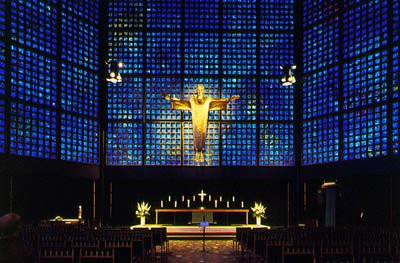
Music rises from the ruins of Berlin


During the terrible Allied air-raids on Berlin on the night of 23rd November 1943 the old Kaiser Wilhelm Memorial Church in the city centre was destroyed. The design for a replacement church by the architect Prof. Egon Eiermann surrounded the ruins of the old church tower with a new tower and a separate contemporary place of worship. The new church, which was consecrated in 1961, is made of concrete, steel and glass. The construction uses a double shell to give acoustic isolation from the busy traffic outside.

One of the most striking features is the extensive use of stained glass inspired by Chartres Cathedral, and created by the French artist Gabriel Loire in Chartres. The new church and tower use 21,292 panes of stained glass. The picture above shows the figure of Christ suspended above the altar against the background of stained glass. The figure is the work of Munich sculptor Karl Hemmeter, and was created after the original more contemporary design by the church's architect was rejected. Housed in the church is the moving Madonna of Stalingrad which I wrote about at Christmas.

Opposite the altar is the dramatically suspended organ by Berlin organ maker Karl Schuke (top below). It has four manuals with sixty-three stops and around 5000 pipes. The stops can be selected electronically in two hundred and fifty six combinations, these can then be expanded using the internal disc drive.


The new church and organ are truly remarkable achievements. Now sample the sounds of live music making in Berlin's Kaiser Wilhelm Memorial Church via the audio files below.


Gregorianik & Orgelimprovisationen is a double CD from Picaromedia of organ improvisations and plainchant with organist Wolfgang Seifen and the vocal ensemble Virga Strata. It was recorded live in the Kaiser Wilhelm Memorial Church using the Schuke organ during a concert in November 2004. Here are three audio files from this highly recommended recording which can be bought from Amazon.de:

* Plain Chant (organ) -

* 1. und 2. Vers (vocal) -


* Marianische Antiphon (Salve Regina) -


Other examples of Gabriel Loire's work include * Prisoners of Conscience Chapel, Salisbury Cathedral * St George's Cathedral, Cape Town * Christ Church, Los Altos * Thanksgiving Chapel, Dallas * Audio stream - amazon.de Image credits: Organ - Schuke-Berlin, Altar - Studio Kolmeier via Berlin.de Image owners - if you do not want your picture used in this article please contact me and it will be replaced. Report broken links, missing images and other errors to - overgrownpath at hotmail dot co dott uk
If you enjoyed this article take An Overgrown Path Other to these photo features * Berlin * Dresden * Leipzig * Aldeburgh * St Tropez *

Wednesday, April 12, 2006

Watch Michel Petrucciani video online

Back in January 2005 I wrote about legendary jazz pianist Michel Petrucciani (right), and that article remains high in my 'popular pages' listing after fifteen months. Since writing that piece Overgrown Path reader Andrew Nathan and I have been tracking down Petrucciani video footage, and just this week Andrew came up with an absolute gem that is available free on Google video.

In my original article I wrote that Michel Petrucciani was a 'pianistic genius', and it is no coincidence that he is buried in the Pierre Lachaise cemetery in Paris alongside Chopin. This 38 minute video with excellent sound (and a bonus guest appearance from the gorgeous Charlotte Rampling) is not just essential viewing for jazz fans, it should be watched by all students of the piano - whatever their discipline. Just click here to view this important document. (The video is not hosted by On An Overgrown Path, this is a link to an external site).

And to set the video into context here is my original article.


Improvisation is a recurring thread on An Overgrown Path. Keith Jarrett is already well woven into the postings, and the colossus of Bill Evans (whose influence reaches as far as Gyorgy Ligeti) awaits. But today it is the turn of jazz pianist Michel Petrucciani.

First, let's get the obvious out of the way. Osteogenesis Imperfecta, the so-called "glass bones" disease meant that Michel Petrucciani grew to just three feet tall, weighed a mere fifty pounds, and was left fatally vulnerable to illness, resulting in his death in 1999 at the age of just thirty seven.

He made his impact before making allowances for those with disabilities quite rightly became the norm.But Michel Petrucciani needed no compromises, he was a giant of the keyboard in everything except stature. He was born in the land of the Gods, Provence, to a French mother and Sicilain jazz pianist father. Like Bill Evans and Keith Jarrett, who he is often compared to, Petrucciani had a classical training, and his love for Debussy shines through his solo recordings. But his genius was for jazz, and this took him first to Paris, then to the States where his collabaration with saxophonist Charles Lloyd led to international stardom which lasted until his untimely death.

Fortunately Petrucciani left a legacy of inspired recordings. Of the trio work Live at the Village Vanguard (Blue Note 2435-38329), Kool Jazz Festival (Blue Note 2435-38329), and Trio in Tokyo (Blue Note 36605-9) are stand-outs, while the double CD of trio and solo work The Owl Years (Owl 548 288) gives a valuable overview including a three and a half minute video clip.

There are also some 'novelty' recordings including a swinging session with jazz violinist Stephane Grappelli (Flamingo on Dreyfus 36580), a not altogether convincing collabaration with string quartet and Dave Holland (Marvellous on Dreyfus 36564), a duo with his guitarist father (Conversations on Dreyfus 36617), and the acclaimed Conference de Presse (Dreyfus 36568) which is a duo with Eddy Louiss on Hammond Organ (you either love or hate the Hammond, I am in the latter group I am afraid).

If the trio recordings are great, and the novelties a little self indulgent, the solo piano work is sheer genius. Here we have the musicality of Bill Evans being extended into a more innovative language, and the creativity of Keith Jarrett without the interminable post-Lisztian monologues. Petrucciani can appeal both to the emotions with melody, and guts through the power of his playing (helped by first class piano sound, something Bill Evans was not always blessed with). Whether improvising from standards (e.g. Ellington's Caravan) or delivering his own compositions Petrucciani is up there with the best.

'Must have' solo recordings are Solo (Dreyfus 36597). Au Theatre Des Champs-Elysees (Dreyfus 36570), and a personal favourite Oracle's Destiny (OWL032).

Michel Petrucciani was a pianistic genius. The power of his playing transcended his physical limitations. He was also an extrovert, bon viveur (the sleeve notes for Flamingo include the credit "Michel Petrucciani's hats are supplied by Motsch ), and ladies' man with a chequered romantic history that certainly proved that size doesn't matter. A marriage to Gilda Butta, a pianist, ended in divorce, and he was survived by his companion, Isabelle, and by a son, Alexandre, and a stepson, Rachid Roperch, both from a previous relationship.

He packed more into thirty seven years than most of us will achieve in a full lifetime. Through his recordings he will endure as an example of what can be done.

People are always blaming circumstances for what they are. I don't believe in circumstances. The people who get on in the world are the people who get up and look for the circumstances they want, and if they can't find them, make them.
Mrs Warren's Profession by George Bernard Shaw


Report broken links, missing images and other errors to - overgrownpath at hotmail dot co dot uk
If you enjoyed this post take An Overgrown Path to Ligeti's Etudes fit the Bill

Tuesday, April 11, 2006

I am a camera - St Tropez 1967


'Those long lecture-free days in France were tailor-made for Nick to practice his guitar. That's what people remember about him during those months leading up to what became known as the Summer of Love. Jeremy Mason recalls going to a bookshop with Nick and buying a copy of Baudelaire's poems Les Fleurs Du Mal (Flowers of Evil).

They read Dostoevsky and Rimbaud. And they had a cheap old gramophone for which Nick bought a copy of Bach's Brandenburg Concertos, a work which he was always keen to have around and which may have just been the last piece of music he heard before he died seven years later.

His earliest outings with the guitar were as a busker. Simon Crocker joined him on harmonica a few times in the streets of Aix and even, on a couple of occasions, near the chic harbour area of fashionable St Tropez.'

The words above are from Trevor Dann's superb new biography of singer-songwriter Nick Drake who died in 1974, aged just 26. Nick Drake was in St Tropez in the summer of 1967, and so was another British student also taking a year off between school and university.

Roger Vadim's 1957 film And God Created Woman (Et Dieu... créa la femme) with its cast of Brigitte Bardot , Curd Jürgens , and Jean-Louis Trintignant had positioned St Tropez at the epicentre of the sensual world. In 1967 St Trop was chic, and Bardot was topless on the Plage de Pampelonne. But St Tropez was also where it was happening musically and artistically, and there was magic (and something else) in the air.

The highlight was
Jean Jacques Lebel's production of the Picasso play Desire Caught By The Tail in a vast circus tent near the sea, with music by Soft Machine. The sound was pretty impressive in the auditorium, it was almost as impressive on the beach at Grimaud, three miles away, where I grabbed a few hours sleep each night.


I had the one of the first Olympus camera with me, a 35mm half-framePen S. The photos here were all taken in St Tropez in August 1967 on Kodachrome 2 slide stock, and have never been published before. Somewhere in those crowds was Nick Drake ...


Nick Drake resources On An Overgrown Path include * A Skin Too Few * A troubled cure ... for a troubled mind * Monteverdi in Cambridge * Smile why it has been * All photos by Pliable and copyright On An Overgrown Path.

Trevor Dann's book Darker Than The Deepest Sea, The Search For Nick Drake is published by Portrait, ISBN 0749950951. Other I am a camera photo features On An Overgrown Path * Berlin * Dresden * Leipzig * Aldeburgh *


Monday, April 10, 2006

In the beginning was sound

' ... in an age where talking about the deed is often bigger than the deed itself ' follow this link to the BBC Radio 4 Reith Lectures by Daniel Barenboim, and this one to BBC Radio 3's Morning on 3 which is featuring Barenboim recordings all this week, and name checking his record company Warner Classics every few minutes, before following this link to the BBC's 'Ring in a day', conducted by, you guessed it, Daniel Barenboim, which links to MP3 downloads courtesy of Warner Classics, which has just released a new recording of Mahler's Seventh Symphony which was featured prominently on Saturday's CD Review on BBC Radio 3, the conductor of the new CD is, you guessed it right, Daniel Barenboim, and that new Mahler recording was played on Morning on 3 at 9.43 this morning with a Warner Classics name check .....

As Daniel Barenboim tells us in his BBC Reith Lectures - 'In the beginning was sound'. Then came Music-like-water.

Opening quote from Nicholas Crane writing in Two Degrees West.
Image credit - Central European University. Image owners - if you do not want your picture used in this article please contact me and it will be removed. Report broken links, missing images and other errors to - overgrownpath at hotmail dot co dot uk
If you enjoyed this post take An Overgrown Path to Wagner downloads and Beethoven cycles

Sunday, April 09, 2006

Antal Dorati - artist extraordinaire

Antal Dorati was born in Budapest on April 9th 1906. He is best known today as a conductor, but he was also a composer of forty-five works including two fine symphonies, and a talented painter and author. The last work that the 82 year old Dorati composed was a setting of the Pater Noster. This was completed in 1988, a few weeks before his death, and is a moving a cappella work for mixed chorus (SATB). It is difficult to understand why this beautiful five minute composition is not better known, or more widely performed. We are very fortunate though to have a fine recording in the catalogue by the Kammerchor der HdK-Berlin conducted by Christian Grube on BIS where it is coupled with another of his works, Jesus oder Barabbas? Sadly parts no longer seem to be available from his publisher Boosey & Hawkes.

Antal Dorati resources On An Overgrown Path include Antal Dorati the composer and Who am I - attaca? .

CDs in this article are available from Prelude Records. Photo credit - iClassics.com. Image owners - if you do not want your picture used in this article please contact me and it will be removed. Report broken links, missing images and other errors to - overgrownpath at hotmail dot co dot uk

If you enjoyed this post take An Overgrown Path to Musicians aginst nuclear weapons

Saturday, April 08, 2006

Lots of noise at St Andrew's Hall, Norwich

Nice lead story on page 19 of today's Eastern Daily Press ...

Music Venue may fall silent after 400 years by Ben Kendall

Live music at St Andrew's Hall, Norwich, could become a thing of the past, throwing the venue's future into doubt, city council bosses warned yesterday.

A sound limiter and a deadline of 11.30pm on amplified music were introduced at the hall at the end of last year following complaints from a minority of residents.But it has now emerged that the limiter - which automatically cuts off electricity to the stage, is so sensitive that even the sound of applause can trigger it.

If the conditions remain in place it effectively means any performance relying on electricity in any way will be out of the question at the hall, where the walls have echoed to the sound of music since Tudor times ....

Read the full EDP article online here.

Great to see this deserving story suddenly making the headlines. But hey, wait a moment, doesn't it sound a bit like yesterday's article Not quite so loudly please Maestro Ashkenazy On An Overgrown Path filled out with some additional reporting?

As there is no mention at all of the article On An Overgrown Path it must be a complete coincidence. But ....

Email to: 'pat.prekopp at archant.co.uk' - EDP website editor, April 7 9.55h
Subject: Not quite so loudly please Maestro Ashkenazy
Hi Pat, hope all goes well with you. Thought you might be interested in this story today which will get a lot of readership in the US particularly –
http://theovergrownpath.blogspot.com/2006/04/not-quite-so-loudly-please-maestro.html
Regards,
Pliable


Email from: pat.prekopp at archant.co.uk' - EDP website editor, April 7 9.57h
Subject: Not quite so loudly please Maestro Ashkenazy
Pliable, Many thanks for that. I'll try and get this on the site in some form.
Pat

Image credit - St Andrew's Hall - unattributable. Image owners - if you do not want your picture used in this article please contact me and it will be removed. Report broken links, missing images and other errors to - overgrownpath at hotmail dot co dot uk
If you enjoyed this post take An Overgrown Path to Guilty of remix?

Bird flew in Norfolk

A surprise avian visitor arrived in our garden this morning. We phoned the owners who live in the village. They told us that the bird's name is Percy, and that as it is the mating season he has been on the prowl for a few days. But sadly peahens are in short supply here in Norfolk.

Please check your antivirus software

The news yesterday that the deadly H5n1 avian flu virus has been found in a dead swan in Cellardyle in Scotland sent shivers down my spine. First, because we lived in the 1980's near the beautiful Fife coast, and know the damage to tourism and the economy that this news will cause. And secondly because our house here in rural Norfolk is surrounded by poultry farms, and in Germany the virus has spread from wild birds to poultry.

But, if possible in this situation, let me offer a little humour. I was puzzled as to why there had been a sharp increase in visitors to one of my articles on Peter Maxwell Davies in the last few days. A quick investigation uncovered that it came out quite high on Google searches for dead swans in Scotland. To find out why follow this link.

Staying in Scotland, and staying with positive news, I wrote recently about the BBC Scottish Symphony Orchestra on a roll. The BBC Scottish players are currently on a South American tour, and you can read cellist Anthony Sayer's account of the tour on his blog via this link.


Image credit - Waterfowl.fuzzup.net. Image owners - if you do not want your picture used in this article please contact me and it will be removed. Report broken links, missing images and other errors to - overgrownpath at hotmail dot co dot uk
If you enjoyed this post take An Overgrown Path a long way back to Conference of the birds

Friday, April 07, 2006

Not quite so loudly please Maestro Ashkenazy

Dear Eastern Daily Press letters,
How can such fierce noise restrictions be placed on Norwich's major concert venue, St Andrew's Hall? As the orchestral manager of Norwich Pops Orchestra I have witnessed the noise limiter light flashing on and off throughout our performances depending on the volume of the piece and how much applause we receive. Nearly all pieces for symphony orchestra played in the Hall will go above the newly imposed limit of 85 decibels. This level is approximately the sound level produced by a vacuum cleaner at the position of the ears whilst vacuuming a carpeted floor. Very loud restaurants or noisy parties can get to levels of about 100 decibels and rock concerts typically attain levels of 120 decibels in the audience. If these restrictions are to be inforced then all concerts in St Andrews Hall will be affected, not just the amplified ones.

In 1924 the young Benjamin Britten (aged 11) heard the composition 'The Sea' by Frank Bridge (left) in St Andrew's Hall during the Norwich Festival. He was, according to his own recollection 'knocked sideways'. Britten then went on to have composition lessons with Frank Bridge, who helped him on his journey to becoming one of the 20th Century's great composers. I wonder if the impact would have been the same if before the concert started a luckless employee of the Festival had pointed out to Mr Bridge the passage between Bars 45-62 was above 85 decibels and 'could he make it a bit quieter please...'

In the 2006 Norwich Festival the Philharmonia Orchestra are playing Rachmaninov Symphony 2 in St Andrew's Hall under the eminent pianist/conductor Vladimir Ashkenazy. I do not envy the person who has to approach Maestro Ashkenazy -
'excuse me sir, but is it possible you can play the beginning of the Allegro vivace not quite so loudly, someone across the street has complained...'

Until Norwich has a proper concert hall, we have to use St Andrew's. Please lift these restrictions.

Keith Hobday - Norwich Pops Orchestra

Pliable writes - this ludicrous 'Health and Safety' limit on sound levels arose as a result of the complaints of just four local residents. This limit, plus the poor acoustics, makes the St Andrew's Hall in Norwich a challenge both for performers and audiences. But it is worth pointing out the fascinating, and distinguished, history of the Hall.

St Andrew's Hall dates from the 15th century when it was built as part of the church of a Dominican Friary. At the time of the Dissolution of the Monasteries in the 1530's the church was divided into two and the present hall was created, and has been in use as a civic building ever since.

The first music festival in Norwich was held in 1788, and performances took place in St Andrew's Hall. Since then St Andrew's has been in use as a festival and music venue for more than 200 years without a break. See photo to left, and yes, that is an organ you see - 85db? The Hall has seen many historic premieres including Britten's Our Hunting Fathers, Opus 8 ( 25 September 1936, St Andrew's Hall, Norwich, Norfolk and Norwich Triennial Music Festival. Sophie Wyss sop, LPO, Benjamin Britten cond).

Few concert halls in the world can claim such a long or distinguished history. And, as Keith Hobday quite rightly points out in his letter to the Eastern Daily Press, few have had such ridiculous restrictions placed on them.


If you feel strongly about this restriction please email your views to thehalls@norwich.gov.uk

The St Andrew's Hall web site has a history of the Hall plus a list of events. Image credits: Ashkenazy from Wikipedia, Frank Bridge - Classical.net , SPL meter - Nefer.com. St Andrew's Hall - unattributable. Image owners - if you do not want your picture used in this article please contact me and it will be removed. Report broken links, missing images and other errors to - overgrownpath at hotmail dot co dot uk
If you enjoyed this post take An Overgrown Path to Britten's Aldeburgh

Thursday, April 06, 2006

Wagner downloads and Beethoven cycles

'When BBC Radio 3 runs the whole of Wagner’s Ring on Easter Monday, Rhine Maidens to immolation, there will be free downloads once again – only this time with a difference. Unlike last summer’s Beethoven splashout, when all nine symphonies were reeled out over a fortnight and 1.4 million downloads were taken worldwide, the Wagner goodies are being strictly limited.

What is being aired is the 1993 Bayreuth cycle conducted by Daniel Barenboim, this year’s Reith lecturer, and the BBC owns no further rights in the production. However, a freebie finger on www.bbc.co.uk/radio3 will point listeners to www.warnerclassics.com where they can help themselves to one track from each of the four operas, amounting in total to a Wagner happy half-hour.

Warner are using the gift as a gateway to what it hopes will be a rush of web sales while the BBC is mending fences with the music industry which
howled blue murder over Beethoven and acted as if Radio 3 was destroying its business when, in fact, no label had issued a symphonic cycle in three years, and none was likely to do so again.'

Interesting article today from Norman Lebrecht on Scena.org from which the quote above is taken.
But is his statement ' no label had issued a Beethoven symphonic cycle in three years, and none was likely to do so again' , on which his argument hinges, actually correct?

What about Osmo Vänskä's cycle with the Minnesota Orchestra? They have released an all-Beethoven CD featuring the Fourth and Fifth symphonies. Recorded at Orchestra Hall in Minneapolis in April 2004 using Super Audio CD technology, the disc is the first album in a five-year, five-disc cycle designed to record the complete Beethoven symphonies. Recorded on the Swedish-based BIS label, an audiophile label known for its high quality, the Minnesota Orchestra Beethoven collection will be one of the first complete cycles of Beethoven’s symphonies recorded in Surround Sound - for confirmation follow this link.

Report broken links, missing images and other errors to - overgrownpath at hotmail dot co dot uk
If you enjoyed this post take An Overgrown Path to BBC to broadcast Wagner's Ring - in one day

Wednesday, April 05, 2006

Found On An Overgrown Path recently

* I think Simple Song is a wonderful song to live by. I think the Mass is greatly misunderstood, Maybe we have better understanding these days - posted by Dave on Critical Mass

* "The last concert" of the Berlin Philharmonic Orchestra is mentioned in: Cornelius Ryan: The Last Battle and in Antony Beevor: Berlin. There the date mentioned is April 12,1945. This seems to be corrobarated by Taschners widow, who said, that the day after they arrived in Thurnau, Bavaria, they were liberated by the US Army. According to military reports and maps, this was April 13 or 14.(2nd US Armored Division). So far no documents of Taschners arrival in the USA could be found. All, that is known about his being there in 1938 is from Taschners own stories.
On passenger lists of ships arriving in New York and Boston, his name does not appear. Do you know more? Tijn Vellekoop (Taschner pupil, E-Mail bodio at xs4all dot nl) Netherlands -
posted by Tijn Vellekoop on The Berlin Philharmonic's darkest hour

* Would you be interested in My Bible, which I have been making since 1987? I am James G. Pepper and if you google "The Pepper Bible" you will find my page with links to CBS and ABC and the United Methodist Church videos on my work. I have done what they have done, but I did it all by myself in Dallas and I have more illuminations in my set of Gospels than they have in their entire bible! And Saint Johns has known about my work ever since the Dallas Morning News interviewed them comparing the two bibles in 2001 - posted by James Pepper on The Saint John's Bible - illuminating dark times .

* Recall, pliable, that Eugene Ormandy also lead the first U.S. performance, in Philadelphia, of the Shostakovich Symphony No. 13, in 1970, eight years after its Moscow premiere. Rostropovich was reported to have smuggled the score to the work out of the Soviet Union - posted by Garth Trinkl on Condoleezza's musical mystery tour revealed.

* I found your father's photograph of Clark Gable during an internet search. We are in the development stages of production on a documentary for Discovery Communications, Inc.'s Military Channel about celebrities in uniform and would love to see if there was a way we could utililize your photograph in our documentary. Thanks very much. Andrew Tilles, Production Manager, Bill Brummel Productions, Inc. 12031 Ventura Blvd., Suite 2, Studio City, CA 91604 - posted by Andrew Tilles on Farewell to Stromness

* Oh, if only this were true. I could see the "retinue" stomping out in disgust .. or would they be forced to sit thru the whole thing ?
We can dream, can't we. How many times have we daydreamed that we could put some world leader in a room, in chains, while we try to explain to them why they are such idiots!
Thanks for the day dream!
- posted by Richard Friedman on Security scare changes Condoleezza's concert

And some very interesting links found travelling the Path. First, thanks to Carol Murchie (see A Year at the Symphony) for The Face of Bach, a fascinating web site solely devoted to portraits of the master, and The Church of the Transfiguration, Cape Cod, a wonderful new Romanesque style church with a superb organ and artworks, and I am told, liturgical music to match . And two more Bach web sites, JSB Workshop is an excellent blog that is linked to JSB Chorales which has a lot of downloads and other resources. Finally a really fascinating oddity, a Danish web site with a database of 930 composers and musicians who have really made the big time and had their portraits published on postage stamps. The image page takes a while to load, but hang on in - it's worth it. All the stamps in this article come, with many thanks, from Paul Kristensens online collection. A fascinating, and valuable resource, and I leave you to work out who the musicians are.

The last few days have also been very rewarding away from the blog. An infinitely moving Bach St John Passion in Norwich Cathedral on Saturday. 'He is the sun, whose light blots out the feeble rays of other composers. There are many whose music I enjoy, but I would throw their entire opus on the bonfire to save one fugue of the divine Bach' - so wrote fellow pilgrim Anne Mustoe.

Back in August 2004, in the first month of posting, I featured a Robert Frost poem because it summed up what I was trying to do with this blog. It still does, so here it is again:

The Road Not Taken (1915) by Robert Frost

Two roads diverged in a yellow wood,
And sorry I could not travel both
And be one traveler, long I stood
And looked down one as far as I could
To where it bent in the undergrowth.

Then took the other, as just as fair,
And having perhaps the better claim,
Because it was grassy and wanted wear;
Though as for that the passing there
Had worn them really about the same.

And both that morning equally lay
In leaves no step had trodden black.
Oh, I kept the first for another day!
Yet knowing how way leads on to way,
I doubted if I should ever come back.

I shall be telling this with a sigh
Somewhere ages and ages hence:
Two roads diverged in a wood, and I--
I took the one less traveled by,
And that has made all the difference.


Image credit: Fractal from Archipress.com. Image owners - if you do not want your picture used in this article please contact me and it will be removed. Report broken links, missing images and other errors to - overgrownpath at hotmail dot co dot uk
If you enjoyed this post take An Overgrown Path to Blogging is doing it for our time ...

Tuesday, April 04, 2006

Live music can never be replaced

Hi Pliable, Thanks for the article about our NOTION software. It's an interesting article and a point of view that VirtuosoWorks (makers of NOTION) are aware of.

If I may talk a little about the flip side of this point of view, which by the way is not a new one; drummers thought the drum machine would be the end of live drummers, movie theaters thought VCRs (and later DVDs) would be the end of going to the movies, and musical instrument manufacturers thought software would be the end of their business. In fact, all of these areas are healthy and in the case of musical instruments, growing.

The bottom line is that listening to and playing live music is an experience that can never be replaced; and the goal of
NOTION certainly is not to try take jobs from musicians. It is a composition, learning, and accompaniment tool to substitute for a live orchestra when one is not possible.

The creator of
NOTION and founder of the VirtuosoWorks, Dr. Jack Jarrett, comes from the world of classical music and academics and sensed an opportunity to give composers the orchestral experience while composing, and to give performance venues the opportunity to add any number of live musicians back into performances where there were none before.

By composing in
NOTION, music students, classical composers, TV/film composers etc, get instant feedback as to what their composition would sound like with one of the world's top orchestras. It helps them learn and hone their craft as well as deliver life like mock-ups to teachers or directors, use as a practice tool, or accompany live performances.

The NTEMPO real-time performance feature lets a musician play or conduct
NOTION to play along with other musicians or live performances. This may sound like taking jobs aways from musicians, but consider that many theater, dance, and ballet productions have been hit by budget decreases over the past years and must invest first into dancers, actors, sets, etc. In addition, smaller theaters have space constraints in fitting in large numbers of musicians. Many of these performances have resigned their music accompaniment to CD playback - the worst all all scenarios. No musicians and no flexibility in performance.

With
Notion, a performance can add a soloist, 4, 6, 12, 20 or however many live musicians they can afford and fill in the rest with NOTION, giving the performance more life. This is actually being done with the Greensboro Ballet who once relied upon CD due to budget cuts and now employ several musicians and NOTION, giving them more flexibility and life in their performances. Also, schools are using this feature to teach and accompany soloists where in the past a CD was used. Notion is a bridge back to musicianship and live music in these scenarios once lost to CD playback.

It's natural for musicians to be paranoid about losing work to technology. The reality of economics, space, and other factors sometimes prohibit the ideal situation. However, technology is not the cause, and should be embraced as a means to foster creativity and creating opportunities for musicians by adding flexibility to otherwise inflexible situations.

Thanks and feel free to post this,
Brian McConnon

London orchestra builds in obsolescence

Do orchestral musicians have a future in the brave new world of digital technology? And more to the point do musicians even care about their future? The following worrying story, which was given to me by a professional musician, suggests that the answer to both questions is no.

Music composition software is a large, and lucrative, market currently dominated by Sibelius. But there is a new player in the market called NOTION, based in Greensboro, NC, and their new software offers two competitive advantages over Sibelius.

First, NOTION uses London Symphony Orchestra players to produce the sampled sounds, and this gives improved quality. ActiveX is fully exploited, and the results are pretty realistic, with the percussion instruments really sounding like bass drums and tam-tams, a big improvement on typical MIDI samples.

The second feature is the really worrying one. The London Symphony samples can be used in live performances. NOTION say: ' The NTEMPO feature which gives you real-time performance control. Rubato, holds, cutoffs, and vamps are accommodated with perfect precision. Incorporate NOTION performance as live accompaniment to players, theatre, or anything else in the real world - seamlessly'. This means you can simply tap the keyboard to conduct it to stay in sync with a live band.

In 2004 impressarion Sir Cameron Mackintosh controversially replaced half the musicians in his Edinburgh production of Les Miserables with American computer software called Sinfonia, which records and reproduces the sound of 300 different instruments.

The purpose of the NOTION samples must have been blindingly obvious to the London Symphony Orchestra musicians at the recording sessions in EMI's Abbey Road Studios, yet they chose to go ahead with them. In view of what happened to their colleagues in Edinburgh that is pretty extraordinary. Although when you consider the same players accepted a recording deal with LSO Live that earns them each around £400 (720 US dollars) per year in total from the sale of all their award winning CD's it becomes a bit more understandable.

Now, if you still think this is a lot of fuss about nothing follow this link, and listen to the strings in the Nutcracker Overture and the choir in the snowflakes waltz played on NOTION - truly frightening. If you are a professional musician you may well be listening to your own funeral march.

Read NOTION's response to this article here On An Overgrown Path.

Image credits: Rai.it and BBC News. Image owners - if you do not want your picture used in this article please contact me and it will be removed. Report broken links, missing images and other errors to - overgrownpath at hotmail dot co dot uk
If you enjoyed this post take An Overgrown Path to Musicians' jobs before free downloads

Monday, April 03, 2006

Peter Pears, died April 3rd 1986


Take An Overgrown Path to Britten's Aldeburgh

Sunday, April 02, 2006

Conductor's mutual admiration society

In the late 1960s, there was something like a Klemperer-cult in London. His concerts sold out almost as soon as they were announced, as did his records, and young musicians were as keen to hear him conduct as he was to go to their concerts and rehearsals - he got easily bored and listening to music got round that problem. He favoured Lorin Maazel at first, but his favourites were Pierre Boulez and Daniel Barenboim, the latter mainly in those days as a pianist.

Before his own concerts, he liked a few people to go to his dressing room perhaps half an hour beforehand to talk quietly while he composed himself for the work ahead. We were sitting once like this with Boulez when suddenly Klemperer said, 'Mr Boulez, are you married?' 'No,' said Pierre. 'Very good!' came the reaction. He did not approve of the modern way in which all young pianists, even conductors, are friends and form some sort of mutual admiration society. 'In my day, Furtwängler and Bruno Walter and Kleiber and I hated each other! It was more healthy!'

From The Tongs and the Bones, the Memoirs of Lord Harewood (Weidenfeld & Nicholson ISBN 0297779605)

Image credit - Klassika Image owners - if you do not want your picture used in this article please contact me and it will be removed. Report broken links, missing images and other errors to - overgrownpath at hotmail dot co dot uk
If you enjoyed this post take An Overgrown Path to Furtwängler and the forgotten new music

Saturday, April 01, 2006

BBC launches podcasts and downloads

Breaking technology news - all BBC radio stations including BBC Radio 3 are launching a trial of podcasts and downloads of selected programmes. The BBC's 'listen again' service is often recommended here, and it is now being supplemented by a service which allows MP3 files of programmes to be downloaded or received via podcast distribution. The terms of use are for seven days and non-commercial.

'Discovering Music' is one of the first programmes in the trial, and here is a list of forthcoming broadcasts available for download:

1 April Schubert's Unfinished Symphony
22 April Bruckner's Motets
13 May Haydn's Symphony No 60 'Il Distrato'
3 June Berlioz's Symphony Fantastique
17 June Haydn / Telemann Trumpet Concertos
1 July Schubert's 5th Symphony

The BBC is keeping a surprisingly low profile with this trial. But follow
this link for more details and to start downloading.

Report broken links, missing images and other errors to - overgrownpath at hotmail dot co dot uk
If you enjoyed this post take An Overgrown Path to Music-like-water

Security scare changes Condoleezza's concert

On Thursday I reported on the upcoming Royal Liverpool Philharmonic Orchestra's concert for US Secretary of State Condoleezza Rice. The concert in Liverpool's Philharmonic Hall went ahead last night, but a last minute security scare stopped performers reaching the hall, and it looked as though the concert would have to be cancelled.

But in a dramatic eleventh hour development a piano student from the Royal Northern College of Music who was in the audience stepped in with a new programme. Instead of Bernstein and Elgar, Condoleezza Rice, the UK Foreign Secretary Jack Straw, and their respective retinues were treated to a masterpiece by an American composer for solo piano that incorporates popular songs. The composer was Frederic Rzewski and the work, which received a standing ovation, was the hour long The People United Will Never Be Defeated!

Frederic Rzewski (left) is a pianist and composer whose early reputation was made by championing the avant-garde, and performing everything from Cage to Boulez. In the '70s his own compositions took a much more populist turn as his political beliefs drove him to find a more accessible language. His best known works are tonal, and use quotations from popular music. The People United Will Never Be Defeated! comprises 36 Variations on the Chilean protest song ¡El Pueblo Unido Jamás Será Vencido!

If you don't know Rzewski's work it is well worth exploring. Here is a 3'21" sample from the highly recommended Hyperion recording played by Marc André Hamelin -

For a full review of the Liverpool concert follow this link.

CDs featured in this article are available from Prelude Records. Audio sample from Hyperion. Image credits: Ms Rice - Moveleft.com, Rzewski - Sherpa.be. Image owners - if you do not want your picture used in this article please contact me and it will be removed. Report broken links, missing images and other errors to - overgrownpath at hotmail dot co dot uk
If you enjoyed this post take An Overgrown Path to Size does matter