Posts

Showing posts matching the search for christopher bishop

Closer to Vaughan Williams than Phil Spector

Image
This year's BBC Proms season includes ' Nick Drake - An Orchestral Celebration ' with Jules Buckley and the BBC Symphony Orchestra. That is Nick in the photo above; on the night in 1974 he died at the tragically young age of 26 a disc of the Brandenburg Concertos was on the record player in his room , and Black Eyed Dog , one of the last tracks he recorded before he died, has striking similarities to the Preludio of Bach's Lute Suite in E Major. But there is also an important and little-known contemporary connection between Nick Drake and the world of classical music. While at Cambridge University Nick met and worked with fellow student Robert Kirby. When Nick recorded his first album Five Leaves Left he chose Robert Kirby to arrange and conduct the backing for the majority of the tracks using strings, brass and woodwind. It is widely acknowledged that these arrangements were a major contribution to the success of the album and also to Nick's next LP Bryter Late...

Exclusive - David Munrow on the record

Image
My Future Radio programme on Sunday December 30th takes an exclusive look at David Munrow on the record . In the early 1970s the scores for the BBC TV series The Six Wives of Henry VIII and Elisabeth R brought David Munrow’s music to millions. His Pied Piper radio programme was broadcast four times a week for five years, he presented a successful TV series, and wrote the scores for several major feature films including Ken Russell’s The Devils and the film version of HenryVIII (sleeve below). David Munrow's interest in early music started when he taught in Peru before going up to Cambridge. He combined reading English at Pembroke College with independent studies of Renaissance and medieval music, and went on to form his famous Early Music Consort of London. Under his leadership the Early Music Consort became best-selling recording artists, and David Munrow’s records were considered so important that copies of them were sent to Saturn on board two NASA spacecraft in 1976. ...

David Munrow tribute on internet radio

Image
Double Grammy winning record producer Christopher Bishop talks about David Munrow on the record on my programme on Future Radio this Sunday (Dec 30) at 5.00pm UK time. The programme includes music from Munrow's first LP for EMI, Two Renaissance Dance Bands , which is seen above and which was produced by Christopher Bishop. Below is a page from Christopher's recording diary, the second entry down is the sessions for another classic David Munrow album, The Art of Courtly Love . Christopher Bishop worked with many great artists during historic times. Here is an excerpt from Michael Kennedy's 1971 biography of Sir John Barbirolli : 'It was Bishop with whom Barbirolli was working at the Abbey Road Studios on a day at the height of the Beatle's popularity. As John arrived he saw the famous four and their retinue. 'Is that the Fuzzy Wuzzies?' he asked Christopher, 'because we'd better close the door in case they charge.'' Now playing - Renaissa...

Happy birthday to a legendary recording producer

Image
That photo shows a 1970 Kingsway Hall session for the EMI recording of Vaughan Williams' The Pilgrim's Progress . From left to right are Ursula Vaughan Williams, Christopher Bishop (producer), Sir Adrian Boult , John Noble , Ian Partridge, Gloria Jennings, Christopher Parker (balance engineer), John Alldis (chorus master), Sheila Armstrong and Marie Hayward. During his career at EMI Christopher Bishop produced legendary recordings with Sir John Barbirolli, André Previn, Sir David Willcocks , David Munrow, Carlo Maria Giulini, Sir Adrian Boult and many others. Christopher was born on April 1st 1931; he is enjoying a well-earned retirement in rural Suffolk not far from Aldeburgh, and I am sure readers will join me in wishing him a very happy birthday. It is a scandal that in an age when so many minor media celebrities receive recognition with State honours that Christopher Bishop's contribution to British and indeed global culture has never been recognised with a suit...

A massive hope for the future

Image
I am one of those boring old farts who laments the demise of the CD and its eclipse by ephemeral streaming . So it is very pleasing to report that one of the major players in the media industry has found a valid and valuable strategy for prolonging the life of the venerable CD format.  Warner Classics are remastering and reissuing CDs of classic recordings in massive 'binge boxes'. Latest release is the 79 CD box of Sir Adrian Boult's complete EMI stereo recordings . (Perversely, the box is titled 'Complete Warner Recordings', because although Warner acquired the EMI classical catalogue, competitor Universal Music owns the EMI trade mark.) The legendary team of producer Christopher Bishop and engineer Christopher Parker produced the majority of the recordings in the box, and the original mostly analogue master tapes set a benchmark in sound quality. However many of EMI's original first generation CD transfers in the 1980s compromised the reproduced sound. So ...

Elgar remastered and renewed

Image
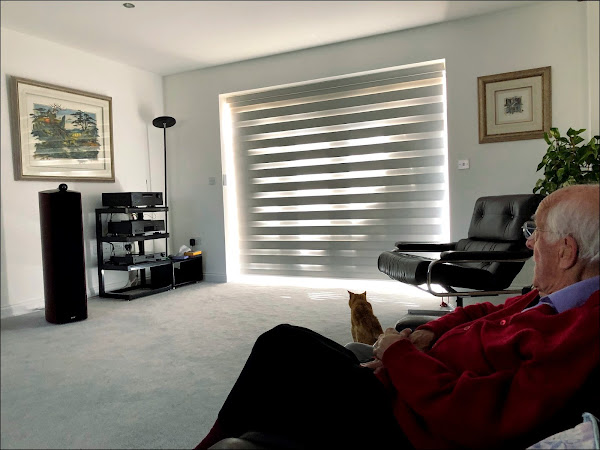
In my recent post  about the remastering by Warner Classics of iconic recordings from the EMI catalogue I reflected on how the concept of 'perfect' sound other than that heard at the instant of performance is a misleading fallacy. This is because it seems impossible to know what went on in the recording studio more than fifty years ago. But actually it is not quite impossible. A number of the remastered EMI recordings from the mid-1960s with Sir John Barbirolli conducting were produced by the celebrated recording producer Christopher Bishop ; notably Elgar's Falstaff and Pomp and Circumstance Marches , and Sibelius' Third, Fourth and Sixth symphonies .  In the photo above taken a few days ago, the 91 year-old Christopher Bishop is hearing the remastered recordings for the first time in my home listening room*. (Also seen joining in the listening session is our nineteen year old three legged cat.) The verdict of Barbirolli's producer on the remastering was that...

When Elgar met Pink Floyd

Image
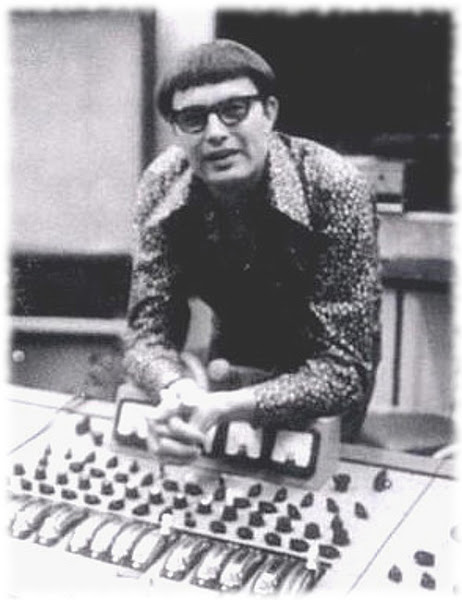
During my recent listening session with the celebrated recording producer Christopher Bishop a fascinating anecdote emerged about the legendary EMI Barbirolli/Janet Baker Dream of Gerontius . For the sessions in 1964 the producer was Ronald Kinoch Anderson with Peter Bown as balance engineer. Peter Bown was highly-skilled at the mixing desk and more of that anon, but his experience and expertise was mainly in rock music. Which meant he would struggle with reading Elgar's score for the oratorio.  So Christopher Bishop, who had just joined EMI to start his career as a producer, was delegated to sit with Peter Bown in the depths of Manchester's Free Trade Hall to interpret the score. Christopher was full of praise for Peter Bown's work at the sessions; which is confirmed by the 1964 recording remaining today as the definitive version of Elgar's masterpiece. That is Peter Bown (1926-1997) in the photo above. He was one of the renowned trio of EMI 'pop' engineer...

Her Master's Grammy

Image
The awards received by the Grammy winners last week are surprisingly modest. This is the actual Grammy for Best Classical Album won by Carlo Maria Giulini & Itzhak Perlman and EMI producer Christopher Bishop for their recording of the Brahms Violin Concerto with the Chicago Symphony Orchestra in 1978. Christopher Bishop was a double Grammy winner, the other was for Best Choral Performance with André Previn and the London Symphony Orchestra and Chorus' recording of Rachmaninov's The Bells in 1976. Playing the part of Nipper is Christopher's 11 year old King Charles Cavalier, Lucy. Image credit - On An Overgrown Path , taken on 12th February 2006. Report broken links, missing images and other errors to - overgrownpath at hotmail dot co dot uk If you enjoyed this post take An Overgrown Path to Even more Brilliant Classics , Exclusive - a little piece of recording history and A quiet celebration with friends.

Early musician who could have become a great conductor

Image
Hopefully at least a little of the content from eleven years of On An Overgrown Path transcends the virtual noise that is the staple fare of online music journalism today . For me the most rewarding projects have been the Philippa Schuyler and Master Musician of Jajouka doubleheaders, the profile of Guyanese conductor Rudolph Dunbar , the exploration of contemporary modal music , and interviews with Jonathan Harvey , Jordi Savall , Ali Keeler , and with David Munrow's recording producer Christopher Bishop. Although the latter interview has been available as a sound file it has not to date been transcribed as text. So while tidying up loose ends I have transcribed the interview below. (The photo at the foot of the article was taken during the radio interview and shows me with Christopher Bishop). Although David Munrow is best known as an early music authority the interview ranges widely. Christopher Bishop mentored both Riccardo Muti and Andre Previn early in their careers...

Rare Wagner is rescued from record company archives

Image
In the Wizard of Bayreuth's bicentennial year Wagner's rarely heard Under the Double Eagle march has been rescued from the archives in a notable new release from Warner Classics. The march is, of course, the work of the Austrian bandmaster and composer J.F. Wagner (1856-1908) and not his more illustrious namesake. But if my nuanced deceit generates some social media buzz about one of the least publicised but most rewarding classical releases of the year, it will have done its job. Under the Double Eagle is one of the slighter words in Warner's retrospective from their newly acquited EMI archive Sir Adrian Boult - the Complete Conductor . I previewed the 10 CD box in August under the headline This Tchaikovsky is the cat's whiskers . Now, having auditioned the new discs, I am moved to pronounce that Sir Adrian's Tchaikovsky surpasses the cat's whiskers - even Ginger's . If you want to hear recorded sound that has never been bettered - period - listen t...

Wolfgang Amadeus at his most seductive

Image
After I uploaded the Boult Planets cover a couple of weeks back Christopher Bishop, who was Sir Adrian's recording producer at EMI, emailed me this story. 'I once found a record of Mozart 40th and Eine Kleine, conducted by Boult, with a black lace bra on the cover (above). I showed it to him, and he said (delightfully missing the point) "Good heavens! What's that got to do with the G minor?"' Read about Christopher Bishop and David Munrow on the record and download the podcast here. Any copyrighted material on these pages is included as "fair use", for the purpose of study, review or critical analysis only, and will be removed at the request of copyright owner(s). Report broken links, missing images and errors to - overgrownpath at hotmail dot co dot uk

The lady is a record producer

Image
EMI's Vernon Handley Icon five CD set is truly a box of delights. Among the many and varied pleasures is the appearance of Beatrix Musker as producer of Tod's recording of Sir Arthur Bliss' Edinburgh overture with the City of Birmingham Symphony Orchestra. There have been some notable women producers working in classical music - Mercury's Wilma Cozart Fine immediately springs to mind. But, like much else in the industry , producing and engineering classical records remains male dominated. Beatrix Musker was assistant to illustrious EMI staff producer Christopher Bishop in the 1970s and worked with him on many great recordings with artists such as Sir Adrian Boult . After Christopher Bishop moved on to manage the Philharmonia and then Royal Scottish National Orchestra Beatrix produced a number of recordings for EMI including the Bliss. Tod was something of a lady's man and would have approved wholeheartedly of her appearance in EMI's retrospective of his...

No one thought there was a market for the Beatles

Image
David Munrow is best known as an early music virtuoso but his genius knew no bounds. His producer at EMI Christopher Bishop mentored both Riccardo Muti and AndrĂ© Previn early in their careers, and therefore his view that had David Munrow not died tragically young he could have become a great conductor cannot be dismissed easily. That view was expressed by Christopher in the  2007 radio interview with me transcribed below - see footer photo taken at the time. There is a lot today's classical industry can learn from this interview: particularly Christopher's explanation that  "I suppose we looked at [David Munrow] in a way that pop producers do. They don't ask 'is there a market for this?'; they say 'that's good, so we'll do it', and then the market is made. I don't suppose anyone thought there was a market for the Beatles when they first started; they just thought this is a great band and it took off".  Christopher Bishop is best ...