Showing posts with label thomas ades. Show all posts

Monday, April 07, 2008

Goodbye conductor - hallo composer


Overgrown Path's web logs over the past few days showed little uplift in traffic to my wide range of Herbert von Karajan articles. Most of the increase that happened came either from searches for the conductor's political and sexual predilections or from Japan, which has always had a special love affair with him. This analysis was mirrored in the mainstream media where, despite strong promotion from Deutsche Grammophon and EMI and some unashamed puffery from Simon Rattle, there was little interest in the Karajan anniversary other than tabloid-style trash from Norman Lebrecht and Ivan Hewett. The music industry loves an anniversary and two years ago we celebrated Shostakovich to death. So why did Herbert's birthday party fall so flat?

Many will say it was because of Karajan, but I disagree. Love him or hate him Karajan was a very high profile conductor who has never struggled in the past for column inches. Nobody came to the party this week-end because our love affair with the conductor is finished. The twentieth-century was the age of the maestro, and the big industry names held a baton - Walter, Toscanini, Furtwängler , Karajan, Boult, Beecham, Barbirolli, Klemperer and others. But as the millenium approached new names emerged, and they were holding a pen instead of a stick. The three 'Bs' of Britten, Bernstein and Boulez were on the cusp, and they have been followed by Stockhausen, Reich, Adams (header photo), Maxwell Davies, Adès and many more. Crucially, a number of these composers are, or were, fine conductors not just of their own music but also of composers as far back as Bach.


As we say goodbye conductor and hello composer major festivals such as the 1938 London Music Festival built around Toscanini (programme above) and the Salzburg Easter Festival created as a vehicle for Karajan have become things of the past. Their replacements are events like the South Bank Centre's Messiaen celebration (poster below), and try finding the conductors (one of who is Pierre Boulez) on that poster.

None of this means conductors will disappear. Orchestras need them just like they need concert masters. But how many readers can name the concert master of the Los Angeles Philharmonic? The celebrity conductor is a dying breed and it is interesting to speculate what that means. The record companies (again) stand to lose most as they depend on personalities to sell CDs. It is almost impossible to get composer/conductors such as Thomas Adès to work the press. Which explains the increasingly shrill attempts to promote increasingly young conductors who are only too willing to co-operate in photo opportunities. When they finally read the writing on the wall (which will probably take as long as it did for them to realise the impact of MP3s) will we see labels signing exclusive deals with composers instead of conductors? And before anyone tells me that contemporary composers don't sell I'd remind them that Naxos' second best selling album in 2007 was Philip Glass' Symphony No. 4 (23,000 units) and the fourth best seller was John Adams' Piano Music (14,000 units). Remember that it took four years for Glenn Gould's 1955 of the Goldberg Variations to sell 40,000 units.

Will we see back catalogue exploitation of neglected conductor/composers of the past such as Antal Dorati? Will we see Thomas Adès recording Mozart concertos directing from the keyboard, and Peter Maxwell Davies recording Mahler and John Adams Beethoven from the podium? Will more composers follow the example of Philip Glass (Orange Mountain Music) and Peter Maxwell Davies (MaxOpus) and establish their own record labels? Your guess is as good as mine. But it is definitely goodbye conductor and hallo composer. Watch this space.


Read more about an artist extraordinaire here.
Toscanini programme from my personal collection and (c) On An Overgrown Path 2008. Any copyrighted material on these pages is included as "fair use", for the purpose of study, review or critical analysis only, and will be removed at the request of copyright owner(s). Report broken links, missing images and errors to - overgrownpath at hotmail dot co dot uk

Wednesday, March 19, 2008

Classical music's most exciting thing today?


Today's Guardian asks 'is this the most exciting thing to have happened to classical music this century?' - Thomas Adès? Osvaldo Golijov? or even Gustavo Dudamel? - er .. no.

They were demanding jazz and rock and roll way back.
Image credit Matrix Business Coaching.Any copyrighted material on these pages is included as "fair use", for the purpose of study, review or critical analysis only, and will be removed at the request of copyright owner(s). Report broken links, missing images and errors to - overgrownpath at hotmail dot co dot uk

Thursday, January 31, 2008

Hallé birthday to you


Youth is certainly a state of mind in Manchester where the Hallé Orchestra is celebrating the 150th anniversary of its founding. Last night there was a celebratory concert presented by Dame Janet Baker (age 75) which included Ralph Vaughan William's Towards the Unknown Region and Edward Elgar's In the South (Alassio) as well as a 1996 Hallé comission, Thomas Adès' These Premises are Alarmed. Well done the Hallé for defying current music fashion and recognising that Elgar and Vaughan Williams did more than linger "lovingly over musical depictions of pastoral hills and fields, implicitly resisting the march of progress."

Hans Richter, Sir John Barbirolli and Mark Elder are the conductors usually associated with the Hallé. But my header photo shows Benjamin Britten rehearsing his Spring Symphony with them in Leeds in 1950. More on the Spring Symphony here.
Image credit Leeds classical music. Any copyrighted material on these pages is included as "fair use", for the purpose of study, review or critical analysis only, and will be removed at the request of copyright owner(s). Report broken links, missing images and errors to - overgrownpath at hotmail dot co dot uk

Wednesday, January 23, 2008

Stockhausen's Stimmung at summer Snape


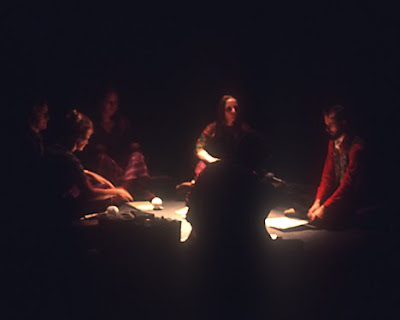
A late night performance of Stimmung is one of the highlights of the 2008 Aldeburgh Summer Festival. It will be sung by London Voices as part of the Faster Than Sound experimental music festival within a festival. The evocative photo above was kindly provided by fellow blogger Richard Friedman. He took it at the October 1971 performance of Stimmung in the Théâtre de la Ville, Paris by the group that commissioned it, Collegium Vocale Köln. Richard is also a fellow webcaster, check out his Music From Other Minds on KALW 91.7 FM San Francisco. The footer photo was taken by me at the 2007 Faster Than Sound. Stockhausen's music is just one of many delights at the 2008 Aldeburgh Festival which runs from 13th to 29th June, here are some of the others:

* World premiere of a new opera An Ocean of Rain by Yannis Kyriakides directed by Cathie Boyd.
* Featured composer György Kurtág and his wife Marta in recital.
* Pierre-Laurent Aimard plays The Art of Fugue and conducts the Britten Sinfonia.
* Ensemble Organum sing Machaut.
* Steven Isserlis and Thomas Adès play music by Kurtág, Debussy, Janáček and a new work by Adès.
* I Fagiolini sing Byrd.
* Premiere of John Woolrich's Violin Concerto.

As I've said here before, contemporary music is flourishing in Aldeburgh. This is due to adventurous and challenging programming. And Aldeburgh is not frightened of controversy. They proudly feature the 2007 premiere of their multi-media opera Elephant and Castle on the front of their new brochure, in confident defiance of a one star Guardian review from a grumpy Andrew Clements. Here are the facts that prove music has to be an adventurous experience:

In the past twelve months Aldeburgh Music has:
* Presented more than 150 concerts and events, including music, opera, dance, visual arts, public masterclasses and talks.
* Sold 91,000 concert tickets.
* Involved 8000 people in 250 Aldeburgh Education project days.
* Nurtured musical talent from around the world through the Britten-Pears Young Artists Programme which has more than 300 alumni.
* Started building its visionary new music campus.
* Involved more than 200 established musicians in Aldeburgh Residencies.
* Coached 25 of the region's finest young musicians through the Aldeburgh Young Musicians scheme.

As Benjamin Britten said, music does not exist in a vacuum.


Header photo (c) Richard Friedman 2008, footer (c) On An Overgrown Path 2008. Any copyrighted material on these pages is included as "fair use", for the purpose of study, review or critical analysis only, and will be removed at the request of copyright owner(s). Report broken links, missing images and errors to - overgrownpath at hotmail dot co dot uk

Tuesday, January 15, 2008

Mahler with such human warmth and soul


'A greater triumph awaited (Sir John Barbirolli) in January 1963 when he conducted Mahler's Ninth Symphony. Mahler was not often played in Berlin, and the (Berlin Philharmonic) orchestra frankly confess that they did not particularly like his music - 'but,' said one of the principals, 'Sir John made us love it as much as he did himself and we played it as he wanted.' So well, indeed, that a leading Berlin critic wrote: 'Not since Furtwängler have we heard such human warmth and soul combined with superb musicianship.'

The orchestra themselves asked that Barbirolli should record the symphony with them, the first English conductor to record with the Berlin Philharmonic since Beecham in 1937. During the cold January of 1964 this famous recording was made in the Jesus-Christuskirche, in the suburb of Dahlem'
- from Barbirolli, the Authorised Biography by Michael Kennedy.

Sir John Barbirolli's Mahler Nine is currently available in the EMI Great Recordings of the Century Series, and for once the record company hype is more than justified. That Berlin critic really said it all - such human warmth and soul combined with superb musicianship. Barbirolli's account ranks alongside Bruno Maderna's as one of the the greatest performances of the symphony committed to record, and easily overshadows Herbert von Karajan's two later versions with the Berlin orchestra.

It is forgotten today that Karajan's classic EMI recording of Die Meistersinger von Nürnberg, made in East Germany with the Staatskapelle Dresden, was originally planned for Barbirolli. But in 1968 Rafael Kubelik asked fellow musicians not to conduct in countries which supported the Russian invasion of Czechoslovakia. Barbirolli withdrew from the proposed recording, leaving the door open to the opportunist Karajan.

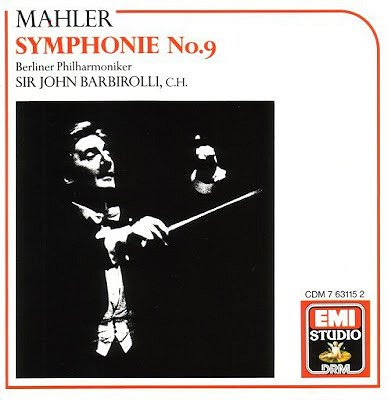
The ghastly sleeve design in the header image is my original 1989 CD copy. Ominously the sound was digitally 're-engineered' in 2002. I haven't heard the result, but I cannot see how the original CD mastering could be improved on, or indeed why it needed 're-engineering'. The recording in Jesus-Christuskirche, Berlin was produced by Ronald Kinloch Anderson, and the sound engineer was Ernst Rothe from the local German EMI company. Glorious sound on my copy, glorious playing, and a glorious interpretation.

Today, Mahler recordings are just another box to be ticked as conductors progress towards superstardom. It was very different in 1964. And there is not much human warmth and soul in EMI these days as new private equity owner Guy Hands prepares to cut up to a third of EMI's 5500 staff. Much has been made in the press of the concerns of EMI's rock artists, but there has been no mention of the priceless classical back-catalogue that is now in the hands of the asset strippers. Snap up Barbirolli's Mahler while you can, and also the new release of Thomas Adès' Violin Concerto before somebody gets their Hands on it.

Too many dead Europeans? Try Glorious John in New York.
Any copyrighted material on these pages is included as "fair use", for the purpose of study, review or critical analysis only, and will be removed at the request of copyright owner(s). Report broken links, missing images and errors to - overgrownpath at hotmail dot co dot uk

Tuesday, December 18, 2007

Thomas Ades out - Pierre-Laurent Aimard in


Just received - a press release announcing that Pierre-Laurent Aimard (photo above) will succeed Thomas Adès as Artistic Director of the Aldeburgh Festival for three years with effect from 2009. As the Independent commented following his BBC Prom earlier this year: "At 50, the French pianist-conductor still has the eager simplicity that induced Messiaen to make him his protégé at 12, and the luminous brilliance that persuaded Boulez to install him at 19 as resident pianist for his brand-new Ensemble InterContemporain. . . .”

Pierre-Laurent Aimard explained: “It was a big surprise to receive Jonathan Reekie's proposal to become Artistic Director of the Aldeburgh Festival. It was only after long reflection that I realised it was the right and possibly natural progression for me in terms of musical challenge and engagement. I love the exploration of musical confrontations and the encounter with various creators and performing partners - embracing the literature of different eras and cultures in such a way as to let the pieces enlighten each other. So what a joy to share with audiences and colleagues music as a living and growing art form in the context of an annual festival rather than a one off event in time. How we can continue to expand on the inspired concept and spirit of the original Aldeburgh Festival will be a fascinating journey in which I hope that we can do justice to the richness and diversity of music today.”

Pierre-Laurent Aimard has an international reputation not only as a great performer but also as a programmer of real invention. He will give three performances at the 2008 Aldeburgh Festival: as soloist/director with the Britten Sinfonia on Saturday June 14th, in recital on Friday June 20th, and performing chamber music with Tabea Zimmermann and Martin Fröst on Sunday June 22nd. All three concerts will feature works by György Kurtág, composer in residence for the 2008 Aldeburgh Festival. Other international curatorial projects led by Pierre-Laurent which form a backdrop to his new role in Aldeburgh include artiste etoile at the Lucerne Festival (2007); Pianist in Residence at the Berlin Philharmonic Orchestra (2006-07); Domaine Privé at the Cité de la Musique (Spring 2008), Carte Blanche at the Vienna Konzerthaus (2006-07), his own Perspectives series for Carnegie Hall (2006-07); and Artistic Directorship of Southbank Centre’s 2008 Messiaen festival.

Jonathan Reekie, Chief Executive of Aldeburgh Music said: "After an inspirational ten years with Thomas Adès at the helm, in our search for a replacement we were looking for an outstanding, original musician and programmer, who would both respect the Aldeburgh traditions but also stamp their mark on the Festival. In Pierre-Laurent Aimard we have all those qualities, rare in one person - a brilliant performer with a flair for creating concerts and Festivals. His performances here have been the talk of recent Aldeburgh Festivals and we are very much looking forward to working with him."

The 2008 Aldeburgh Festival, Thomas Adès’ tenth festival as Artistic Director, opens on Friday 13th June with a new opera commissioned from Yannis Kyriakides. During the festival Adès will conduct BCMG (Sunday June 15th) and two days later, with Steven Isserlis, will give the premiere of work that he has written for Isserlis. Associate Director of the festival, composer John Woolrich, will remain in this role, working alongside Pierre-Laurent Aimard.

“Every distinguished artist who has been chosen to present a series of Perspectives concerts at Carnegie Hall has used the opportunity to make connections among music of different styles and eras. But no one has taken this kind of exploration to the exhilarating extremes of the brilliant French pianist Pierre-Laurent Aimard. . . . By mixing and matching short pieces or excerpts from longer ones (46 in all), he created, in effect, an original, evening-length, five-section patchwork composition that audaciously leapt across centuries, defying stylistic categories.” New York Times, May 14th 2007

Now read an exclusive interview with Jonathan Reekie
Photo credit Chamber Music Society of Lincoln Center. Any copyrighted material on these pages is included as "fair use", for the purpose of study, review or critical analysis only, and will be removed at the request of copyright owner(s). Report broken links, missing images and errors to - overgrownpath at hotmail dot co dot uk

Sunday, November 11, 2007

Why no Requiem atonal?

Today is Remembrance Sunday in the UK, when we remember all those who lost their lives in the struggle for peace and freedom. Remembrance Sunday has many musical connections, ranging from Benjamin Britten through Arvo Pärt, to George Lloyd, who was himself traumatised in action.

Next Saturday I will be at a performance in Norwich Cathedral of Herbert Howell's 1936 Requiem. This is an economic, intense and moving work that lasts for little more than fifteen minutes, and is scored for SSAATTBB and organ. There is an excellent recording of it on Naxos by the Choir of St Johns' College, Cambridge directed by Christopher Robinson. The CD also includes Take him, earth, for cherishing, the motet composed by Howells to mark the assasination of President John F. Kennedy. We will be remembering that sad event just five days after the Norwich Cathedral performance of Howell's Requiem.

My footer photo is a reminder of one of the more obscure musical connections to Remembrance Sunday. It shows the Cenotaph in Whitehall where the nation remembers the war dead today. The stark monument was designed by the architect Sir Edwin Lutyens, whose daughter we caught recently walking with Stravinsky. And that mention of 'Twelve-tone Lizzie' brings me to an important question that lies behind my scepticism about the current media hype surrounding John Foulds' World Requiem. Why does our public music of remembrance have to be 'accessible' and not too challenging? Why does it have to be so 'Classic FM'?

If you must have your Nimrod, but you like to be tonally challenged, why not try Thomas Adès' first string quartet Arcadiana? This was first performed at the Cambridge Elgar Festival in 1994. It is quintessential Adès, and you definitely won't hear it on Classic FM. But the sixth movement is titled O Albion, and for seventeen devotissimo bars in E flat, the key of Nimrod, it movingly pay homage to the time of Elgar and those that died in the trenches of the Somme. But if you come from the World Requiem 'big is beautiful' school why not try Geoffrey Burgon's 1976 Requiem, and give your loudspeakers a real workout? More on Geoffrey Burgon here.

In his peerless War Requiem Benjamin Britten stressed reconciliation as well as remembrance by specifying (but not obtaining) a British, German and Russian soloist for the work's first performance in Coventry Cathedral, the preserved ruins of which are seen below. If, like me, you value reconciliation as well as remembrance, and are uncomfortable with the jingoism associated with the Albert Hall, I give you two personal choices of music for Remembrance Sunday.


Toru Takemitsu's Requiem (for string orchestra) was written in 1957 in memory of the Japanese film composer Fumio Hayasaka. It is a slow, elegiac work lasting a little over ten minutes. The three movements are marked Lento, Modére and Moins lent. Disarmingly the composer later explained "I was never able to write an Allegro ..."

I write this waiting for the start of the BBC broadcast from the Cenotaph. A CD is playing that moves me even more than the Nimrod that will be played in a few minutes. Eleven young choristers from the famous Kreuzchor were among more the 25,000 killed in the British and American bombing of Dresden on February 13th 1945. As well as the terrible loss of its choristers, the famous choir also lost its its neogothic choir school on the Georgplatz, its library of sheet music and archive, and its very raison d'être, the beautiful Kreuzkirche (Church of the Holy Cross) which dated from the 13th century.

The cantor of the Kreuzkirche, Rudolf Mauersberger, completed his Dresden Requiem in 1961. It is a profoundly moving memorial to the victims of the bombing of Dresden. But it was also a living symbol of Dresden's resistance to the repressive political regime in the GDR until Die Wende in 1989. There is an excellent recording of the Dresden Requiem by the Kreuzchor on the German Carus label. My header image is a session photo from the recording in Dresden's Lukaskirche in 1994. This has been the venue for many famous recordings, including Herbert von Karajan's 1970 Die Meistersinger von Nürnberg.

Rudolf Mauersberger's Dresden Requiem was written for the boy's voices of the Kreuzchor. Much of the singing is a capella, but the score also uses a small ensemble of organ, celeste, trombones, double basses and percussion. It is certainly not atonal, but neither is it 'Classic FM'. And it has been performed in Dresden every year since its premiere more than fifty years ago.

You can read the full story of the Dresden Requiem, and listen to samples, here. To my knowledge it has never been performed in London. Let us remember the dead of the bombing of Dresden, Hiroshima and Nagasaki today, as well as all other victims of war. And let us hope for a London performance of Rudolf Mauersberger's Dresden Requiem in the future.

* Update - read here how the World Requiem un-Foulded.


Follow this path to see Dresden restored from the ruins.
Image credits. Header Carus, middle Wikipedia, footer Ministry of Defense Any copyrighted material on these pages is included as "fair use", for the purpose of study, review or critical analysis only, and will be removed at the request of copyright owner(s). Report broken links, missing images and errors to - overgrownpath at hotmail dot co dot uk

Friday, November 02, 2007

So bye-bye Miss American pie


'With a few obvious exceptions (John Adams springs to mind, as do Elliott Carter and Steve Reich), Britain is not conspicuously friendly territory for recent American music' writes Steven Stucky in a very well-argued article in today's Guardian.

You are right Steven. The problem lies with our broadcasters and concert planners. They suffer from the American pie synodrome. If a composer's music shows any sign of audience acceptance we are fed such large portions of that composer's particular pie by the BBC and the Barbican Centre (which are now, effectively, one and the same) that we run screaming back to our own Thomas Adès and Malcolm Arnold. As reported here, it has happened recently with John Adams, Philip Glass, Elliott Carter, Steve Reich, and Osvaldo Golijov.

We'd love to hear more of the many other fine contemporary American composers. Just tell the BBC and Barbican that a healthy diet is a varied one.

When did the BBC last broadcast 'America's greatest symphony'?
Any copyrighted material on these pages is included as "fair use", for the purpose of study, review or critical analysis only, and will be removed at the request of copyright owner(s). Report broken links, missing images and other errors to - overgrownpath at hotmail dot co dot uk

Monday, October 29, 2007

Staying at home with Couperin


"My ideal day would be staying at home and playing the harpsichord works of Couperin - new inspiration on every page" said Thomas Adès, and François Couperin is a major influence on the music of Adès, including his Sonata de Caccia, a trio for baroque oboe, horn and harpsichord.

If you don't have a harpsichord at home all is not lost. Michael Borgstede (photo above) has recorded the complete harpsichord music of Couperin. The performances are excellent, and the the sound captured by engineer Peter Arts in three different Dutch churches is very good. The 11 CD box is on the Brilliant Classics label, and that means it's at budget price - I paid £30 ($62) in the UK.

Michael Borgstede's background is interesting. He lives in Tel Aviv, and is the Middle East correspondent for the Frankfurter Allgemeine Sonntagszeitung as well as being a highly regarded harpsichordist and organist. Follow this link for a wide range of MP3 downloads from his website.

No excuse now for not staying at home with Couperin. And follow this path for
another big harpsichord box.
Any copyrighted material on these pages is included as "fair use", for the purpose of study, review or critical analysis only, and will be removed at the request of copyright owner(s). Report broken links, missing images and other errors to - overgrownpath at hotmail dot co dot uk

Monday, October 15, 2007

Aldeburgh has always been about the new


Contemporary music is flourishing in Aldeburgh. Thomas Adès is the Festival's artistic director, innovative programming is pulling in new audiences, traditional musical boundaries are disappearing, and an inspirational £14m ($28m) creative campus will make new music available to future generations.

Teamwork has played a vital role, but much of the credit for this success must go to Aldeburgh Music's chief executive Jonathan Reekie, who came to Suffolk in 1998 from Almeida Opera. The photo above shows Jonathan (left) talking to Bob Shingleton at Snape during this exclusive interview for On An Overgrown Path:

BS - What is 'Aldeburgh Music', and what is its remit?

JR - Aldeburgh Music was founded by the composer Benjamin Britten and singer Peter Pears in 1948, when they set up a Festival based in their home town of Aldeburgh. It’s remit draws on the original principles they established. These were to nurture talent by mixing established musical stars with emerging artists, to focus on the new, and to be rooted in the local community.

BS - How is Aldeburgh Music funded?

JR - In simple terms a third comes from box office income, a third by fundraising, and a third from the government via Arts Council England.

BS - How does the relationship between Aldeburgh Music and the Britten Pears Foundation work?

JR (below) - Aldeburgh Music looks after Britten’s “living” legacy – his Festival, the Britten–Pears Young Artist Programme, the education programmes and Snape Maltings concert hall. The Britten–Pears Foundation is our separate sister organisation, responsible for Britten’s music and archive and is based at the house in Aldeburgh where Britten and Pears lived for many years. The Foundation receives all of Britten’s royalty income, and some of it goes to supports us. We work closely together.


BS - Is Britten still an influence on contemporary festivals, and how do you decide how much of his music is programmed today at Aldeburgh?

JR- For the Festival his principles are arguably more important than his music. The principles, which I outlined previously, still guide us in what we do, and they give the Aldeburgh Festival its strong identity. The amount of his music performed depends on what feels right and fits with all the other things we want to do. There is no minimum or maximum.

BS - Looking back at the 2007 Aldeburgh Festival what do you view as the high, and low, spots?

JR - The high spots were undoubtedly Britten’s opera Death in Venice, the second Faster than Sound, and the multi-media opera Elephant and Castle. The low spots were the rain stopping the dress rehearsal of Elephant and Castle, which caused us technical problems on the first night

BS - How does your role as chief executive fit with that of Thomas Adès?

JR - Tom’s role as artistic director of the Festival is to help the programme, and to perform in the Festival in June. Mine is year-round and isn’t just artistic, but includes all the business side too. Several people contribute to the programming of the Festival including Tom and the Associate Director, John Woolrich. Aldeburgh Music’s work with young artists, residencies, and developing new opera all feed in ideas and possibilities for the Festival. I act as a gatekeeper to these ideas. Tom always has the final say.

BS - Your background includes opera at Glyndebourne and Almeida, and, as you have said, Yoshi Oida's new production of Death in Venice for this year's Aldeburgh Festival was highly acclaimed. Can more be done with opera, particularly contemporary opera at Snape? Will the new development plans help this?

JR - Opera is an artform that excites me greatly. When music, text, theatre & design combine effectively there is arguably nothing more powerful for an audience. Unfortunately it is an artform that is expensive, complicated and strong on tradition, so fewer and fewer opera companies are prepared or able to take risks. We are at the vanguard of trying to change this, and we put on more new opera than anywhere else in the UK. We also have one of the world’s only programmes for developing the opera writers of tomorrow. The new spaces we are building at Snape (below) will be great for this kind of developmental work and smaller scale opera.


BS - How do your audience demographics compare with other festivals such as the Proms and Glyndebourne.

JR- They are similar, possibly slightly older, because the population of the Suffolk coast is higher than average. They are a great audience, who listen and like to take risks.

BS - Talking of risk taking, you have pushed the boundaries into electronica, World Music and other genres. Is this a conscious strategy, and if so will it go further?

JR - Aldeburgh has always been about the new. Music is changing, boundaries between different genres are dissolving. What we are doing simply reflects this. For example the distance between the cutting edge of “contemporary classical music” (don’t you hate that phrase?) and electronica is arguably very small. They are both musicians trying to do something quite similar, just using a different set of tools.

BS - You talk about using a different set of tools. Does more extensive use of the internet figure in your plans, both for performance and promotion? And, I have to ask this question, do you read music blogs, and how do you see their role?

JR- The internet and other technologies are playing a growing part of our creative output and how we promote. We are doing quite of lot of R&D in this field, and it's just going to get more and more important. I do read blogs when I can but lack of time limits this. It's great that the stranglehold of the printed media is being released by blogs, which are bringing fresh blood to criticism and a new perspective on musical life. At last it feels we can escape the tired cynicism that traps many of the traditional media.

BS - Much has been written elsewhere about the death of classical music, yet Aldeburgh today seems to be flourishing. How do you explain this?

JR - Don’t believe what you read! Yes, in some places, where no-one takes risks, it is certainly stagnating. But at the end of the day if you only put on events that excite you, with a bit of luck they will excite an audience too. Good live music, performed by great artists, will never die. Keep a balance between the familiar and the new, and take risks.

BS - Any hints as to the direction that the 2008 Aldeburgh Festival may take?

JR - No major new directions. But highlights will include a new opera, Ocean of Rain by Yannis Kyriakides, our third Faster than Sound, lots of music by György Kurtag, and new works by Thomas Adès and John Woolrich. See you there!


Jonathan Reekie is seen above looking into the future of contemporary music. The new creative campus being built at Snape is one of the most exciting developments in classical music anywhere. Read about it here.
All photos and text (c) On An Overgrown Path 2007. Report broken links, missing images and other errors to - overgrownpath at hotmail dot co dot uk

Thursday, August 23, 2007

BBC Proms - new music in safe doses


Here are Pliable's personal picks for the remainder of this year's BBC Proms season. All Proms are available for seven days online, detailed programmes and broadcast times for every concert are available from the BBC web site.

* August 29, 10.00pm - important contemporary music is once again consigned to the bed-time ghetto. Works by Oliver Knussen, Anton Webern and Julian Anderson are performed by the Birmingham Contemporary Music Group.

* August 30, 7.30pm - a rare opportunity to hear Artur Honegger's excellent 1946 Symphony No. 3 Symphonie liturgie played by the Bavarian Radio Symphony under Mariss Jansons . Herbert von Karajan's recorded legacy has dated somewhat, but his recording of this symphony is definitive. (Lovely Lauterwasser cover photo as well).

* August 31, 7.30pm - shout it from the rooftops - the world premiere of Thea Musgrave's Two's Company, a BBC commission. I wrote about Thea Musgrave's concerto for orchestra, Helios, a few weeks ago when I played the NMC recording of it on my Overgrown Path radio programme. The soloists for this premiere are oboist Nicholas Daniel, who also plays on the NMC recording of Helios, and Evelyn Glennie. For this Prom we have a rare sighting of chief conductor Jiří Bělohlávek on the podium with the BBC Symphony Orchestra, obviously finding out where the Albert Hall is before presiding over the Last Night on Saturday. Great to see a big dose of new music, but the BBC really does have a blockage about women composers at the Proms. At the time of writing Thea Musgrave's name is completely missing from the BBC's online listing of composers with performances at the 2007 Proms.

* September 4, 7.30pm - the Vienna Philharmonic and Daniel Barenboim serve up Ligeti in a digestible portion (Atmosphères - 9 mins), and a rather bigger serving of Bartók (Music for Strings, Percussion and Celesta - 30 mins). No minimalist composers, but a distinctly minimalist programme - 30 minutes of music in the first half and 38 minutes in the second with top price tickets at £45. Did I hear anyone mention attracting new audiences?

* September 7, 7.30pm - is it a coincidence that this concert by the Boston Symphony and James Levine also contains exactly nine minutes of contemporary music in the form of Elliott Carter's Three Illusions for Orchestra? Or is nine minutes the maximum permissible duration for contemporary music before it is shunted off to the late-night graveyard slot? Safer Brahms and Bartók provide the other 86 minutes.

* September 8, 7.30pm - tokenism reaches its logical conclusion with just one contemporary work in this concert - a three minute excerpt from Thomas Adès' The Storm. Not enough to mar the whitewashing of the history of music.

Now read more about music history rewritten.
Any copyrighted material on these pages is included as "fair use", for the purpose of study, review or critical analysis only, and will be removed at the request of copyright owner(s). Report broken links, missing images and other errors to - overgrownpath at hotmail dot co dot uk

Saturday, August 18, 2007

Doctor Atomic explodes as BBC Proms excel


Here are Pliable's personal picks for the coming week's BBC Proms. All Proms are available for seven days online, detailed programmes and broadcast times for every concert are available from the BBC web site.

* August 20, 7.30pm - Thomas Adès' Powder Her Face - Suite, London premiere, plus Bartók's Duke Bluebeard's Castle in a complete performance. Christoph von Dohnányi conducts the Philharmonia Orchestra
* August 21, 7.30pm - World premiere of John Adams' Doctor Atomic Symphony which is a BBC joint commission, plus his Century Rolls. The composer conducts the BBC Symphony Orchestra, and Olli Mustonen rolls in the opening work.
* August 22, 7.30pm - Mahler Symphony No. 3 with Claudio Abbado and Lucerne Festival Orchestra
* August 23, 7.30pm - Handel, Purcell and Telemann played by the combined Orchestra of the Age of Enlightenment and Freiburg Baroque Orchestra, plus the divine Kate Royal.

* August 24, 7.00pm - my prediction for one of the Proms of the season, Bernard Haitink conducts Bruckner's Symphony No. 8. And how good it is to see Haitink back with the Royal Concertgebouw Orchestra. One of my more bizarre Proms memories was in 1975, I think, hearing Zubin Mehta with the touring Los Angeles Philharmonic perform Brucker 8 at a Prom, and then immediately travelling to Amsterdam to hear Haitink conduct Bruckner 9 the following evening with the, then, Concertgebouw Orchestra in the ravishing acoustics of their own hall. Haitink followed the 'unfinished' Bruckner 9 with the composer's Te Deum, a practice which seems to have fallen out of favour. At around the same time I also attended Colin Davis' Ring Cycle at Covent Garden before being sidelined by a nasty attack of glandular fever. Oh to be young and foolish again.
* August 25, 6.30pm - my last choice from an outstanding week's Proms features Haitink and the Royal Concertgebouw Orchestra again. (I can't get used to typing that 'Royal'). Orchestral excerpts from Parsifal and Tristan will confirm that youth is not a time of life but a state of mind.

Nicholas Kenyon has, quite justifiably, taken a lot of stick here about this year's Proms season. No stick this week though. If I still lived in London I would be at every one of the concerts above. Now read the back story on Doctor Atomic.

Image credit Uruknet. Any copyrighted material on these pages is included as "fair use", for the purpose of study, review or critical analysis only, and will be removed at the request of copyright owner(s). Report broken links, missing images and other errors to - overgrownpath at hotmail dot co dot uk

Saturday, August 11, 2007

BBC Proms and beyond


Here are Pliable's personal picks for the coming week's BBC Proms. All Proms are available for seven days online, detailed programmes and broadcast times for every concert are available from the BBC web site.

* August 13, 1.00pm Cadogan Hall, Philip Langridge sings Elizabeth Maconchy's Four Elizabethan Songs together with Britten and Schumann.

* August 13, 7.30pm - Schoenberg's orchestration of Brahms' Piano Quartet Op. 25 is played by the Frankfurt Radio Symphony conduced by Paavo Järvi.
* August 15, 7.30pm - a rare performaance of Sibelius' complete incidental music for The Tempest in an authentically Finnish performance by the Lahti Symphony orchestra conducted by Osmo Vänskä.
* August 16, 10.15pm - a nice chewy programme of contemporary music by James MacMillan and ending with Harrison Birtwistle's Panic which was infamously premiered at the 1995 Last Night of the Prom. Martyn Brabbins conducts the BBC Scottish Symphony Orchestra. It's a sign of the times that under John Drummond Birtwistle was programmed in the most popular Prom of all, while under Nicholas Kenyon Birtwistle is marginalised to the bedtime slot.
* August 17, 7.30pm - More Schoenberg (the Five Orchestral Pieces) coupled with Stravinsky, Oliver Knussen's Violin Concerto and the UK premiere of Henze's Sebastian im Traum.
* August 18, 6.30pm - the Elgar anniversary is celebrated with his oratorio The Apostles. Outgoing City of Birmingham Symphony Orchestra music director Sakari Oramo conducts. Let's hope there are no silly Guardian articles written by his spin doctors this time.
* August 19, 6.30pm - Gustavo Dudamel, the Simón Bolívar Youth Orchestra of Venezuela and the Deutsche Grammophon PR machine play Shostakovich, Bernstein, Revueltas and Ginastera between Edinburgh, Essen, Schleswig Holstein, Leipzig, Dresden, Bonn and Frankfurt.

There's also lots of great music making elsewhere.
* Delft Music Festival, Museum Het Prinsenhof, Delft (The Netherlands), August 12, 2.15pm - chamber music by Dutilleux, Hindemith, D'Riviera and R. Schumann and the world premiere of Springs Eternal by Vanessa Lann.
* Edinburgh Usher Hall, August 13, 8.00pm - Thomas Adès conducts the Chamber Orchestra of Europe in Beethoven, Stravinsky, and his own Violin Concerto.

* Snape Maltings, Suffolk, August 14, 7.30pm - Mr McFall's Chamber mix classical, jazz, tango and rock, including a brand new piece by Gavin Bryars.

And now read Gavin Bryars on independent record labels.
Photograph On An Overgrown Path. Any copyrighted material on these pages is included as "fair use", for the purpose of study, review or critical analysis only, and will be removed at the request of copyright owner(s). Report broken links, missing images and other errors to - overgrownpath at hotmail dot co dot uk

Friday, June 22, 2007

Now try some delicious Thomas Ades

Thomas Adès' opera The Tempest is being broadcast by BBC Radio 3 from Covent Garden at 18.30 BST on Saturday 23rd June, follow this link for the webcast. Staying with Adès, if you find Elgar too romantic and pastoral try Adès' first string quartet Arcadiana. It was commissioned for the Cambridge Elgar Festival in 1994, and has a sublime tribute to Sir Edward in the form of seventeen bars in E flat, the key of 'Nimrod'. Not what you would expect from Adès, and quite delicious.

Thomas Adès' Arcadiana is on the EMI CD of his music Living Toys, available at budget price. Any copyrighted material on these pages is included as "fair use", for the purpose of study, review or critical analysis only, and will be removed at the request of copyright owner(s). Report broken links, missing images and other errors to - overgrownpath at hotmail dot co dot uk

Wednesday, June 20, 2007

An amazing gesture of hope for the future?


"There was a Royal Academy exhibition in 1997 about the architect Denys Lasdun. As I recall, there was a photograph of him in wartime on the beach at Normandy wearing battledress, teaching architecture to the army education corps. I thought that was an amazing gesture of hope for the future. I began to think of buildings as hopes, as frail human endeavours, as children that need to be brought up, invested in and looked after. It's also an idea of the architect as hero, as distinct from architect as villain. Lots of things unravelled from that: where did it all go wrong, where did it all go right...

My endowment from the National Endowment for Science, Technology and the Arts (NESTA) concerned exploring connections between the historic ambition of opera to combine human expressive arts, and the possibility of contemporary technology. A starting point was to enhance a use of moving image within opera performance. The arrival of digital technology proposes a new box of tools in this area, within the economic reach of arts projects. It's a bit like the early days of film: the grammar of how you use it and what you can do with it hasn't been decided yet.

The question arose as to what kind of musical voice the work could have. The potential to echo the contrasting environment with two compositional styles emerged, and Jonathan Reekie, chief executive of Aldeburgh Music, suggested composers Mira Calix and Tansy Davies. Tansy uses acoustic classical instruments and is inspired by different cultural registers. Mira Calix uses an electronica approach but the source of her sound is often from the natural or found world - rendered into patterns. So both connect to qualities of contrast or duality in the piece within their own work, as well as in contrast to each other."


Tim Hopkins talks about the new Aldeburgh Festival commissioned opera Elephant and Castle which he devised and directs, with music by Mira Calix and Tansy Davies, and text by Blake Morrison. The opera incorporates film, digital sounds, installations and live performance. It is about architecture and aspiration, urban legends and primal myths, past and future, work and play, and children and parents.

The first two performances are today Wednesday (June 20) and Thursday (June 21), and the audience has been told 'dress for the weather' as the performance promenades through the landscape around the Snape Maltings - see picture below. The two images here are computer renderings of scenes from Elephant and Castle. The video artist Tal Rosner is the partner of Festival creative director Thomas Adès. Although Rosner is not connected with the new opera the Festival has a commitment to exploring video and other new media.

In his 1964 Aspen Award acceptance speech Aldeburgh Festival founder Benjamin Britten said "There are many dangers which hedge around the unfortunate composer: pressure groups which demand true proletarian music, snobs who demand the