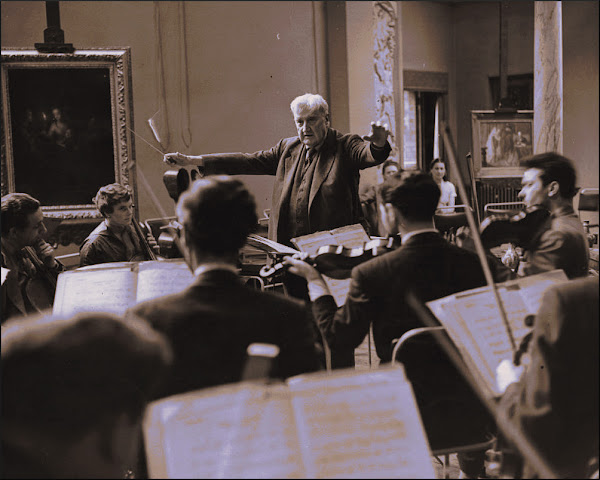
In their 1951-2 season the Hallé Orchestra perfomed all six of the symphonies Ralph Vaughan Williams had then written. Five of them were conducted by the inimitable John Barbirolli, while No. 1, the Sea Symphony with its Walt Whitman text, was conducted by Vaughan Williams himself. When the symphony was performed in Sheffield with the composer conducting, the orchestra was a 'cello short, and at Vaughan William's request Barbirolli, a talented 'cellist, took the vacant seat.
I was reminded of this story when listening to Jordi Savall and Hesperion XXl's superb new CD Estampies & Danses Royales. The programme of music from the thirteenth century Chansonnier du Roi is for instrumental forces only, so soprano Montserrat Figueras (aka Mrs Savall) wasn't needed for the sessions. But she wasn't going to miss the fun, and there she is on the recording playing the kithara, a rare instrument which featured here recently.
Fun is what this new release is really all about. It is superb music brilliantly played and recorded; but above all there is a quality that seems to be disappearing from recordings and live concerts - the sound of musians having fun. As contemporary composer Kurt Schwertsik said - 'I believe the function of art is to denounce seriousness. It should be fun. There's a halo of awe around modern music. You achieve more if you're not serious'.
Vaughan Williams, Savall, Barbirolli and Schwertsik in one post? - that's what I call fun! And there's more musicians having fun here.
The Kurt Schwersik quote is from the excellent CageTalk (ISBN 9781580462372). Any copyrighted material on these pages is included as "fair use", for the purpose of study, review or critical analysis only, and will be removed at the request of copyright owner(s). Report broken links, missing images and errors to - overgrownpath at hotmail dot co dot uk
Friday, May 09, 2008
Danger - musicians having fun
Friday, April 04, 2008
The pilgrim enters the celestial city

The sad news comes from America of the death of the baritone John Noble after a long illness. He was born in 1931 and studied mathematics at Cambridge University. While still a student at Cambridge in 1954 he sung the part of Pilgrim in Ralph Vaughan William's The Pilgrim's Progress and went on to a professional career which included singing the role in the EMI recording under Sir Adrian Boult in 1970/71.
The header photo above was taken in the Kingsway Hall control room during the recording and John Noble is in the centre foreground with, from left to right, Ursula Vaughan Williams, Christopher Bishop (producer), Sir Adrian Boult, Ian Partridge, Gloria Jennings, Christopher Parker (balance engineer), in front John Alldis (chorus master) and Sheila Armstrong.
John Noble's other recordings included Britten's Albert Herring for Decca, Verdi's Macbeth and Don Carlos for HMV, and Finzi's In Terra Pax for Lyrita. He also frequently sung the role of the Christus in the Matthew Passion and movingly passed away on Good Friday. His funeral is on April 8, which quite appropriately is Sir Adrian Boult's birthday.
Lead me, Lord, make my ways straight before my face.
And let all men that put their trust in Thee rejoice.
From Act 3 Scene 2 of Ralph Vaughan Williams' The Pilgrims Progress
With thanks to Mr. J. Vaughan. Photo credits Godfrey McDominic/EMI. Any copyrighted material on these pages is included as "fair use", for the purpose of study, review or critical analysis only, and will be removed at the request of copyright owner(s). Report broken links, missing images and errors to - overgrownpath at hotmail dot co dot uk
Tuesday, February 12, 2008
The complete works on Future Radio

Ralph Vaughan Williams' Fantasia on a Theme by Thomas Tallis is one of his best known works, and Tudor church music was a major influence on the composer. During 2008 I am playing all the Vaughan Williams symphonies on my Future Radio programme, and this Sunday (Feb 17) it is the turn of the Eighth Symphony. This for many, including me, is one of his finest works, and it certainly destroys the myth of the composer as a backward looking English pastoralist, with its scoring for vibraphone, xylophone, tubular bells, glockenspiel and three tuned gongs.
I'm coupling all the Vaughan Williams Symphonies with choral music from Thomas Tallis. This will be taken from the splendid new 10CD box of Tallis' complete works at bargain price from Brilliant Classics sung by the Chapelle du Roi directed by Alistair Dixon. Tallis also composed a number of instrumental works which are included in the box. They are not of the same peerless quality as his choral works, but are, nevertheless well worth hearing. I paid £30 for the boxed set (texts included on CD-ROM) from an independent record store, but they are available cheaper online. Which rather captures the current lunacy of the classical music industry. The last of the ten Tallis CDs was recorded by Signum in 2004, and they were selling individually last year for £15.
Cue columns of plainsong soaring upwards.
Listen on Future Radio at 5.00pm every Sunday and 12.50am every Monday UK time in real time here (convert to local time zones here). Windows Media Player doesn't like the audio stream very much and takes ages to buffer. WinAmp or iTunes handle it best. Unfortunately the royalty license doesn't permit on-demand replay, so you have to listen in real time. Report broken links, missing images and errors to - overgrownpath at hotmail dot co dot uk
Thursday, January 31, 2008
Hallé birthday to you

Youth is certainly a state of mind in Manchester where the Hallé Orchestra is celebrating the 150th anniversary of its founding. Last night there was a celebratory concert presented by Dame Janet Baker (age 75) which included Ralph Vaughan William's Towards the Unknown Region and Edward Elgar's In the South (Alassio) as well as a 1996 Hallé comission, Thomas Adès' These Premises are Alarmed. Well done the Hallé for defying current music fashion and recognising that Elgar and Vaughan Williams did more than linger "lovingly over musical depictions of pastoral hills and fields, implicitly resisting the march of progress."
Hans Richter, Sir John Barbirolli and Mark Elder are the conductors usually associated with the Hallé. But my header photo shows Benjamin Britten rehearsing his Spring Symphony with them in Leeds in 1950. More on the Spring Symphony here.
Image credit Leeds classical music. Any copyrighted material on these pages is included as "fair use", for the purpose of study, review or critical analysis only, and will be removed at the request of copyright owner(s). Report broken links, missing images and errors to - overgrownpath at hotmail dot co dot uk
Friday, January 25, 2008
Got the T-shirt? - now hear the music

There was some healthy discussion on my recent article about pianist Angela Hewitt's Bach World Tour T-shirts. No discussion on my Future Radio programme this Sunday (Jan 27) at 5.00pm UK time, just 51 minutes 3 seconds of the perfect pianism of Angela Hewitt playing Messiaen and J.S. Bach, connected by less than 5 minutes of the usual low key links from me. The audio stream can be launched here, and is available in real time only.
There is some interesting music coming up on my Future Radio webcasts in the next few months. It includes Elliott Carter's Sonata for Flute, Oboe, Cello and Harpsichord, Michael Tippett's Second Symphony (why aren't his symphonies performed more often?), and a new recording of Lou Harrison's Concerto for Violin and Percussion Orchestra, all complete - no extracts. Through the year I will also be playing all the Vaughan Williams symphonies. Future Radio agreed to this following very positive listener responses to my broadcast of the Fifth earlier this month, and they are rearranging their schedule to accomodate the 71 minute Sea Symphony in August to coincide with the centenary of the composer's birth.
On April 6 I will be presenting Karajan and Twentieth Century Music to mark the centenary of the conductor's birth. For all his faults Karajan made some superlative records, none more so than his 1972 recording of Arthur Honegger's Third Symphony Liturgique, and I'll be playing that with his 1973 recording of Alban Berg's Three Pieces from the Lyric Suite, both with the Berlin Philharmonic. Framing all these contemporary works will be music by Bach, Tallis, Corelli and from the Sephardic Diaspora.
It's all about thinking outside the box, as Olivier Messiaen did.
Listen on Future Radio at 5.00pm UK time this Sunday, January 27th in real time here (convert to local time zones here). An Overgrown Path podcast will follow. Windows Media Player doesn't like the audio stream very much and takes ages to buffer. WinAmp or iTunes handle it best. Unfortunately the royalty license doesn't permit on-demand replay, so you have to listen in real time. If you are in the Norwich, UK area tune to 96.9FM. Report broken links, missing images and errors to - overgrownpath at hotmail dot co dot uk
Monday, December 31, 2007
Happy long tail to all my readers

Right at the end of 2007 the Observer ran a story that shames the whole classical music community, including this and other blogs. It was about the BBC's rejection of director Tony Palmer's Vaughan Williams film, a news story that was featured prominently by the Observer and several music blogs, including this one. It now appears that the rejection letter quoted in the coverage was a publicity-seeking hoax, although the identity of the hoaxer remains unclear - read the full account here.
This story neatly sums up a year in which relevance became the order of the day, and swapping the long tail of culture for the short head of the mass market became the number one priority. 2007 saw Norman Lebrecht's attempts to go mass market hit the buffers, while William Barrinton-Coupe's efforts on behalf of his late wife met a similar fate. It was also the year when the Royal Opera House went mass market with its advertising, BBC TV went mass market with its classical music programming, Deutsche Grammophon went mass market with its CD covers, John Foulds went mass market with his World Requiem, the BBC Proms went mass market with its crooners, and the Simon Bolivar Youth Orchestra went mass market with its concert attire and politics.
'Relevance' is in and the long tail is out. But it doesn't always work as Dominic Sandbrook recounts in his excellent book White Heat, a History of Britain in the Swinging Sixties? 'Many Protestant churchmen, alarmed at their inability to reverse the long decline in church-going, concluded that 'relevance was the order of the day'. According to Grace Davie, the churches, besotted like so many other institutions by the 'desire to be modern', consequently 'looked to the secular world for a lead and borrowed, in some cases rather uncritically, both its ideas and forms of expression'. It was in this period, for example, that liberal churchmen first began wielding guitars, introducing handclapping into the Anglican rite and generally conducting themselves like frustrated pop singers, a tactic that failed to attract many new parishioners and often alienated those still loyal to the Church of England'
In 2008 On An Overgrown Path will stay focussed on the long tail, and now playing is Satori (1999) for solo harpsichord by John Palmer. A long way from the Anglican rite, Satori describes the spiritual awakening during Zen meditation. This penetrating work, with its long silences is influenced both by the composer's friendship with John Cage and by his deep involvement with Japanese culture. Adventurous and thought-provoking new music from the enterprising Sargasso label, which revels in promoting the long tail. Check out good length MP3 samples here.
The CD has excellent sleeve notes by Peter Burt, including this one for the title work - A koan, for instance, is that type of apparently nonsensical question by means of which students in the Rinzai school of Zen are trained to transcend the limitations of verbal reasoning, the most famous example perhaps being Hakuin's 'What is the sound of one hand clapping?' (My own mischievous answer has always been that it is the audience reaction at the average new music concert).
Peter Burt neatly disposes of the long tail versus mass market conflict with these words - All this picturesque 'Japaneseness' might make it sound as though the listener to this CD is in for a comfortable session of 'New-age' easy listening. But be warned: someone who submits himself to the ascetic severities of Zen monastery life could hardly be expected to opt for facile and superficial artistic solutions, and the musical language of John Palmer's work is uncompromisingly Western and modernist. It demands of its listener, no less than of its creator, an attitude of disciplined seriousness. Deeply rewarding listening.
Which eloquently sums up the long tail listening experience.
* Celebrate the new year with some more long tail - my David Munrow on the record programme is being repeated on Future Radio by popular demand at 7.00pm on New Year's Day, click here for the audio stream.
Sand mandala header photo from my 2007 post about the Free Tibet campaign. And no apologies to all those who think politics, music and sport don't mix. With the Olympics in Beijing in 2008 it is a subject I'll doubtless be returning to. Sand mandalas are a motif in Martin Scorsese's film Kundun which also deals with the Chinese occupation of Tibet, and I featured Philip Glass' score for the film on internet radio in November. My middle photo is from Going Buddhist which featured the music of Lou Harrison, the footer image is from Zen and the art of new music about Jonathan Harvey's music, and there is another contemporary music Koan here from James Tenney. Lots of long tail links for the new year.
All photos (c) On An Overgrown Path 2007. Report broken links, missing images and errors to - overgrownpath at hotmail dot co dot uk
Sunday, December 09, 2007
BBC wants Vaughan Williams premiere

"One of television's most imaginative film-makers has condemned Mark Thompson's leadership of the BBC as a 'catastrophe' and accused the corporation of undermining its worldwide reputation by insulting the intelligence of viewers.
Tony Palmer, who has won more than 40 awards including Baftas, Emmys and, uniquely, the Prix Italia twice, criticised the director-general after the BBC turned down a documentary of his. The film, about English composer Ralph Vaughan Williams, has been produced by Five instead.
Palmer said he received an extraordinary rejection letter from a BBC commissioning editor explaining that, 'having looked at our own activity via the lens of find, play & share', it had been decided the film did not fit with 'the new vision for [BBC] Vision'.
Bizarrely, Palmer said, the letter concluded: 'But good luck with the project, and do let me know if Mr. V. Williams has an important premiere in the future as this findability might allow us to reconsider.' Vaughan Williams died in 1958."
This story in today's Observer may help explain why I, and many others, are so critical of today's BBC.
The fiftieth anniversary of the death of Ralph Vaughan Williams falls on August 26, 2008. I will be starting the celebrations on my Future Radio programme on Sunday January 6. Unlike the BBC I haven't looked for an important premiere by Mr. V. Williams. Instead, I'm making do with his overture The Wasps and 'Glorious John' Barbirolli's blazing account of RVW's magnificent Fifth Symphony - for me not just one of the composer's greatest works, but also one of the masterpieces of twentieth century music.
Header photo was taken in better times at the BBC, when Michael Tippett's Second Symphony was being rehearsed at their Maida Vale studios. From left Sir Adrian Boult, Michael Tippett, RVW, Ursula VW and John Minchinton. More Vaughan Williams here.
Any copyrighted material on these pages is included as "fair use", for the purpose of study, review or critical analysis only, and will be removed at the request of copyright owner(s). Report broken links, missing images and errors to - overgrownpath at hotmail dot co dot uk
Tuesday, November 27, 2007
Norfolk Rhapsody by Ralph Vaughan Williams

Winter sky over North Norfolk this afternoon.
Now playing - Norfolk Rhapsody No. 1 by Ralph Vaughan Williams, Sir Adrian Boult conducts the London Philharmonic Orchestra on EMI LP ASD 2847. The Norfolk Rhapsody No. 1 was based on tunes collected from King's Lynn fisherfolk. The town is about 20 miles from where I took this photograph today. In the sleeve notes for the LP Michael Kennedy writes that the Rhapsody "begins and ends with a musical description of the Fens landscape, misty and mysterious ..."
Now read about November woods from a brazen romantic.
Photograph (c) On An Overgrown Path 2007. Report broken links, missing images and errors to - overgrownpath at hotmail dot co dot uk
Tuesday, November 06, 2007
BBC TV's Classical Star condemned as 'sick'

'A society that revels in others' public distress or humiliation, filmed in intrusive close-up, is a pretty sick society. Classical Star harks back to the worst excesses of the Roman arena. The children are exhibits in a human circus. The judges use the thumbs up/thumbs down technique of the Roman emperor; they offer us pretension, patronage and a deep sense of self-importance. We are all being coarsened by this continual diet of exploitation. '
That's just one paragraph from Hilary Davan Wetton's attack on BBC TV's Classical Star in today's Guardian. He hits the nail right on the head, he says it is bad for classical music. And Hilary isn't just a grumpy old blogger. He is a musician, teacher and conductor. And his new CD of Vaughan William's seasonal Hodie is out on Naxos this week.
Now, on the day of Ursula Vaughan William's memorial service let's remember a pilgrim's final progress.
Any copyrighted material on these pages is included as "fair use", for the purpose of study, review or critical analysis only, and will be removed at the request of copyright owner(s). Report broken links, missing images and other errors to - overgrownpath at hotmail dot co dot uk
Wednesday, October 24, 2007
A pilgrim's final progress

Ursula Vaughan Williams died on October 23 2007 aged 96. She married Ralph Vaughan Williams in 1953, and contributed to several of his later works, including the magical Serenade to Music which sets words from The Merchant of Venice. The photo above was taken at the 1971 sessions for Vaughan William's Pilgrims Progress, and shows Ursula Vaughan Williams on the extreme left.
The Guardian obituary reminds us that, as well as contributing to her husband's work, Ursula Vaughan Williams provided librettos to a veritable who's who of twentieth century composers including Gerald Finzi, Alun Hoddinott, Herbert Howells, Elisabeth Lutyens, Elizabeth Maconchy, Anthony Milner, Alan Ridout, Phyllis Tate and Malcolm Williamson.
So ends an important chapter in the history of modern music. Although, sadly, it may not be recognised as such everywhere.
... Soft stillness and the night
Becomes the touches of harmony.
The Merchant of Venice, Act V
Here's a topical mix of Vaughan Williams and Norman Lebrecht.
Photo credit Godfrey McDominic/EMI. Any copyrighted material on these pages is included as "fair use", for the purpose of study, review or critical analysis only, and will be removed at the request of copyright owner(s). Report broken links, missing images and other errors to - overgrownpath at hotmail dot co dot uk
Tuesday, October 23, 2007
Remembering a forgotten maestro

Last Friday's BBC Radio 3 broadcast of Vaughan Williams' Fifth Symphony, played by the Ulster Orchestra conducted by John Lubbock, contained more beauty in one bar than was to be found in the whole of Riccardo Muti's recent London concerts with the Chicago Symphony Orchestra. Why do we focus so much on a few 'star' conductors and orchestras? And why do we consign to oblivion the forgotten maestros and musicians who work away from the limelight, and who contribute so much?
The Ulster Orchestra was created as a full time professional orchestra in 1966, and its first conductor Maurice Miles (above) is one of those forgotten maestros. He was born in 1908, and was principal conductor of the Yorkshire Symphony from 1947 until 1954. The orchestra played many twentieth century works, including more than thirty by British composers in his first season alone. His repertoire was eclectic, and he gave a rare performance of Arthur Honegger's oratorio King David at the 1950 Leeds Triennial Musical Festival.
But the star system was setting the musical agenda more than fifty years ago, just as it does today. In 1954 Maurice Miles was replaced as conductor in Leeds 1954 by the mucher higher profile Russian Nikolai Malko, who had given the first performances of Shostakovich's First and Second Symphonies.
Maurice Miles' specialities were never likely to become fashionable. Arnold Bax, and Arthur Butterworth were among the composers he championed. He gave the first performance of Gerald Finzi's beautiful Dies Natalis in the Wigmore Hall in 1940, and conducted Geoffrey Bush's Symphony No. 1 at the Proms in 1958. As well as his work in Northern Ireland Maurice Miles was a frequent conductor of the BBC Welsh and Scottish Symphony Orchestras. He spent decades advocating unfashionable composers with unglamorous orchestras, before, finally, turning to teaching conducting at the Royal Academy of Music in London.
In the early 1980s my wife and I bought our first house outside Dorking, in the shadow of Ralph Vaughan Williams' beloved Leith Hill, and we were living there when our first child was born. The house was modest but nice, and it was on the kind of housing development that young people with families lived on. But a charming old gentleman moved into the house opposite, and lived there on his own. He travelled on the train to London several times a week, and kept himself to himself much of the time. But my brief conversations with him told me that he knew a lot more about my musical heroes than I ever would.
Our son was young, and we were preoccupied with those transient things that preoccupy young parents. To my eternal regret I did not spend more time with our neighbour Maurice Miles before he died in 1985, aged 77. Today he is just one of many forgotten maestros. But the wonderful music that the Ulster Orchestra continues to make means I will not forget him.
* This Sunday (Oct 28) I will play Gerald Finzi's forgotten Cello Concerto from 1955 on my Future Radio programme at 5.00pm UK time, together with another forgotten cello concerto from an earlier time by Leonardo Leo.
* He may have hit the spot with Shostakovich, but not all of Nikolai Malko's repertoire became fashionable. He also conducted the first performances of Nikolai Myaskovsky's Symphony No. 5 and Vagn Holmboe's Symphony No. 7 - where are they now? In fact Owain Arwel Hughes, of all people, recorded a cycle of the Vagn Holmboe symphonies for BIS some fifteen years ago, and I have the Symphony No. 2 playing as I write. It was what my late, and lamented, EMI colleague Douglas Pudney would probably have described as 'a justly neglected masterpiece'.
* But do listen to the Finzi Cello Concerto via the audio stream here on Sunday Oct 28 at 5.00pm UK time. Convert Overgrown Path radio on-air times to your local time zone using this link. Windows Media Player doesn't like the audio stream very much and takes ages to buffer. WinAmp or iTunes handle it best. Unfortunately the royalty license doesn't permit on-demand replay, so you have to listen in real time. If you are in the Norwich, UK area tune to 96.9FM.
Photo credit Discovering Leeds. Any copyrighted material on these pages is included as "fair use", for the purpose of study, review or critical analysis only, and will be removed at the request of copyright owner(s). Report broken links, missing images and other errors to - overgrownpath at hotmail dot co dot uk
Thursday, October 04, 2007
The Pilgrim's Progress on internet radio

My two photos were taken at the sessions in November 1970 and January 1971 for Sir Adrian Boult's classic EMI recording of Ralph Vaughan Williams morality The Pilgrims Progress, which is based on John Bunyan's allegory of the same name. The recording was made in the Kingsway Hall, and Sir Adrian can be seen conducting the soloists, and London Philharmonic Orchestra and Choir above.
The lower photo was taken in the control room during a playback, and shows from left to right, Ursula Vaughan Williams, Christopher Bishop (producer), Sir Adrian Boult, John Noble (The Pilgrim), Ian Partridge, Gloria Jennings, Christopher Parker (balance engineer), in front John Alldis (chorus master) and Sheila Armstrong. Photo credits Godfrey McDominic/EMI.
The theme of my Overgrown Path radio programme at 5.00pm UK time this Sunday (Oct 7) will be Pilgrims of the Soul, and I will be playing the Prologue and Act 1 of this recording of The Pilgrim's Progress in the second part of the programme. (Which means two Pliable will be taking part, with the singing role taken by the tenor Wynford Evans). Act 1 contains several of the themes that Vaughan Williams used in his Fifth Symphony, including the Romanza that begins the symphony's lyrical slow movement.
Preceeding The Pilgrim's Progress will be a sequence from the concert of medieval and traditional pilgrim songs by Sarband and the Osnabrück Youth Choir that I featured here recently. This should be a fascinating programme. The music I'll be playing is below. More details at the foot of the post, or listen in real-time only by clicking on this image:
From Pilgrims of the Soul - Jaro 4248-2
Dum pater familias Codex Calixtinus
Laudemus virginem Llibre Vermell de Montserrat
Salve virgo regia (instrumental) Codex Ripoll (Paris, BN lat. 5312)
Splendens ceptigera Llibre Vernell
Ya rai'i z-ziba Traditional: Al-Andalus
Salve Regina Codex Las Huelgas
Nani nani Traditional Sephardic
O successores fortissimi leonis Hildegard von Bingen - 21' 55"
From The Pilgrim's Progress by Ralph Vaughan Williams - EMI CMS 7642122
Prologue
Act 1 - Scene 1: The Pilgrim Meets Evangelist
Scene 2 - The House Beautiful - 26' 44"
More on The Pilgrim's Progress here.
Listen to the Future Radio audio stream here. Convert Overgrown Path radio on-air times to your local time zone using this link. Windows Media Player doesn't like the audio stream very much and takes ages to buffer. WinAmp or iTunes handle it best. Unfortunately the royalty license doesn't permit on-demand replay, so you have to listen in real time. If you are in the Norwich, UK area tune to 96.9FM. Any copyrighted material on these pages is included as "fair use", for the purpose of study, review or critical analysis only, and will be removed at the request of copyright owner(s). Report broken links, missing images and other errors to - overgrownpath at hotmail dot co dot uk
Thursday, July 19, 2007
BBC Prom evokes memories of 'Glorious John'

Here are Pliable's personal picks for the coming week's BBC Proms, plus a wonderfully meandering path which leads eventually to Sir John Barbirolli (photo above) and the topical New York Philharmonic. All Proms are available for seven days online, detailed programmes and broadcast times for every concert are available from the BBC web site.
* July 25, 7.00pm - Marin Alsop and Bournemouth Symphony in a programme of Beethoven's Leonore No. 3, Barber's Violin Concerto, Copland's Symphony No. 3. Worth a listen. But if you had a top conductor, top orchestra, and top concert hall for the evening, not to mention a few million radio, TV and internet listeners, would you really give them that programme?
* July 25, 10.00pm - Hummel's Alma virgo and Schubert's Mass D950 with Richard Hickox and Collegium Musicum 90. Shouldn't have been bumped into the late night slot by that Fanfare for the Common Man.
* July 26, 7.30pm - a classic British music Prom including Tippet's neglected Triple Concerto, and Vaughan William's luminous Fifth Symphony, which for my money is one of the great twentieth century symphonies. Exactly the kind of programme the chief conductor of the BBC Symphony should be performing. Only problem is he isn't. Jiří Bĕlohlávek will be pursuing his operatic career fifty miles away in Glyndebourne, and rehearsing the London Philharmonic in Tristan. Which means Andrew Davis conducts. Which is probably not such a bad thing.
* July 27, 7.30pm - yet another bizarre "find me three works that together last for 90 minutes" programme from Nicholas Kenyon - R. Strauss Macbeth, Britten Our Hunting Fathers and Nielsen's Symphony No. 4. The justification for the programme is a 'Shakespeare and Auden theme', which leaves me struggling to find the connection with Nielsen 4. Suggestions for suitably bizarre encores on a postcard to On An Overgrown Path please. Anyway, the performance should blaze with Marc Elder conducting the Hallé Orchestra, and the Nielsen is the second truly great twentieth century symphony in the week.
At least we should get to hear these works complete. Which is more than happened with the BBC Proms commission Substratum from Sam Hayden on Tuesday this week. Immediately before the first performance it was announced the BBC Symphony under David Robertson would only play the last three of the new works seven movements. The official reason given by the BBC was inadequate preparation time. But I wonder if the real reason was some audience participation in the unperformed part of the score?
Writing about Vaughan Williams Symphony No. 5 in D prompted me to play the CD of Sir John Barbirolli's classic account (EMI CDM 5651102) of that masterpiece. What a wonderful convergence of paths. Barbirolli's is one of the great readings of VW5, and 'Glorious John' was permanent conductor and music director of the New York Philharmonic from 1936 to 1941. Barbirolli was 37 when he took up the post, and the New York Philharmonic this week announced the appointment of the currently 40 year old Alan Gilbert to lead the orchestra from 2009. Sounds like a great decision, and a great antidote to the current round of complacent jet set maestros. But it won't all be plain sailing in New York, as Glorious John found out.
More on Barbirolli, Vaughan Williams and Bax's Tintagel (which is the coupling on the VW5 CD) on this overgrown path.
Sir John Barbirolli photo from EMI. Any copyrighted material on these pages is included as "fair use", for the purpose of study, review or critical analysis only, and will be removed at the request of copyright owner(s). Report broken links, missing images and other errors to - overgrownpath at hotmail dot co dot uk
Monday, November 20, 2006
November Woods by a brazen romantic
Photograph above taken at the Carmelite Monastery, Quidenham, Norfolk on November 18th 2006 by Pliable.
Now playing - November Woods (1917) by Arnold Bax, performed by the Ulster Orchestra conducted by Bryden Thomson (Chandos LP ABRD066). Bax described himself as a 'brazen romantic', so you won't find him on Sequenza21. His life and music were informed by literature and nature, and he drew on Celtic and Nordic mythology for inspiration. November Woods is a close companion to two other Bax tone poems, The Garden of Fand and Tintagel.
The legends of King Arthur and the knights of the Round Table are linked to the Cornish castle of Tintagel, and Bax's eponymous tone poem is available on one of my nomination for the greatest records of the 20th century. This EMI recording was made in No 1 Studio, Abbey Road with Robert Kinloch Anderson producing in 1967. The coupling is one of the great 20th century symphonies, Vaughan Williams 5th, the score of which was completed in 1943, and is dedicated to Jean Sibelius 'without permission'. Both works are conducted by one of the great 20th century conductors, Sir John Barbirolli. As you may have guessed I recommend it. Also recommended is Bax's autobiography Farewell My Youth. Sadly it is now out of print, my copy is of a 1949 edition and expect to pay quite a high price if you find a copy.
The words on the crucifix at Quidenham in my header photo are: Wanderers stay and think of me here a while, how I hung on the cross so that thou could come to me. This message is reflected in Vaughan Williams' magnificent 5th Symphony which draws on material from his 1951 opera The Pilgrim's Progress which in turn was based on John Bunyan's 17th century allegorical novel. There is a classic EMI recording of the opera with Sir Adrian Boult conducting, and John Noble singing The Pilgrim. It was made in London's Kingsway Hall in 1972 with exemplary sound from the legendary producer and engineering team of the two Christophers - Bishop and Parker. My webname, Pliable, comes from one of the characters in Bunyan's novel. I have been married for 30 years today, and my wife thinks it significant that Pliable was one of the two residents of The City of Destruction in Bunyan's Pilgrim's Progress. The other was Obstinate.
That mention of The City of Destruction brings this Overgrown Path through more November Woods to its final destination. The two photographs above were taken yesterday as we walked through the campus of the University of East Anglia to the Sainsbury Center for Visual Arts to view their magnificent Francis Bacon exhibition. Bacon shared Celtic connections with Bax, and was born in Dublin in 1909, although he spent much of his creative life in London. The exhibition focuses on Bacon's work from the 1950s, and quite stunning it is. Just as even the very best audio system cannot realistically reproduce an orchestral fortissimo from a recording, so Bacon's paintings cannot be done justice on the printed page. They must be seen in the flesh. Some are massive, black statements from the City of Destruction, but others, by contrast, celebrate with colour Bacon's love of van Gogh and travel. And those contrasts brings me the end of this Path. It has travelled from the enlightenment, through romanticism to the modern, and is a reminder, if we neeed one, of how fortunate we are to live in a society of contrasts that can embrace equally Bunyan, and Bax, and Bacon, and beyond.
* Listen to a 43 minute BBC audio programme on Vaughan William's Fifth Symphony - ![]()
* For more recordings of Bax, Vaughan Williams and their contemporaries take An Overgrown Path to Treasure trove of 20th century composers
Any copyrighted material on these pages is included as "fair use", for the purpose of study, review or critical analysis only, and will be removed at the request of copyright owner(s). Report broken links, missing images and other errors to - overgrownpath at hotmail dot co dot uk
Tuesday, November 01, 2005
'Glorious John' in New York

'Barbirolli's appointment was announced by the New York Philharmonic Society's directorial board on 7th April 1936. The musical world rubbed incredulous eyes. Barbirolli, said the announcement, was to open the forthcoming season, conducting twenty-six concerts out of a season's total of eighty-four. In much newspaper comment the following day surprise verged on perplexity. Nobody had heard of John Barbirolli. The official statement carried a hundred or two words of biographical matter which fed without satisfying. Not a line in the newspaper morgues. Not a word in the New York Times' elephantine index, a fact about which the New York Times did not omit to exclaim.
The New York Philharmonic was the greatest orchestra in the world. Every New Yorker knew that. There were people in Vienna, Berlin, London and Milan who knew it as well. What sense was there in giving the New York Philharmonic to a man who had never been on an American front page before or, so far as could be made out, on any front page of moment anywhere?' From John Barbirolli by Charles Read, published 1971
John Giovanni Batista Barbirolli was born in London in 1899 to a musical family. His father and grandfather were leading Italian violinists, and his mother was French. After studying at the Royal Academy of Music he started his career as a cellist with leading London orchestras, and was the soloist in an early performance of Elgar's Cello Concerto. He was also an acclaimed opera conductor who worked with the British National Opera and Covent Garden Companies. In 1933 he was appointed permanent conductor of the Scottish National Orchestra, and it was while holding this position that he received a cablegram from Arthur Judson, manager of the New York Philharmonic, inviting him to a ten week try out for the permanent conductor's position in succession to the legendary Toscanini.
Money was the main reason for Toscanini's departure from the Philharmonic, and his re-emergence in the same city with the reconstituted NBC Orchestra. The depression had hit America hard, and the New York Philharmonic had run up a quarter
of a million dollar deficit in their 1935-36 season. They had been unable to reach an acceptable financial agreeement with Toscanini for 1936-37, so the search had started for an alternative. Stokowski was unwilling to make the time available, Fritz Busch had commitments in Denmark and London. Furtwängler was favoured, but made a politic withdrawal after his Nazi connections prompted major protests. Finding themselves between a rock and a hard place the board of the Philharmonic announced Barbirolli's probationary appointment in April 1936.
The programme for Barbirolli's first ever concert in New York on 5th November, 1936 was Berlioz, Bax (The Tale the Pines Knew - unknown in America), Mozart, and concluded with Brahms' Fourth Symphony. In his probationary season there were three works from American composers not previously performed by the Philharmonic, Charles Martin Loeffler's tonepoem Memories of my Childhood, a symphony by Anis Fuleihan, and Philip James' Bret Harte overture. He also performed Koussevitzky's Double Bass Concerto.
Barbirolli was an immediate success with both players and audience. Soon after an acclaimed Tchaikosky Fifth a deputation of players told the Philharmoic management that they would be happy for Barbirolli to be appointed to a permanent position. The outcome of this was an invitation to him to become Music Director and Permanent Conductor for three years starting with the 1937-38 season. In fact he spent a total of seven seasons in New York.
The early years were a honeymoon period. Barbirolli's main strength was in the romantic repertoire. In his first season he performed 183 works by seventy-five composers. Wagner was most frequent with sixty performances, Beethoven second with thirty-nine, followed by Brahms, Berlioz, Richard Strauss, Weber and Mendelssohn. This programming did not please all his New York audiences, where for instance was crowd pleaser Tchaikovsky? Thus at this early stage were the small seeds of discontent sowed that were ultimately to cause his departure. But overall the early seasons were a triumph. The 1937-38 season was one of the most successful in the Philharmonic's history. Average attendances reached almost two and a half thousand, and critic Olin Downes, of whom we shall hear more later, wrote "Nearly every performance of the evening, good or bad, was applauded with practically equal fervour and tumult".
New music was a central feature of Barbirolli's New York programmes. During his first season he read through more than fifty new scores from American resident composer's.
Subsequently he programmed works from Daniel Gregory Mason, Joseph Deems Taylor (excerpts from his comic opera Peter Ibbetson), Abram Chasins, Samuel Barber, Ernst Toch, Arkady Dubensky, Charles Wakefield Cadman, Quinto Maganini, Gardner Read, Charles Griffes and Quincy Porter. Among the works from American based composers that he premiered were Lucien Cailliet's fantasia and fugue on O Susanna, and Paul Creston's Threnody.
Barbirollis exploration of new music ranged wider than North America. His programmes also included Ibert's Chamber Concertino, Eugene Goosen's Concertina for double string orchestra, Bliss' Double Piano Concerto, and two important works from Britten, the Violin Concerto and Sinfonia da Requiem. But his championing of contemporary music again brought him into conflict with the all important subscribers. He was told by an associate manager of the orchestra that when first performances were announced many subscribers asked to swap their tickets for other concerts which did not feature contemporary works. The evangelical Barbirolli was shocked by this, and concluded that the subscribers were ... "prepared to damn a new work before hearing it... If a person hears such a work and doesn't like it he is entitled to his opinion. But just to stay away when one is programmed certainly does not help the Society or the conductor in their efforts to give new music a proper chance." But the approbium of subscribers was not reserved exclusively for contemporary works. An inspired performance by Sergei Rachmaninov, no less, as soloist in Beethoven's First Piano Concerto was followed by an audience walk-out after the first movement of Bruckner's Seventh Symphony.
Ultimately it was the combination of New York critics and audiences that were Barbirolli's undoing. By the 1939-40 season Arthur Judson was becoming concerned about subscription sales. The critics started to turn, and the glowing reviews from his early years with the orchestra turned into what contemporary writer David Ewen called 'a rain of critical denunciation'. This was led by Olin Downes writing for the New York Times and Virgil Thomson in the Herald Tribune. The quality and insight of this 'criticism'
can be guaged by quoting a contemporary review by Virgil Thomson, not of a Barbirolli performance, but of the work being performed...."Elgar's Enigma Variations are an academic effort not at all lacking in musical charm. I call them academic because the composer's interet in the musical devices he was employing was greater than his effort towards a direct and forceful expression of anything in particular......Mr. Elgar's variations are mostly a pretext for orchestration, a pretty pretext and a graceful one, not without charm and a modicum of sincerity but a pretext for fancy work all the same, for that massively frivolous patchwork in pastel shades of which one sees such quantities in any intellectual British suburban dwelling".
John Barbirolli's last concert as Music Director of the New York Philharmonic was on 7th March 1943. In April he sailed for a war torn Britain via Lisbon, and the position of permanent conductor of the Hallé Orchestra where he excelled. New York's loss was Manchester's gain, and Barbirolli was to continue his association with the Hallé until his death in 1970 (when he had the last laugh on Virgil Thomson by instructing that Nimrod from the Enigma Variations should be played at his funeral). From 1960-67 he was conductor-in-chief at the Houston Symphony. It is appropriate that when he first returned to guest conduct the New York Philharmonic in 1959 his opening concert included Vaughan Williams' Eighth Symphony which he had premiered in Manchester just three years earlier. This symphony is dedicated by the composer 'For glorious John, with love and admiration from Ralph'.
The New York critics played a major part in Glorious John's premature departure from the city. So it is fitting to give the last words to Harold C. Schonberg: - 'Barbirolli . . illuminated for us, incandescently the meaning of the notes that great men put on paper'.

If you enjoyed this post take An Overgrown Path to Furtwangler and the forgotten new music
Picture credits: Barbirolli header - Barbirolli Society, Statue of Liberty - South Georgia College, Barbirolli conducting - Bach Cantatas, Barbirolli sketch - Princeton images , Barbirolli footer - Manchester City Council .Please report any broken links, missing images, or other errors to overgrownpath at hotmail dot co dot uk