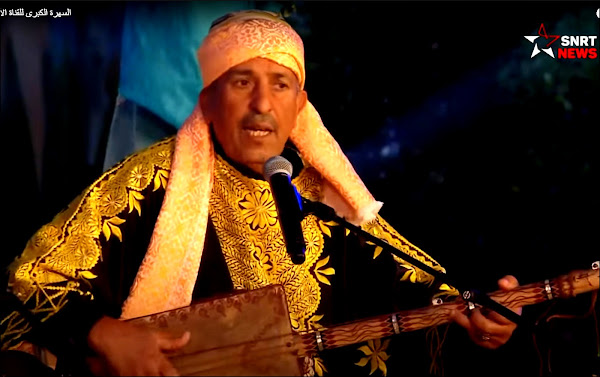
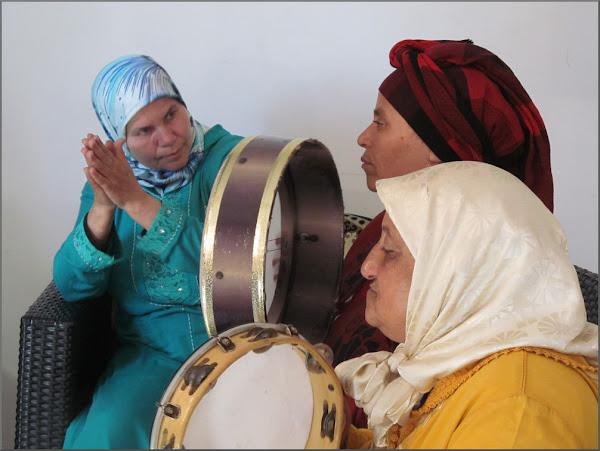
My photo shows a halakis, or storyteller, in the Jemaa El Fna in Marrakech, Morocco. Every evening there are several halakis continuing the great oral tradition of storytelling in Marrakech's public space, and they are real performance artists who attract large local audiences of all ages. Storytelling was traditionally an important way of passing down ideas and legends in a society where 47% of the adult population are still illiterate and where the legacy of gender discrimination means that in the twenty-first century 60% of Moroccan women remain illiterate, a statistic that is missing from most of the 'lifestyle' coverage devoted to Marrakesh and other fashionable cities.
But despite this dependance on oral communication the art of words is under threat as young Moroccans turn to new technolgy for their entertainment. Spanish author and Marrakech resident Juan Goytisolo has eloquently pleaded the case for the storytellers and in 2001 UNESCO named Jemaa El Fna as 'a masterpiece of the oral and intangible heritage of humanity' and it is planned to make recordings of the halakis available online.
More proof that words are the new music.
Photo (c) On An Overgrown Path 2008. Report broken links, missing images and errors to - overgrownpath at hotmail dot co dot uk
Tuesday, May 06, 2008
Saving the art of words
Wednesday, April 30, 2008
Had to get away to see what we could find
Evening in Jemaa El Fna in Marrakech, (c) On An Overgrown Path 2008, headline from Crosby, Stills & Nash. Report broken links, missing images and errors to - overgrownpath at hotmail dot co dot uk
A door to the Arab world

For a valuable resource on the Arab world go to http://www.al-bab.com/. The sections on arts and culture and music in particular are very useful. Also good music resources for individual countries, for instance check out Berber music. Al-bab is a private project by Brian Whitaker who is the Guardian's Middle East editor.
Now read about the secret life of an Arab record label.
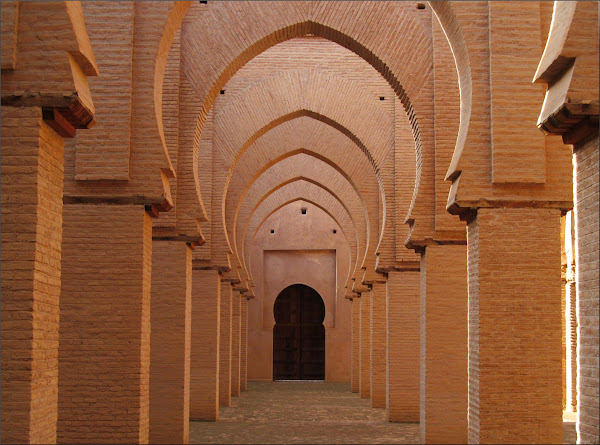
Photo is detail of Koutoubia Mosque in Marrakech, Morocco. The Koutoubia dates from the 13th century and its name derives from el-koutoubiyyin which is Arabic for booksellers, as a book market once filled the surrounding streets. More art of the mosque here. Photo (c) On An Overgrown Path 2008. Report broken links, missing images and errors to - overgrownpath at hotmail dot co dot uk
Sunday, April 27, 2008
Tripping the Licht fantastic

'Our real journey in life is interior: it is a matter of growth, deepening and of an ever greater surrender to the creative action of love and grace in our hearts' - Thomas Merton
Karlheinz Stockhausen and Thomas Merton are also together here.
Photos of Marrakech-Menara Airport terminal roof (c) 2008 On An Overgrown Path. Report broken links, missing images and errors to - overgrownpath at hotmail dot co dot uk
Thursday, April 10, 2008
We're riding on the Marrakesh Express

Marrakech in Morocco is one of the few cities that I haven't seen in this blog's reader stats. But if there are any readers there, or if anyone knows the music scene I'd love to hear from them via overgrownpath at hotmail.co.uk as we will be there next week.
While on the subject of Crosby, Stills & Nash can anyone explain why the lyrics of that classic track talk of
Travellin the train through clear Moroccan skies -
Ducks, and pigs, and chicken call, animal carpet wall to wall
when there are hardly any ducks in Morocco, and as it is a strictly Muslim country there are about as many pigs as polar bears? Presumably it was all to do with
blowing smoke rings from the corner of my mouth
C,S & N also appear in Notes of a College Revolutionary.
Any copyrighted material on these pages is included as "fair use", for the purpose of study, review or critical analysis only, and will be removed at the request of copyright owner(s). Report broken links, missing images and errors to - overgrownpath at hotmail dot co dot uk
Tuesday, April 01, 2008
The secret life of an Arab record label

Congratulations to French architect Jean Nouvel for winning the prestigous Pritzker prize. Nouvel's work in the field of music includes the new hall for the Philharmonie de Paris (do view the stunning images via that link) and the Copenhagen Concert Hall. But his masterpiece is his 1987 l'Institut du Monde Arabe in Paris which won a huge following for modern architecture a decade before Frank Gehry's Bilbao Guggenheim. The photos of l'Institut have all been kindly supplied by fellow blogger Tara Bradford.
The award of the Pritzker prize has deservedly put l'Institut du Monde Arabe in the spotlight. But the glorious building also has a little secret, it is the home of an enterprising record label with a small, but very interesting catalogue of Arab music. An example of their output is Saïd Chraïbi’s La clef de Grenade (The Key to Granada). This CD features the Moroccan ud (lute) virtuoso playing his own compositions and improvisations, all of which are linked to Muslim Spain, al-Andalus, and the residence of the Muslim kings of Granada, the Alhambra palace.
The Alhambra palace is a gem of 14th century Islamic architecture, and the l'Institut du Monde Arabe (Arab World Institute or AWI in English) is a gem of late twentieth century modern architecture. The AWI was conceived in 1973 by French president Valéry Giscard d’Estaing as a way of forging closer links with the Arab world, not the least with the North African countries from which many migrants had settled in France. The project was planned as a French showcase for Arab culture, with sponsorship from eight leading Arab nations, and participation from all member states of the Arab League.
Despite these lofty aims the AWI remained nothing more than a concept for seven years while local left wing politicians blocked Giscard d’Estaing’s proposals. A change of president to François Mitterrand in 1981 suddenly meant that the AWI became a priority presidential project, and Jean Nouvel won a competition to design the building with an ambitious design for the site on Rue de Fossés Saint Bernard on the Left Bank of the Seine. Construction was completed in 1987 at a cost of $100m, and the striking modern building houses an important museum of Arabic and Islamic culture, a large library, and an auditorium that stages music, cinema and drama. The huge south-facing courtyard with its Islamic motifs provides a symbolic link to the patio delos leones in Granada.
L'institut du Monde Arabe positions itself as having no political agenda, and in its early days an official explained that its aim was to “satisfy widespread curiosity about the Arab world by correcting the often factual ignorance about it.” The political landscape and the image of the Arab world has changed dramatically since those words were spoken in the late 1980’s. But despite Western leaders’ current preoccupation with the ‘war on terror’ L'institut du Monde Arabe is a remarkable building and educational resource, and not a bad little record label either.
Now celebrate Islam in the art of the mosque
All images are reproduced with permission from Paris Parfait. Report broken links, missing images and other errors to - overgrownpath at hotmail dot co dot uk